North West Gets Cross-Border Health MOU and Strategic Growth Plan at Stormont Launch
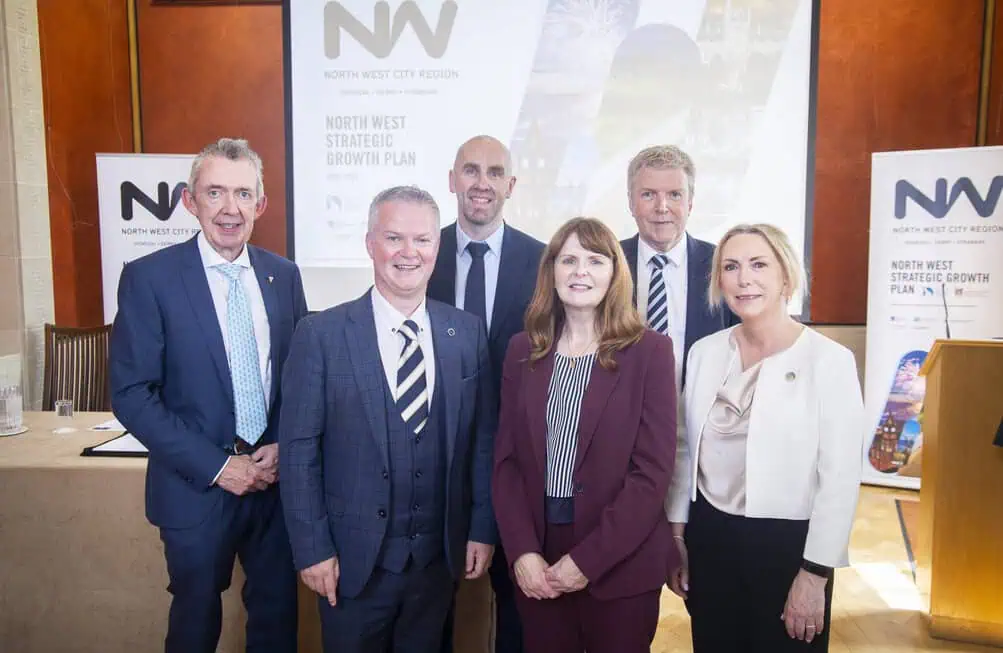
A revised North West Strategic Growth Plan and a landmark cross-border Health Memorandum of Understanding between the Western Health and Social Care Trust and the HSE were jointly launched at Stormont on Tuesday, in a significant step towards more joined-up service provision for the communities of Derry, Strabane, and Donegal who have long argued that the border creates artificial barriers to healthcare access.
Background
The north-west of Ireland — encompassing Derry city, the Strabane district, and County Donegal — is one of the most distinctive regions on the island, straddling the border in a way that creates unique challenges and opportunities. The region has historically been underserved relative to its population, with infrastructure investment concentrated in Belfast and Dublin and the border acting as a barrier to the development of a coherent regional economy and service network.
The health dimension of this challenge is particularly acute. Residents of Donegal who require specialist services that are not available locally must travel to Galway or Dublin — journeys of several hours — rather than to the much closer Altnagelvin Area Hospital in Derry, which is just across the border. Similarly, residents of the Strabane area who might benefit from HSE services in Letterkenny are prevented from accessing them by the administrative boundary between the two health systems.
Previous attempts to develop cross-border health cooperation in the north-west have had mixed results. The Cooperation and Working Together (CAWT) initiative, which has been in existence since the 1990s, has facilitated some joint working between the Western Trust and the HSE, but its scope has been limited by funding constraints and the complexity of operating across two different health systems with different governance structures, funding models, and clinical protocols.
Key Developments
The Health Memorandum of Understanding signed on Tuesday represents a more ambitious and structured framework for cross-border cooperation than anything that has existed previously. The MOU commits the Western Health and Social Care Trust and the HSE to a programme of joint working across a range of clinical areas, including cancer services, mental health, and emergency care. It establishes a joint governance structure with senior leadership from both organisations, and sets out a process for identifying and removing the administrative barriers that currently prevent patients from accessing services across the border.
First Minister Michelle O'Neill and Deputy First Minister Emma Little-Pengelly attended the Stormont launch, lending the event significant political weight. O'Neill, who represents the Fermanagh and South Tyrone constituency and has long championed cross-border cooperation, described the MOU as "a practical demonstration of what the Good Friday Agreement makes possible." Little-Pengelly, whose Ulster Unionist background might have made her a less enthusiastic supporter of all-island initiatives, was notably positive about the health cooperation dimension of the agreement.
The revised North West Strategic Growth Plan, which was also launched at the event, sets out a framework for economic and infrastructure investment in the region over the next decade. The plan includes commitments to improved road and rail connectivity, investment in digital infrastructure, and support for the development of the north-west as a hub for the life sciences and technology sectors.
Why It Matters
The north-west MOU is significant for several reasons. It demonstrates that cross-border health cooperation is achievable even in the current political environment, where relations between the two governments and between the communities in Northern Ireland are under strain. The fact that both the First Minister and Deputy First Minister attended the launch — and that the DUP's Little-Pengelly was supportive — suggests that the practical benefits of cooperation can transcend political differences.
The MOU also has implications for the broader debate about all-island health services. The NI Health Minister has recently indicated that he has "no ideological objection" to expanding all-island health provision, and the north-west agreement provides a model that could potentially be replicated in other border regions. The South Eastern Trust, which covers the Down and Antrim areas, has been exploring similar arrangements with the HSE in the Louth and Meath areas.
For the communities of Derry, Strabane, and Donegal, the practical benefits of the MOU could be transformative. If the agreement delivers on its promise of removing the administrative barriers to cross-border care, patients in these areas will have access to a much wider range of services than is currently available to them — without the need for long journeys to Dublin or Galway.
Local Impact
In Derry city, the MOU is expected to facilitate closer working between Altnagelvin Area Hospital and Letterkenny University Hospital, which are separated by just 25 miles but currently operate as entirely separate systems. The two hospitals have complementary strengths — Altnagelvin has a strong cardiac surgery programme, while Letterkenny has developed expertise in certain cancer treatments — and the MOU creates a framework for sharing these capabilities across the border.
In Donegal, where access to specialist services has been a persistent challenge, the MOU offers the prospect of patients being able to access services at Altnagelvin without the bureaucratic barriers that currently exist. The county's geography — it is the most northerly county in Ireland but is cut off from the rest of the Republic by the border — makes cross-border health cooperation particularly important for its residents.
What's Next
The joint governance structure established by the MOU will hold its first formal meeting within the next month, with a work programme to be agreed by the end of September. The first priority areas for joint working — likely to include cancer services and mental health — will be identified through a clinical needs assessment that will be conducted over the summer. The North-South Ministerial Council is expected to receive a progress report on the MOU at its next meeting in the autumn.