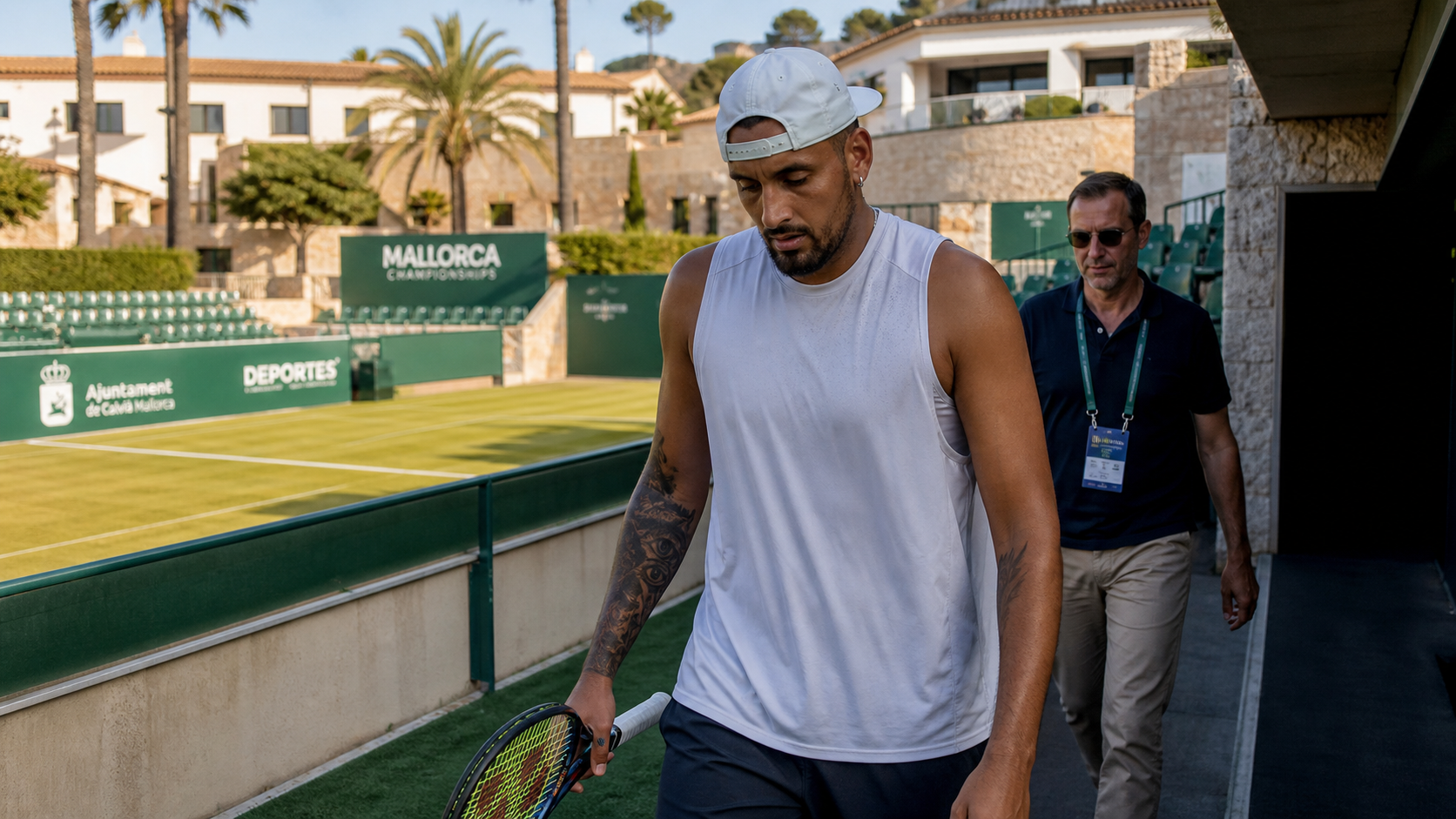
Nick Kyrgios Provisionally Suspended from Tennis After Testing Positive for Cocaine at Mallorca Event
Former Wimbledon finalist Nick Kyrgios has been provisionally suspended from professional tennis after testing positive for cocaine at an ATP 250 event in Mallorca in June 2026 — a development that has cast a shadow over the Australian's attempted comeback from injury and raised fresh questions about his long-term future in the sport.
Background
Nick Kyrgios has been one of the most compelling and controversial figures in professional tennis for the past decade. At his best, he is a player of extraordinary talent — a serve-and-volley specialist with a game that combines power, touch, and creativity in a way that few players in the modern era can match. His 2022 Wimbledon final appearance, where he pushed Novak Djokovic to four sets, was a reminder of what he is capable of when fully focused and physically fit.
But Kyrgios's career has been defined as much by its interruptions as by its achievements. A series of significant injuries — including a full wrist reconstruction in 2023 — have limited his availability, and his relationship with the demands of professional tennis has always been complicated. He has spoken openly about his struggles with mental health, his ambivalence about the tour lifestyle, and the difficulty of maintaining the motivation required to compete at the highest level week after week.
His return to the tour in 2026 was greeted with cautious optimism. He had spoken of a renewed commitment to the sport and a desire to compete at the major tournaments before his career ended. The positive test at Mallorca — a relatively minor ATP event — is therefore a significant setback, both for his immediate competitive plans and for the narrative of redemption that had been building around his comeback.
Key Developments
The International Tennis Integrity Agency confirmed on Wednesday that a sample provided by Kyrgios at an ATP 250 event in Mallorca on June 22, 2026, had tested positive for benzoylecgonine, a metabolite of cocaine. The positive result was confirmed by laboratory testing on July 17, and a provisional suspension has been in effect since August 4.
Under the Tennis Anti-Doping Programme, cocaine is classified as a stimulant and a "substance of abuse" on the World Anti-Doping Agency prohibited list, making a provisional suspension mandatory. Kyrgios has not appealed the decision. The duration of his final sanction remains to be determined, with the potential length dependent on whether the substance was used in-competition or out-of-competition, as well as evidence regarding intent.
Kyrgios addressed the situation through an Instagram statement, characterising his actions as a "huge mistake" and expressing regret to his fans and family. He announced that he would be stepping away from public life and social media for 28 days to focus on his well-being. The statement was notable for its directness and its absence of excuses — a tone that was widely acknowledged as appropriate given the circumstances.
Why It Matters
The Kyrgios case matters for several reasons. First, it is a reminder that the pressures of professional sport — the travel, the scrutiny, the physical demands, the uncertainty of results — can take a significant toll on athletes' mental health and well-being, and that the support structures available to players are not always adequate to address those pressures. Kyrgios has been open about his struggles, and the positive test is, in that context, a symptom of a broader challenge rather than simply a disciplinary matter.
Second, the case raises questions about the adequacy of the support available to players who are struggling. The ATP and the ITF have invested in player welfare programmes in recent years, but the effectiveness of those programmes in reaching players who are at risk is not always clear. Kyrgios's situation suggests that more needs to be done.
Third, the case has implications for the sport's integrity. Cocaine is a prohibited substance under the WADA code, and its presence in a player's sample — regardless of the circumstances — is a violation of the anti-doping rules. The ITIA's decision to impose a provisional suspension is consistent with the rules, and the process for determining the final sanction will need to be followed carefully to ensure that the outcome is proportionate and fair.
Local Impact
In Ireland, the Kyrgios case has generated significant media coverage, partly because of his profile as a former Wimbledon finalist and partly because of the broader interest in tennis that has been generated by the success of Irish players at the junior and amateur levels. The case has also prompted discussion about the mental health challenges faced by elite athletes — a conversation that is relevant to Irish sport as well as to the international tennis circuit.
Tennis Ireland has been working to grow the sport's profile in Ireland, and the Kyrgios case — while not directly relevant to Irish tennis — is a reminder of the pressures that elite athletes face and the importance of robust support structures at all levels of the game.
What's Next
The ITIA will determine the length of Kyrgios's final suspension following a review of the circumstances of the positive test. If the substance is determined to have been used out-of-competition, the maximum sanction under the WADA code is two years; if it is classified as in-competition use, the sanction could be longer. Kyrgios's cooperation with the process and his acceptance of responsibility are likely to be taken into account in determining the final outcome. A decision is expected within the next three to six months.