New BBC Documentary Explores How Ulster-Scots Shaped America's Fight for Independence
A compelling new two-part BBC documentary series produced by Belfast's DoubleBand Films is set to illuminate the remarkable and largely untold story of how Ulster-Scots emigrants from the north of Ireland played a pivotal role in America's fight for independence, tracing the journeys of families from counties Antrim, Down, and Tyrone who became key figures in the American Revolution and whose descendants continue to shape American life today.
Background
The Ulster-Scots diaspora is one of the most significant and least celebrated chapters in the story of Irish emigration. Between the early 18th century and the American Revolution, hundreds of thousands of people from the Ulster provinces — predominantly Presbyterian Scots-Irish who had settled in Ulster in the 17th century — emigrated to the American colonies, driven by a combination of economic hardship, religious discrimination, and the spirit of adventure that characterised the age.
These emigrants settled primarily in the Appalachian frontier, in Pennsylvania, Virginia, the Carolinas, and Georgia, where they established communities that retained strong cultural connections to their Ulster homeland. Their descendants — who came to be known as the Scots-Irish in America — played a disproportionate role in the American Revolution, providing many of the frontiersmen and militia fighters who were crucial to the colonial cause. Several of the founding fathers, including Andrew Jackson and James Polk, had Ulster-Scots heritage.
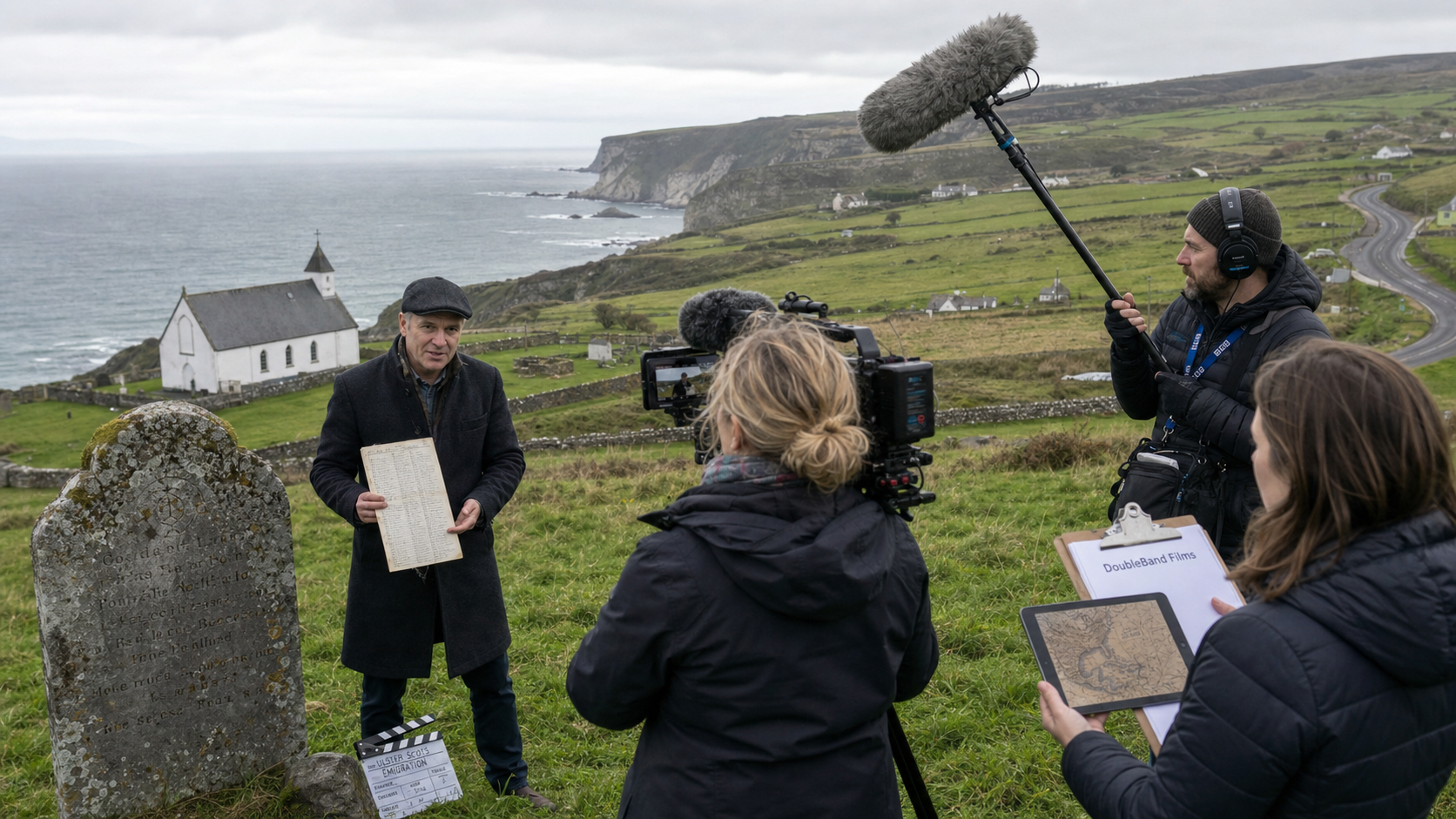
The story of the Ulster-Scots in America has been told in fragments over the years, but a comprehensive documentary treatment has been lacking. DoubleBand Films, one of Northern Ireland's most respected independent production companies, has spent several years researching and filming the series, travelling to communities across the eastern United States to find the descendants of Ulster emigrants and to trace the connections between the old world and the new.
Key Developments
The two-part series, which has been supported by Northern Ireland Screen and the BBC, takes a distinctive approach to its subject matter. Rather than focusing primarily on the famous figures of the Ulster-Scots diaspora, the documentary traces the stories of ordinary families — people like Ken Shearer, a descendant of Ulster-Scots immigrants in Colrain, Massachusetts, whose family's journey from County Antrim to New England is reconstructed through a combination of archival research, genealogical investigation, and personal testimony.
The series draws on a rich archive of documentary evidence, including church records, land grants, and letters that illuminate the lives of Ulster emigrants in the American colonies. It also features contributions from historians on both sides of the Atlantic, who provide context for the broader story of Ulster-Scots emigration and its impact on American history.
Northern Ireland Screen, which provided funding support for the production, has described the series as an important contribution to the understanding of Northern Ireland's cultural heritage and its connections to the wider world. The organisation has been actively supporting documentary productions that explore the Ulster-Scots dimension of Northern Ireland's identity, recognising it as a significant but often overlooked aspect of the province's cultural life.
Why It Matters
The Ulster-Scots documentary matters for several reasons. It tells a story that is genuinely important to the understanding of both Northern Ireland's cultural heritage and American history, and it does so in a way that is accessible to a broad audience. The connections between Ulster and America are deep and enduring, and the documentary provides an opportunity to explore those connections in depth and with the rigour that the subject deserves.
The series also matters for what it says about the vitality of Northern Ireland's screen industry. DoubleBand Films is one of a number of production companies that have established Northern Ireland as a significant centre of documentary filmmaking, and the quality of their work has attracted international attention and investment. The BBC's commissioning of the series is a recognition of that quality and a vote of confidence in the Northern Ireland screen sector.
For the Ulster-Scots community in Northern Ireland, the documentary is a welcome acknowledgement of a cultural heritage that has sometimes been overshadowed by other aspects of the province's complex identity. The Ulster-Scots tradition — with its distinctive language, music, and cultural practices — is an important part of Northern Ireland's cultural diversity, and its contribution to American history is a source of genuine pride.
Local Impact
In Northern Ireland, the documentary has already generated considerable interest among the Ulster-Scots community and among those with an interest in the province's history and cultural heritage. The Ulster-Scots Agency, which promotes the language and culture of the Ulster-Scots community, has welcomed the production as an important contribution to public understanding of the tradition. In counties Antrim, Down, and Tyrone — the areas from which many of the emigrants featured in the documentary originated — local historical societies and community groups have been involved in the research process, providing access to local archives and family histories that have enriched the documentary's narrative.
What's Next
The two-part documentary series is scheduled to premiere on BBC Northern Ireland this summer, with a transmission date to be confirmed in the coming weeks. Northern Ireland Screen has indicated that the series will also be made available on BBC iPlayer, ensuring that it can reach audiences across the United Kingdom and beyond. DoubleBand Films has indicated that it is in discussions with American broadcasters about the possibility of a US transmission, which would allow the documentary to reach the large audience of Americans with Ulster-Scots heritage who are likely to find the series of particular personal interest.