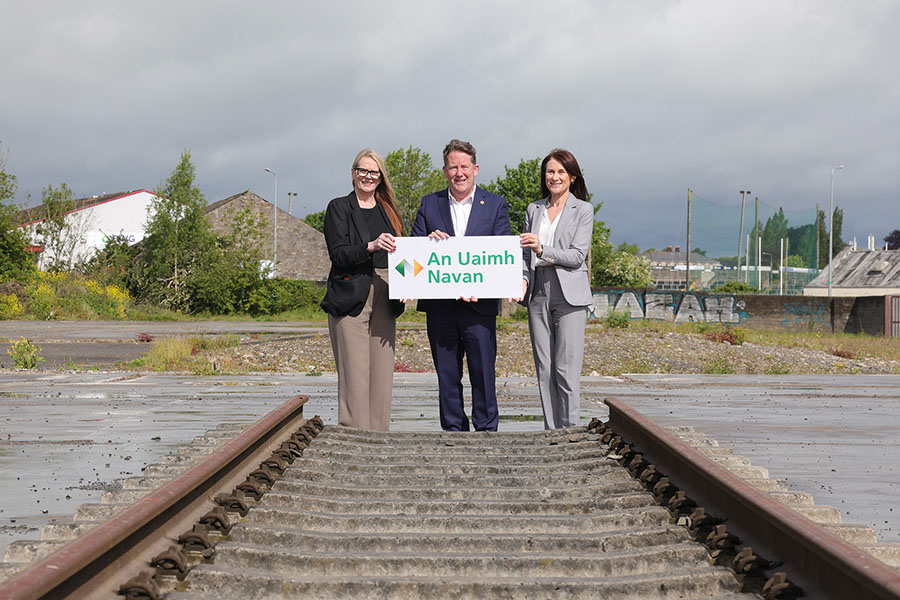
Navan Rail Line: Government Advances Billion-Euro DART Extension as Public Consultation Closes
The government's plan to restore passenger rail to Navan — Ireland's largest town without a rail connection — has taken a significant step forward following the close of a public consultation on the emerging preferred route for a 34-kilometre electrified DART extension from M3 Parkway, with four new stations proposed and a projected journey time of 60 minutes to Dublin's Connolly Station, in a project estimated to cost over €1 billion and representing one of the most ambitious transport infrastructure commitments in the National Development Plan.
Background
Navan lost its passenger rail connection in 1963, when the line from Drogheda was closed as part of the rationalisation of the Irish rail network that followed the Beddy Report. In the six decades since, the town has grown from a modest market town to one of the largest urban centres in Ireland, with a population of over 30,000 and a commuter catchment that extends across much of County Meath. The absence of rail has made Navan one of the most car-dependent towns in the country, with the M3 motorway and the N3 national road carrying enormous volumes of commuter traffic into Dublin each morning.
The case for restoring rail to Navan has been made repeatedly over the years, but it was the All-Island Strategic Rail Review — a joint initiative between the Republic and Northern Ireland — that provided the strategic framework for the project to advance. The review, which sets a vision for rail development through 2050, identified the Navan line as a priority investment, and the National Development Plan Review 2025 confirmed the government's commitment to funding it.
The proposed route largely utilises the disused railway corridor that closed in 1963, with a specific alignment revision near Dunshaughlin to better serve the town's growing population. The four proposed stations — Dunshaughlin, Kilmessan, Navan Central, and Navan North — will each be served by park-and-ride facilities to support commuters from the wider region, including Kells and Cavan.
Key Developments
The public consultation on the emerging preferred route, which was originally scheduled to close on July 3, was extended by two weeks to July 17 to accommodate strong public interest. The National Transport Authority and Iarnród Éireann received thousands of submissions during the consultation period, reflecting the level of public engagement with the project across County Meath and beyond.
The design team will now refine the route based on the consultation feedback and conduct detailed environmental studies. A formal Railway Order application — the planning permission equivalent for rail infrastructure — is not anticipated until 2028, with construction potentially commencing in 2030. The line is designed to facilitate DART services with trains running up to every 15 minutes during peak hours, offering a total capacity of approximately 4,400 commuters per hour in each direction.
The project has received strong backing from the Department of Transport and the National Transport Authority, with Minister for Transport Darragh O'Brien describing it as a "key milestone" in the government's commitment to sustainable transport. Rail Users Ireland has welcomed the project but raised concerns about the government's ability to fully fund it, citing delays in other public transport projects including DART+ Southwest.
Why It Matters
The Navan rail line is more than a transport project; it is a statement about the kind of country Ireland wants to be. For decades, the absence of rail has forced Navan's residents into car dependency, contributing to congestion on the M3 and N3, carbon emissions, and the social isolation that comes with living in a large town without adequate public transport. The restoration of rail would transform Navan's relationship with Dublin, making it genuinely viable to live in Meath and commute to the capital without a car.
The project also has significant implications for housing policy. One of the central challenges facing the Irish housing market is the concentration of development in Dublin and its immediate commuter belt, driven partly by the inadequacy of public transport connections to more distant towns. A 60-minute DART service to Navan would open up the town as a genuine alternative to Dublin for families priced out of the capital, potentially easing pressure on the housing market in a way that road improvements alone cannot achieve. This is the first major new rail line to be advanced in the Republic since the Luas Cross City, and its delivery will be a test of the government's capacity to execute large infrastructure projects on time and on budget.
Local Impact
For Navan and County Meath, the rail line would be transformative. The town's economy has been constrained by its transport infrastructure, and the arrival of DART services would attract investment, support the development of the town centre, and reduce the pressure on local roads. The proposed park-and-ride facilities at Dunshaughlin, Kilmessan, and Navan North would serve communities across a wide catchment area, including Trim, Athboy, and the rural hinterland of north Meath. Meath County Council has been a strong advocate for the project and is expected to play a central role in the planning and development process as the Railway Order application is prepared.
What's Next
The design team will refine the emerging preferred route over the coming months, incorporating feedback from the public consultation. Environmental impact assessments will be conducted in parallel, with the results informing the Railway Order application expected in 2028. The government has committed to allocating funding for the project in the National Development Plan, and the NTA will publish a detailed project timeline before the end of 2026. Construction is currently projected to begin in 2030, with the line operational by the mid-2030s.