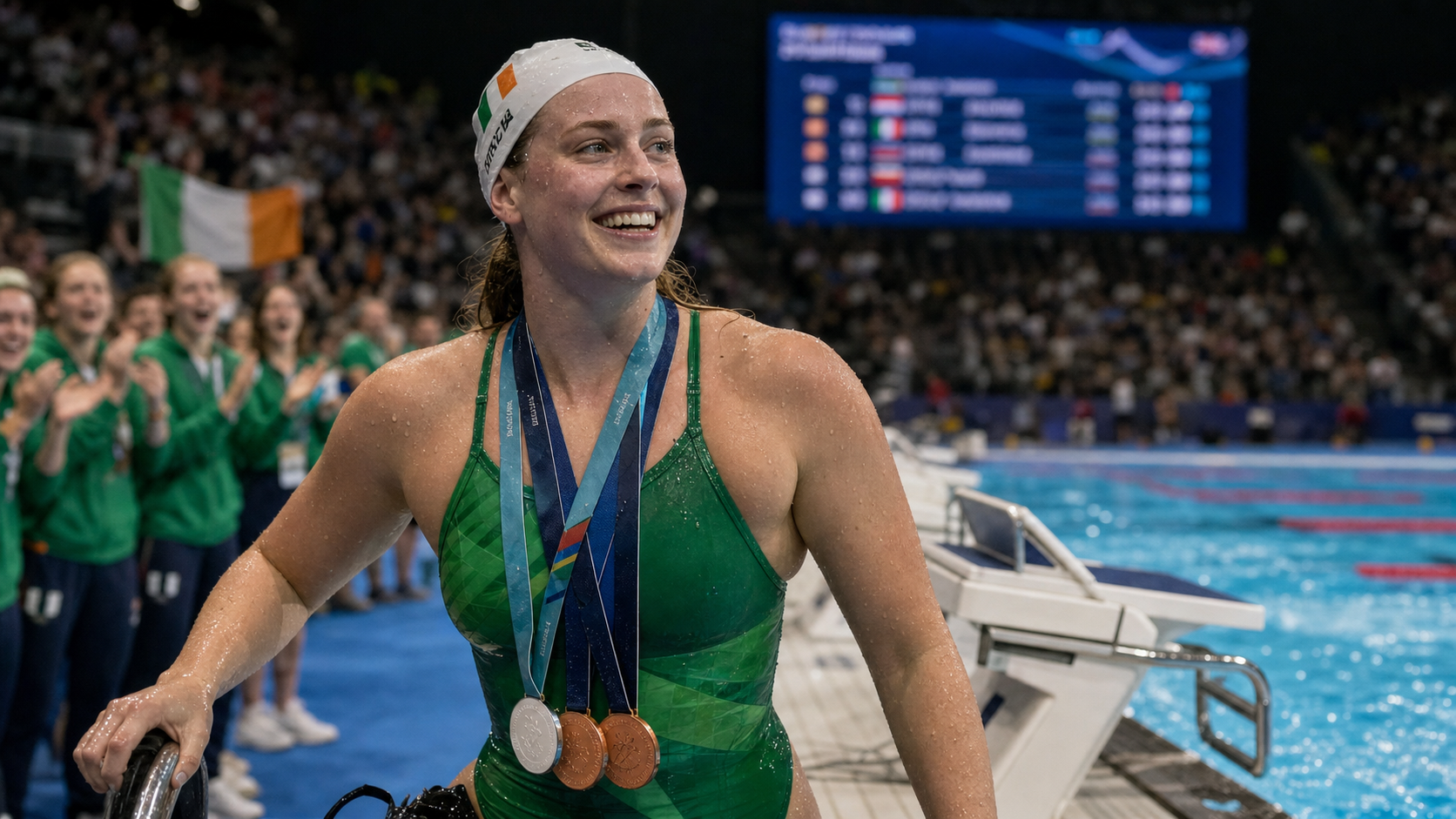
McSharry's Paris Triple Confirms Her Place Among Europe's Swimming Elite
Sligo swimmer Mona McSharry delivered one of the finest individual performances by an Irish swimmer in a generation at the European Aquatics Championships in Paris, claiming three individual medals across the breaststroke events — a silver in the 100m and bronze medals in both the 200m and 50m disciplines. Her 50m breaststroke bronze, touched in 29.95 seconds, set a new Irish national record and provided a fitting conclusion to a week that confirmed McSharry's status as one of Europe's premier breaststroke swimmers. Her efforts contributed significantly to Ireland's total haul of five medals at the championships, which ran concurrently with the European Athletics Championships in Birmingham.
Background
Mona McSharry's journey to the top of European swimming has been one of the most compelling stories in Irish sport over the past five years. The Sligo native, who trains in the United States at the University of Tennessee, has developed into a complete breaststroke swimmer with the technical precision, race management, and competitive temperament to compete at the highest level of the sport. Her performances at the Tokyo and Paris Olympics established her as a genuine international contender, and the European Championships in Paris provided the opportunity to demonstrate that her best performances are not confined to the Olympic stage.
The European Aquatics Championships, held at the Paris La Défense Arena from 11–17 August, brought together the continent's finest swimmers in a competition that serves as both a standalone championship and a key preparation event for the 2028 Los Angeles Olympics. For McSharry, the championships represented an opportunity to build on the momentum of a strong domestic season and to test herself against the best breaststroke swimmers in Europe in a major championship environment.
Her preparation for the championships was meticulous. Working with her coaching team at Tennessee, McSharry had identified specific technical improvements in her underwater work and her turn execution that she believed would translate into faster times at the championships. The results in Paris vindicated that preparation, with personal bests and national records across multiple events demonstrating that the technical work had paid dividends.
Key Developments
McSharry's championship began with a silver medal in the 100m breaststroke, where she touched the wall in a time that placed her second behind the Dutch world champion. The performance was a statement of intent, demonstrating that she was in the form of her life and capable of competing for gold across all three breaststroke events.
The 200m breaststroke bronze, claimed on 14 August with a time of 2:22.43, required a different kind of performance — a controlled, tactical race in which McSharry managed her effort across four lengths of the pool to hold off a late challenge from the Netherlands' Tes Schouten. The bronze was a reward for the patience and race intelligence that she has developed over years of international competition.
The 50m breaststroke bronze on 16 August was perhaps the most emotionally charged of the three medals. The shortest breaststroke event demands explosive power and perfect technique, and McSharry's time of 29.95 seconds — a new Irish national record — demonstrated that she has the raw speed to compete with the very best in the world over the shortest distance. The record, which broke her own previous mark, was greeted with enormous enthusiasm by the Irish swimming community.
In addition to her individual medals, McSharry participated in the women's 4x100m medley relay alongside Lottie Cullen, Ellen Walshe, and Grace Davison. The quartet finished sixth, setting a new Irish national record of 3:57.26 — a result that reflects the growing depth of Irish women's swimming and augurs well for the relay programme ahead of Los Angeles 2028.
Why It Matters
McSharry's three-medal haul at the European Championships matters because it demonstrates that Irish swimming has reached a new level of international competitiveness. For decades, Irish swimmers competed at major championships with the primary goal of reaching finals and setting personal bests. McSharry's ability to win multiple medals at a continental championship — competing against the full strength of European swimming — represents a qualitative shift in what Irish swimming can achieve.
The broader significance lies in the inspiration her performances provide to the next generation of Irish swimmers. Swimming Ireland has reported increased participation in competitive swimming in recent years, and the visibility of McSharry's success — broadcast live on RTÉ 2 and the RTÉ Player — has introduced the sport to a wider audience. For young swimmers in clubs across Ireland, from Sligo to Cork and from Dublin to Derry, McSharry's medals provide a tangible aspiration that no amount of promotional material could replicate.
Local Impact
In Sligo, where McSharry grew up and where her family still lives, the European Championships medals have been celebrated with enormous pride. The Sligo Swimming Club, where she first learned to swim, has reported increased interest from young people in the weeks since the championships, with coaches noting that the visibility of a world-class swimmer from the county has a galvanising effect on participation. Across Connacht, where swimming has a strong tradition in clubs in Galway, Mayo, and Roscommon, McSharry's success has provided a boost to the sport's profile and to the ambitions of young competitive swimmers.
What's Next
McSharry is expected to return to the United States in the coming weeks to begin her preparation for the 2026/27 collegiate season at the University of Tennessee. Her international schedule for the autumn will be confirmed by Swimming Ireland in due course, with the World Aquatics Championships in 2027 the next major target on the international calendar. Swimming Ireland will publish its high-performance programme for the road to Los Angeles 2028 in the autumn, setting out the targets and priorities for the country's top swimmers over the next two years.