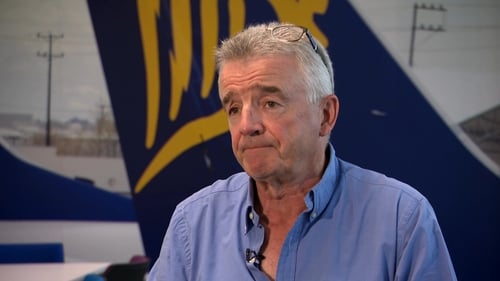
Michael O'Leary Confirmed to Lead Ryanair for Six More Years in Major Vote of Confidence from Board
Ryanair's board has confirmed that chief executive Michael O'Leary will remain at the helm of Europe's largest low-cost airline for another six years, providing continuity of leadership as the Mullingar-born executive navigates the carrier through an increasingly competitive European aviation market and a period of significant fleet expansion.
Background
Michael O'Leary has been the defining figure in European aviation for three decades, having taken over as chief executive of Ryanair in 1994 and transforming what was then a small Irish regional carrier into the continent's largest airline by passenger numbers. His tenure has been characterised by relentless cost discipline, aggressive expansion, and a willingness to challenge established norms — from the way airlines price their tickets to the way they negotiate with airports and aircraft manufacturers.
Under O'Leary's leadership, Ryanair has grown from carrying a few million passengers a year in the mid-1990s to transporting over 200 million annually, making it one of the most significant companies in Irish corporate history. The airline's success has been built on a model of ultra-low fares, ancillary revenue, and operational efficiency that has been widely studied and imitated but never quite replicated at the same scale.
O'Leary's relationship with the media, regulators, and competitors has been consistently combative, and his willingness to make provocative statements has made him one of the most recognisable business figures in Europe. His contract renewals have always attracted significant attention, given the extent to which Ryanair's identity and strategy are bound up with his personal leadership style.
Key Developments
The board's decision to extend O'Leary's contract for a further six years was confirmed at the weekend, providing clarity about the airline's leadership at a time when it is navigating several significant challenges. These include the ongoing delivery of its Boeing 737 MAX order — which has been subject to delays — the competitive pressure from other European low-cost carriers, and the regulatory environment around aviation emissions and sustainability.
O'Leary has indicated that his priorities for the next phase of his tenure include completing the fleet expansion programme, growing Ryanair's presence in new European markets, and continuing to drive down costs in order to maintain the airline's competitive advantage. He has also signalled that the airline will continue to invest in its digital infrastructure and customer experience, areas where it has historically lagged behind some competitors.
The confirmation of O'Leary's contract has been welcomed by investors, with Ryanair's share price responding positively to the news. Analysts have noted that the certainty provided by a six-year extension removes a significant source of uncertainty for the airline's strategic planning.
Why It Matters
Ryanair is one of Ireland's most significant companies, employing thousands of people directly and supporting tens of thousands more in the wider aviation and tourism ecosystem. The airline's Dublin base — at Dublin Airport, which it uses as its primary hub — makes it a central pillar of the Irish economy, and its route network connects Ireland to hundreds of European destinations that would otherwise be poorly served by air.
O'Leary's continued leadership matters because Ryanair's strategy is so closely identified with his personal vision and management style. The airline has had a succession plan in place for several years, but the board's decision to extend his contract suggests that it sees no compelling reason to accelerate that transition. For Irish aviation, the continuity of Ryanair's leadership provides stability at a time when the sector is facing significant headwinds from rising costs, regulatory pressure, and the ongoing challenge of decarbonisation.
Local Impact
Ryanair's operations at Dublin Airport support thousands of direct and indirect jobs in the Dublin region, from pilots and cabin crew to ground handlers, maintenance engineers, and airport retail workers. The airline's presence at Cork Airport and Shannon Airport also provides significant economic benefits to those regions, with Ryanair routes connecting Cork and Shannon to a wide range of European destinations. The confirmation of O'Leary's contract provides reassurance to the thousands of Irish workers whose livelihoods depend on the airline's continued success and growth.
What's Next
O'Leary will formally begin his new contract period in the coming months, with the board expected to publish a strategic update outlining the airline's priorities for the next six years. The fleet expansion programme — centred on the delivery of Boeing 737 MAX aircraft — will be a key focus, with Ryanair having placed one of the largest aircraft orders in European aviation history. The airline's summer 2026 schedule is already in full operation, and attention will now turn to the winter schedule and the planning for summer 2027.