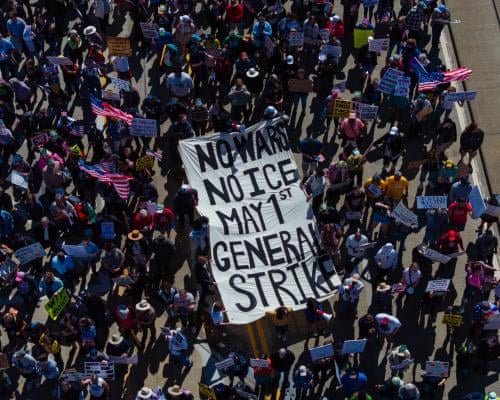
May Day 2026: Nationwide Economic Blackout Draws Thousands as Workers Protest Iran War Costs
More than 3,000 planned actions unfolded across the United States on May 1 as labor unions, immigrant advocacy groups, and progressive coalitions organized a coordinated "economic blackout" -- urging Americans to abstain from work, school, and consumer spending to protest the economic fallout of the 2026 Iran conflict, recent ICE enforcement sweeps, and what organizers describe as a government that prioritizes corporate interests over working families.
Background
May Day, the international workers' holiday observed on May 1, has historically served as a flashpoint for labor activism in the United States, though American observances have been more muted than those in Europe and Latin America. The 2006 "Day Without Immigrants" marches, which drew an estimated 1.5 million participants in Los Angeles alone, remain the modern benchmark for mass immigrant-led protest in the US. The 2026 edition draws on that legacy while adding new grievances: energy prices have surged roughly 18 percent since the outbreak of the Iran conflict in early 2026, squeezing household budgets from Maine to California.
The Chicago Teachers Union, SEIU Healthcare Illinois and Indiana, and the Coalition for Humane Immigrant Rights of Los Angeles -- known as Chirla -- are among the most prominent organizations coordinating the day's actions. Organizers framed the blackout as both an economic statement and a political signal ahead of the 2026 midterm elections.
Key Developments
In Los Angeles, Chirla organized a city-wide economic blackout targeting the downtown commercial corridor, with participating businesses displaying signs indicating their support. The Chicago Teachers Union called on members to use personal days, citing the union's longstanding opposition to federal immigration enforcement in schools. In New York City, rallies were planned at Foley Square in lower Manhattan and at Flushing Meadows-Corona Park in Queens, a neighborhood with one of the largest immigrant populations in the country.
Smaller actions were reported in Houston, Phoenix, Atlanta, and Miami -- cities with large immigrant communities that have faced heightened ICE activity since January. Organizers in Phoenix pointed specifically to a series of workplace raids in Maricopa County that resulted in more than 400 arrests over the past three months. In Houston, the Harris County AFL-CIO coordinated with local restaurant and construction trade unions to encourage members to participate.
The "economic blackout" framing -- encouraging participants to withhold consumer spending rather than simply march -- reflects a strategic evolution in protest tactics, designed to demonstrate economic leverage rather than just political sentiment.
Why Americans Should Care
The protests reflect economic pressures that are acutely felt in specific communities across the country. In the Rust Belt cities of Detroit, Cleveland, and Pittsburgh, manufacturing workers have seen energy costs eat into real wages as natural gas and electricity prices climb. In California's Central Valley, agricultural workers face the dual pressure of ICE enforcement and rising fuel costs that affect farm equipment and transportation. In Texas border communities like El Paso and Laredo, the combination of ICE operations and reduced cross-border commerce has strained local economies that depend on binational trade. For middle-class households in suburban swing districts from Pennsylvania to Arizona, the 18 percent energy price increase since January represents hundreds of dollars in additional annual costs -- a figure that will shape voter sentiment heading into November's midterms.
Why It Matters
The May Day 2026 actions arrive at a moment when the American labor movement is navigating a complex political landscape. Union membership has stabilized at around 10 percent of the workforce after decades of decline, but unions have demonstrated renewed organizing energy -- particularly in the service sector and among gig workers. The decision to frame May Day around an "economic blackout" rather than a traditional march reflects lessons learned from the 2020 and 2022 protest cycles, when large demonstrations generated media coverage but limited measurable policy change.
Internationally, May Day 2026 protests are occurring simultaneously in France, Germany, South Korea, and Brazil, where workers are also contesting the economic consequences of the Iran conflict and global energy market disruptions. The coordinated nature of these actions -- even if loosely connected -- signals a broader pattern of labor unrest tied to geopolitical instability. For American policymakers, the protests represent a warning signal: the economic costs of the Iran conflict are beginning to generate domestic political resistance that could complicate the administration's foreign policy posture heading into the midterm campaign season.
What's Next
Organizers have announced a follow-up national day of action planned for late May, timed to coincide with Memorial Day weekend. Congressional Democrats from California, Illinois, and New York have signaled they will hold town halls in the weeks ahead to address constituent concerns about energy costs and immigration enforcement. The AFL-CIO is expected to release a formal policy platform in mid-May outlining legislative priorities for the remainder of the 119th Congress, with energy affordability and worker protections at the top of the agenda.
Sources: The Guardian; The Washington Post