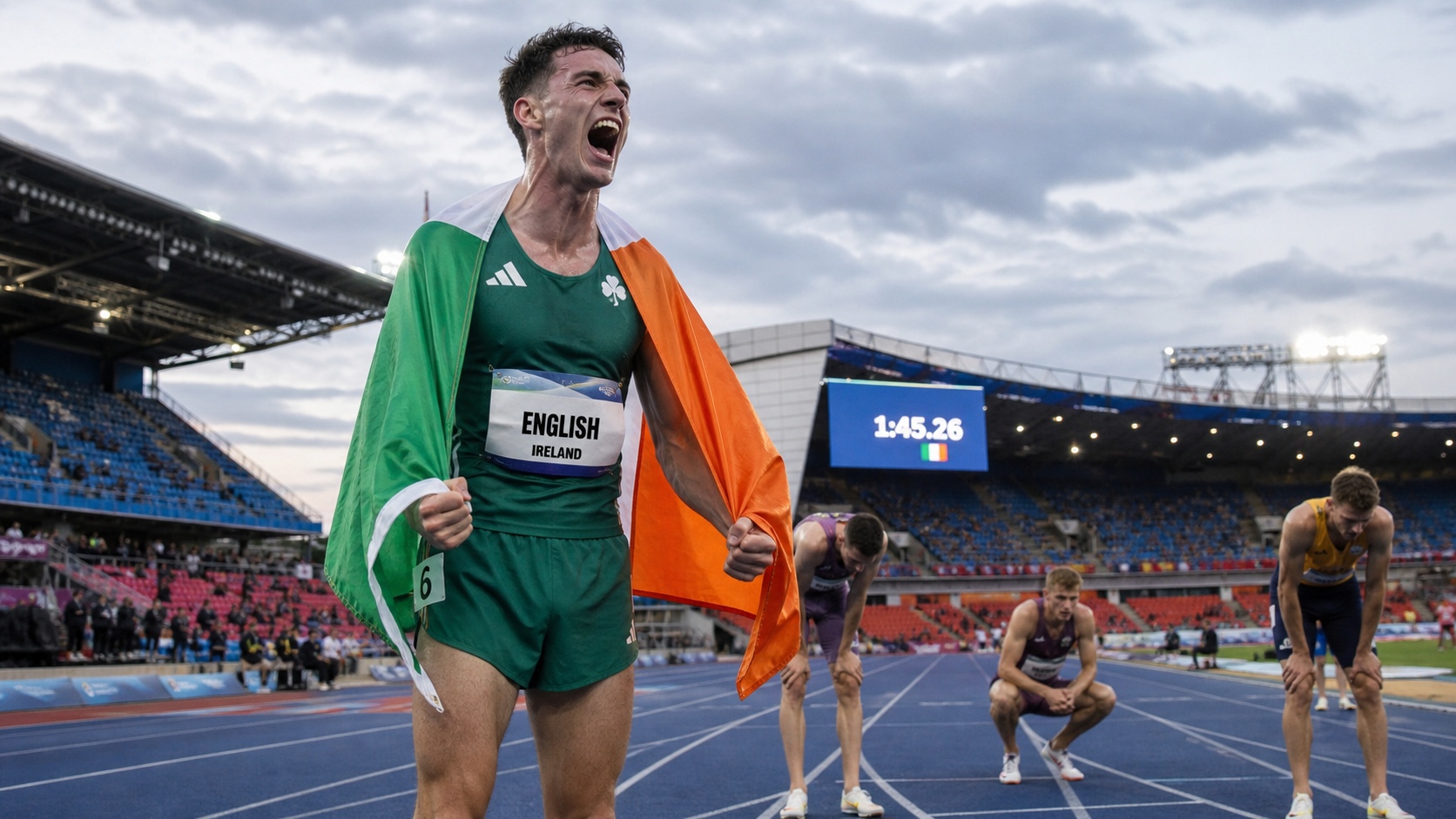
Mark English Makes History with Gold in 800m at European Athletics Championships in Birmingham
Mark English from Letterkenny in County Donegal has made history at the European Athletics Championships in Birmingham, claiming gold in the men's 800m final with a time of 1:45.26 to become the first Irish male athlete ever to win gold at the European Athletics Championships — a milestone that has been celebrated across Ireland and that caps a career defined by persistence, intelligence, and an unwillingness to accept that the top step of the podium was beyond his reach.
Background
Mark English's journey to European gold is one of the more compelling narratives in Irish athletics. The 33-year-old from Letterkenny has been competing at the highest level of European middle-distance running for more than a decade, winning bronze medals at the 2014 European Championships in Zurich and the 2022 edition in Munich. He has competed at three Olympic Games, reached World Championship finals, and established himself as one of the most consistent 800m runners in European athletics. But the gold medal had always eluded him — until Birmingham.
English is unusual among elite athletes in that he has pursued a parallel career in medicine, qualifying as a doctor while maintaining a training regime that would challenge most full-time athletes. His ability to manage the competing demands of elite sport and a demanding professional career has been widely admired, and his success in Birmingham has been cited by many commentators as evidence that the two pursuits are not incompatible — that the discipline and analytical thinking required by medicine can complement rather than undermine athletic performance.
The 2026 European Championships in Birmingham represented what many observers believed might be English's last realistic opportunity to claim the gold medal that his career had deserved. At 33, he is at the upper end of the competitive age range for 800m runners, and the emergence of a new generation of European middle-distance talent has made the event increasingly competitive. The pressure on him going into the final was considerable.
Key Developments
The 800m final at Alexander Stadium was a tactical race from the outset, with Croatia's Marino Bloudek setting a strong pace that strung out the field in the early stages. English ran with characteristic patience, sitting in the pack through the first lap and conserving his energy for the decisive moment. As the field rounded the final bend, Bloudek appeared to have the race under control, but English had positioned himself perfectly on the inside of the track.
With 50 metres remaining, English unleashed the finishing kick that has been the hallmark of his career, surging past Bloudek to cross the line in 1:45.26. The Croatian finished second, with Sweden's Samuel Pihlstrom taking bronze. English's reaction at the finish line — a combination of disbelief, relief, and pure joy — captured the emotion of a moment that had been a decade in the making.
Speaking after the race, English said he had been striving for a major title for his entire career and that the victory felt like a vindication of every sacrifice he had made. He credited his new coach, Justin Rinaldi, with helping him make the technical adjustments that had taken his performance to the next level. He also paid tribute to his family and to the athletics community in Letterkenny, which has supported him throughout his career.
Why It Matters
Mark English's gold medal is significant not just as an individual achievement but as a statement about what Irish athletics is capable of. Ireland is a small country with limited resources for elite sport, and the fact that an Irish athlete can compete with and beat the best in Europe in one of the most competitive events in track and field is a testament to the quality of the talent pipeline that has been developed over the past decade. English's victory will inspire a generation of young Irish middle-distance runners who now know that the top step of a European podium is within reach.
The historical dimension of the achievement should not be understated. English is the first Irish male athlete to win gold at the European Athletics Championships — a competition that has been running since 1934. That it has taken 92 years for an Irish man to claim the top prize in this competition reflects both the scale of the achievement and the depth of the competition that English has overcome. His name now sits alongside those of the greatest Irish athletes in history.
Local Impact
In Letterkenny, the reaction to English's gold medal was described as euphoric. The town's pubs and community centres filled spontaneously as the news broke, with residents gathering to watch replays of the race and to celebrate a moment that the town will not forget. Letterkenny Athletics Club, where English began his running career, has been inundated with enquiries from young athletes inspired by his victory. Donegal County Council has indicated it will honour English with a civic reception on his return to the county. The Donegal GAA community, which has a long tradition of celebrating the county's sporting achievements, has also been effusive in its congratulations.
What's Next
English has indicated he intends to compete at the 2028 Los Angeles Olympics, which would be his fourth Games. He has also expressed interest in competing at the 2027 World Athletics Championships in Tokyo, where he will be one of the favourites for a medal following his European gold. His coach Justin Rinaldi has indicated that the training programme for the next two years will be designed to peak for the Olympics, with the World Championships serving as a key preparation event. English has also indicated he will continue his medical career alongside his athletics, though he acknowledged that the demands of Olympic preparation may require some adjustments to his professional commitments.