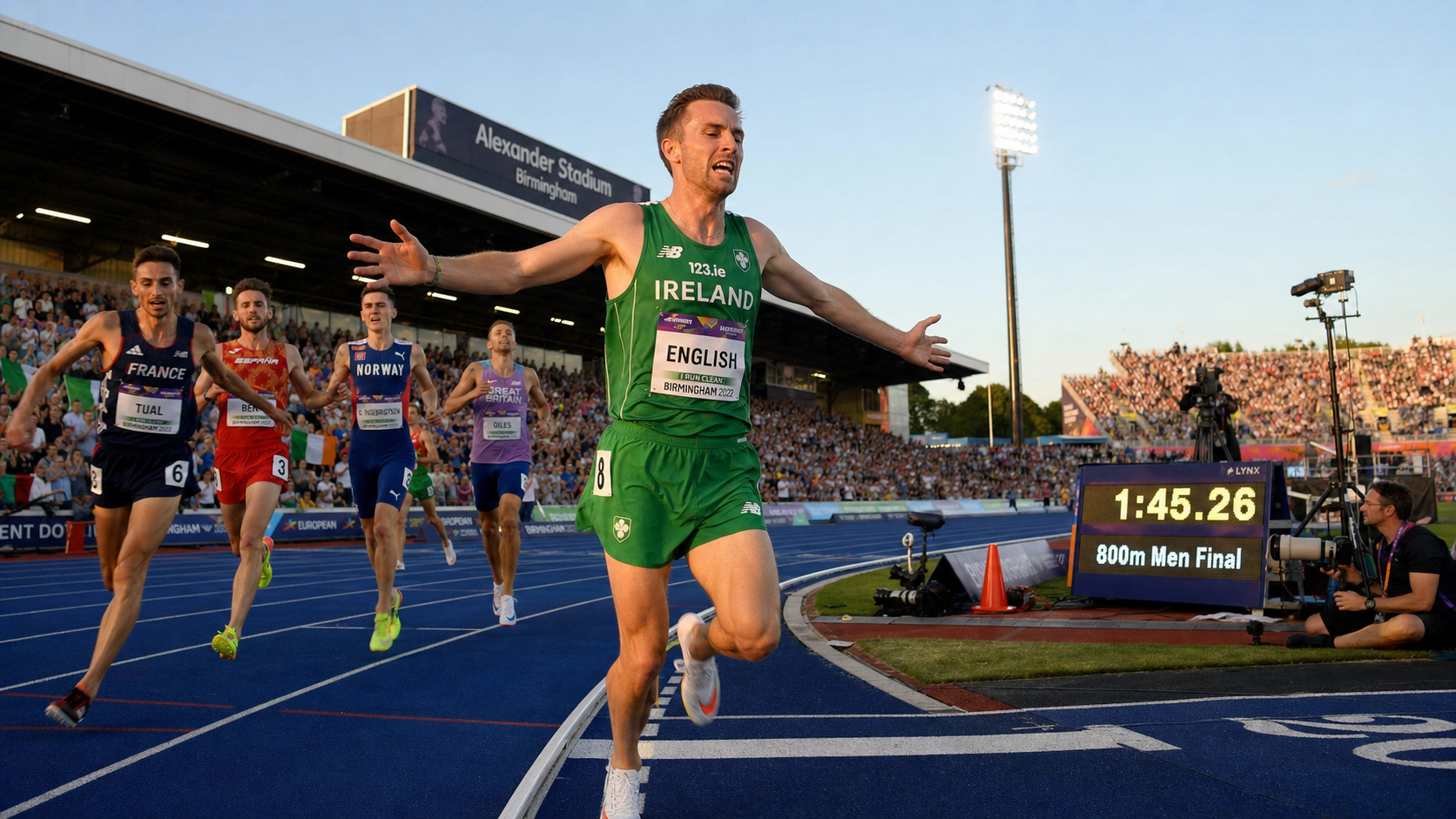
Mark English Makes History with European 800m Gold in Birmingham
Mark English of Donegal became the first Irish man to win a European outdoor athletics gold medal on Thursday evening, storming to victory in the men's 800m final at the Alexander Stadium in Birmingham with a time of 1:45.26 — a moment of profound personal and national significance for a runner who has spent sixteen years in pursuit of a major championship title.
Background
English's journey to the top of the European podium is one of the most patient and determined in Irish athletics history. The 33-year-old from Letterkenny, who is also a qualified medical doctor, first announced himself on the continental stage at the 2014 European Championships in Zurich, where he claimed bronze as a 21-year-old. He added further medals at the 2022 championships and at multiple European Indoor Championships, but the gold medal that would define his legacy had always eluded him.
The 2026 season brought a significant change: English began working with new coach Justin Rinaldi, a decision that he credited directly with the transformation in his performance. His semi-final run of 1:43.49 — which broke a 48-year-old European Championship record set by East Germany's Olaf Beyer in 1978 — announced to the field that this was a different, more dangerous English than they had faced before.
The final was shaped by the withdrawal of Great Britain's Max Burgin through injury, removing one of the pre-race favourites and opening the field. Croatia's Marino Bloudek set a strong pace from the front, with English tracking him through the first lap and positioning himself perfectly for the decisive move.
Key Developments
With approximately 50 metres remaining, English made his move, sweeping past Bloudek with a surge of controlled power that left the Croatian unable to respond. English crossed the line in 1:45.26, with Bloudek taking silver in 1:45.62 and Spain's Mohamed Attaoui claiming bronze in 1:45.71. The margin was decisive, the execution clinical.
Speaking after the race, English described the moment as one of profound relief as much as joy. "To get on top of the European podium is something I've been trying for for sixteen years," he said. "I'll hear the national anthem again, and yeah, it is going to be really special." His words captured the weight of a career spent accumulating silver and bronze while the gold remained just out of reach.
The victory came on the same extraordinary evening that Rhasidat Adeleke claimed silver in the women's 200m, making it one of the most celebrated nights in Irish athletics since Sonia O'Sullivan's golden era in the 1990s.
Why It Matters
English's gold is not merely a personal milestone — it is a landmark in the history of Irish athletics. No Irish man had previously won a European outdoor gold medal in any event, a fact that underscores the magnitude of what was achieved in Birmingham. The achievement places English alongside the very greatest names in Irish middle-distance running, a tradition that stretches from Ronnie Delany's Olympic gold in 1956 through Eamonn Coghlan's world indoor records to Sonia O'Sullivan's European and World Championship triumphs.
What makes English's story particularly resonant is its arc. He did not arrive as a prodigy who fulfilled early promise; he arrived as a veteran who refused to accept that his best days were behind him. At 33, an age at which many middle-distance runners have long since retired, he produced the finest performance of his career. His willingness to change coaches, to adapt his training, and to trust a new process speaks to a mental resilience that is as impressive as his physical gifts.
For Irish athletics more broadly, the Birmingham championships — with English's gold and Adeleke's silver on the same evening — represent a statement of intent. Ireland is no longer a nation that competes at European level; it is a nation that wins there.
Local Impact
In Letterkenny and across County Donegal, the reaction to English's gold was one of unbridled celebration. The town has produced a remarkable number of elite athletes over the decades, and English's victory adds the most prestigious chapter yet to that tradition. Athletics clubs across the county reported a surge of interest from young runners inspired by the achievement, with coaches noting that moments like Thursday evening are precisely what drive the next generation to lace up their spikes.
Athletics Ireland confirmed that English's medal will be celebrated at a homecoming event in Donegal in the coming weeks, with the national governing body describing the achievement as a watershed moment for the sport on the island of Ireland.
What's Next
English will return to Ireland following the conclusion of the European Championships on Saturday, 15 August. His attention will then turn to the World Athletics Championships, scheduled for Tokyo in September 2027, where he will be among the leading contenders for a medal. In the shorter term, he is expected to compete on the Diamond League circuit in the autumn, with his Birmingham performance likely to attract invitations to the season's most prestigious meetings. The question now is not whether English can win at the highest level — he has answered that definitively — but how many more times he can do so.