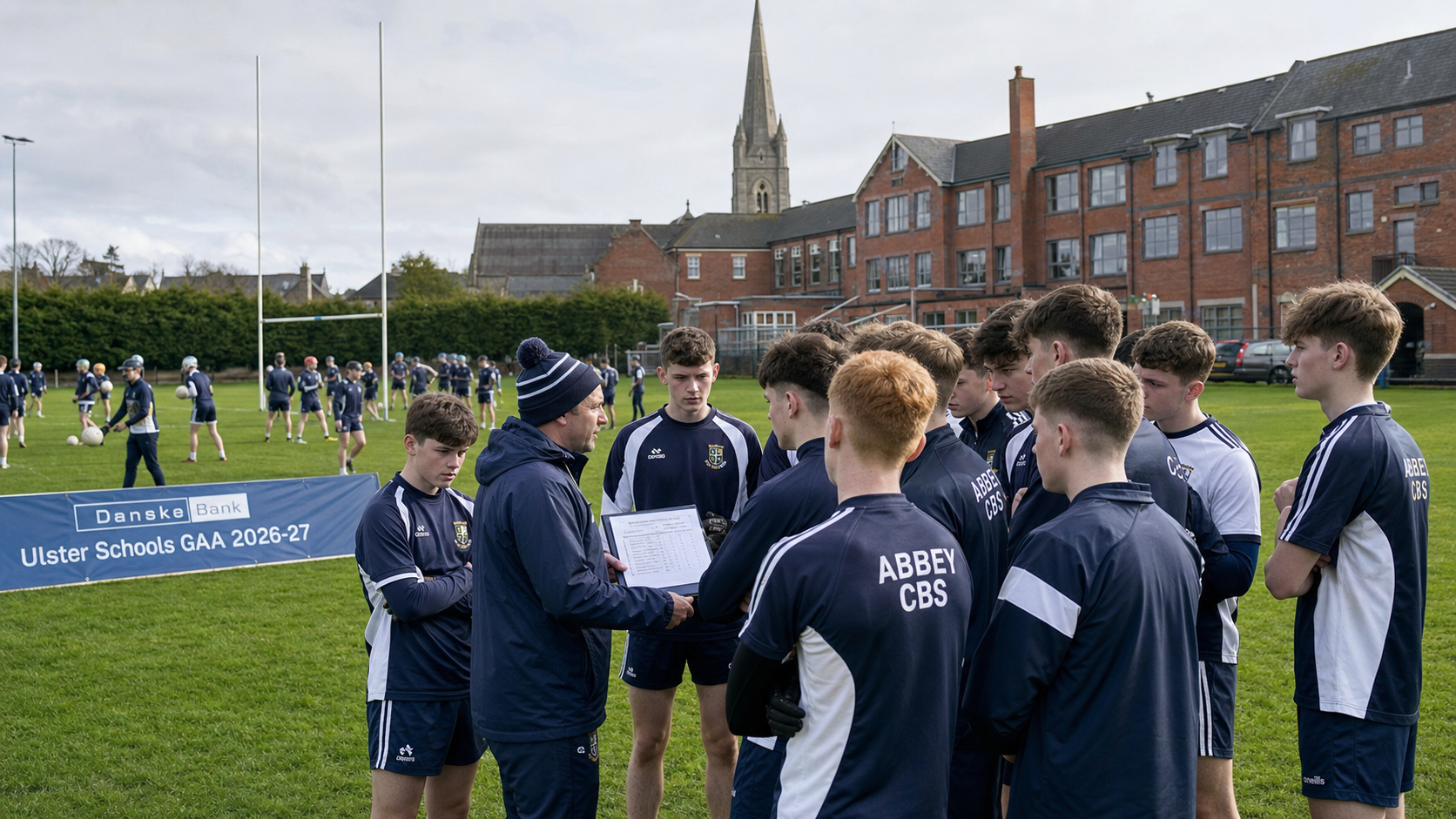
MacRory and MacLarnon Cup Draws Confirmed as Ulster Schools GAA Season Takes Shape for 2026-27
The draws for the 2026-27 Danske Bank MacRory Cup and MacLarnon Cup have been confirmed, setting up what promises to be a compelling Ulster schools GAA season. Defending MacRory champions Abbey CBS Newry have been drawn in Group C alongside Omagh CBS, St Joseph's Donaghmore, and Our Lady's Castleblayney — a group that will test the holders from the outset. The 17-school MacRory Cup and 15-school MacLarnon Cup will begin their group stages in November, with finals scheduled for the first weekend of February 2027.
Background
The MacRory Cup is the premier Ulster schools Gaelic football competition, contested annually by the leading post-primary schools from across the six counties and the border counties of the Republic. The competition has a history stretching back to 1923 and has served as a nursery for some of the greatest players in Ulster GAA history, with many of the province's most celebrated inter-county footballers having first made their names on the MacRory Cup stage. The competition is fiercely contested, with schools from counties including Tyrone, Armagh, Derry, Down, Fermanagh, Antrim, Cavan, Monaghan, and Donegal all represented in the 2026-27 field.
Abbey CBS Newry, the defending champions, have been one of the most successful schools in the competition's recent history, and their presence in Group C alongside two Tyrone schools — Omagh CBS and St Joseph's Donaghmore — and Our Lady's Castleblayney from Monaghan creates a group that will be competitive from the first round. The holders will be expected to progress, but the quality of the opposition means that nothing can be taken for granted in the group stage.
The MacLarnon Cup, which serves as the second-tier Ulster schools competition, provides an important pathway for schools that are developing their programmes and for players who are not yet ready for the MacRory Cup stage. The 15-school field for 2026-27 includes a mix of established MacLarnon Cup contenders and schools that are building toward future MacRory Cup participation.
Key Developments
The MacRory Cup draw has produced four groups of varying composition. Group A, which features five schools, includes St Patrick's Academy, St Michael's Enniskillen, St Patrick's Cavan, St Patrick's Armagh, and St Colman's Newry — a group that will see one school eliminated in the round-robin stage. Group B brings together Aquinas Grammar, Abbey Vocational Donegal, St Paul's Bessbrook, and St Mary's Magherafelt. Group D features St Patrick's Maghera, St Macartan's Monaghan, Patrician Carrickmacross, and St Ronan's Lurgan.
The knockout stages are structured so that Groups C and D are paired for the Round of 16 in early December, while Groups A and B face each other on the opposite side of the draw. This structure means that the defending champions in Group C will face opponents from Group D in the Round of 16, creating the possibility of early high-profile clashes between some of the competition's strongest schools.
In the MacLarnon Cup, the four groups have been drawn with a mix of schools from across Ulster and the border counties. Group A includes Dean Maguirc Carrickmore, Largy College Clones, St Louis Ballymena, and Rathmore Grammar Belfast. Group B features St Pius X Magherafelt, St Ciaran's Ballygawley, St Malachy's Belfast, and Lecale Trinity Downpatrick. Group C brings together St Eunan's Letterkenny, St Mary's CBGS Belfast, St Malachy's Castlewellan, and St Mark's Warrenpoint. Group D has Holy Trinity Cookstown, St Patrick's Keady, and Our Lady and St Patrick's Knock.
Why It Matters
The MacRory Cup is more than a schools competition — it is a central pillar of Ulster GAA culture and a critical development pathway for the next generation of inter-county footballers. The schools that compete in the MacRory Cup are producing players who will go on to represent their counties at senior level, and the competition provides a level of coaching, preparation, and competitive experience that shapes careers. For the communities that support these schools, the MacRory Cup season is a major event in the sporting calendar, with large crowds attending the later rounds and the final.
The draw's significance also lies in what it reveals about the competitive landscape of Ulster schools football. The presence of schools from Tyrone, Armagh, Down, Derry, Fermanagh, Antrim, Cavan, Monaghan, and Donegal in the MacRory Cup field reflects the breadth of the competition and the depth of talent across the province. Each group contains schools with genuine ambitions of progressing to the knockout stages, and the group phase promises to be competitive throughout.
Local Impact
For the schools involved, the draw is the starting point of months of preparation, training, and competition that will define the 2026-27 academic year for their GAA programmes. Schools like St Patrick's Maghera in County Derry, which has one of the most storied MacRory Cup histories of any school in Ulster, and St Michael's Enniskillen in County Fermanagh, will be setting their sights on a deep run in the competition. For the players — many of them in their late teens and competing at the highest level of schools football for the first time — the MacRory Cup represents an opportunity to demonstrate their ability on a stage that is watched closely by county selectors and GAA coaches across Ulster.
What's Next
The group stage of the MacRory Cup will begin in November 2026, with fixtures to be confirmed by Ulster GAA in the coming weeks. The Round of 16 is scheduled for early December, with the quarter-finals, semi-finals, and final to follow in January and February 2027. The MacLarnon Cup will follow a similar timeline, with the final also scheduled for the first weekend of February. Schools will now begin their pre-season preparations in earnest, with the draw providing the competitive context for the months of training ahead.