Leaving Cert 2026: Tears, Triumph and a New Chapter for Ireland's Biggest Class
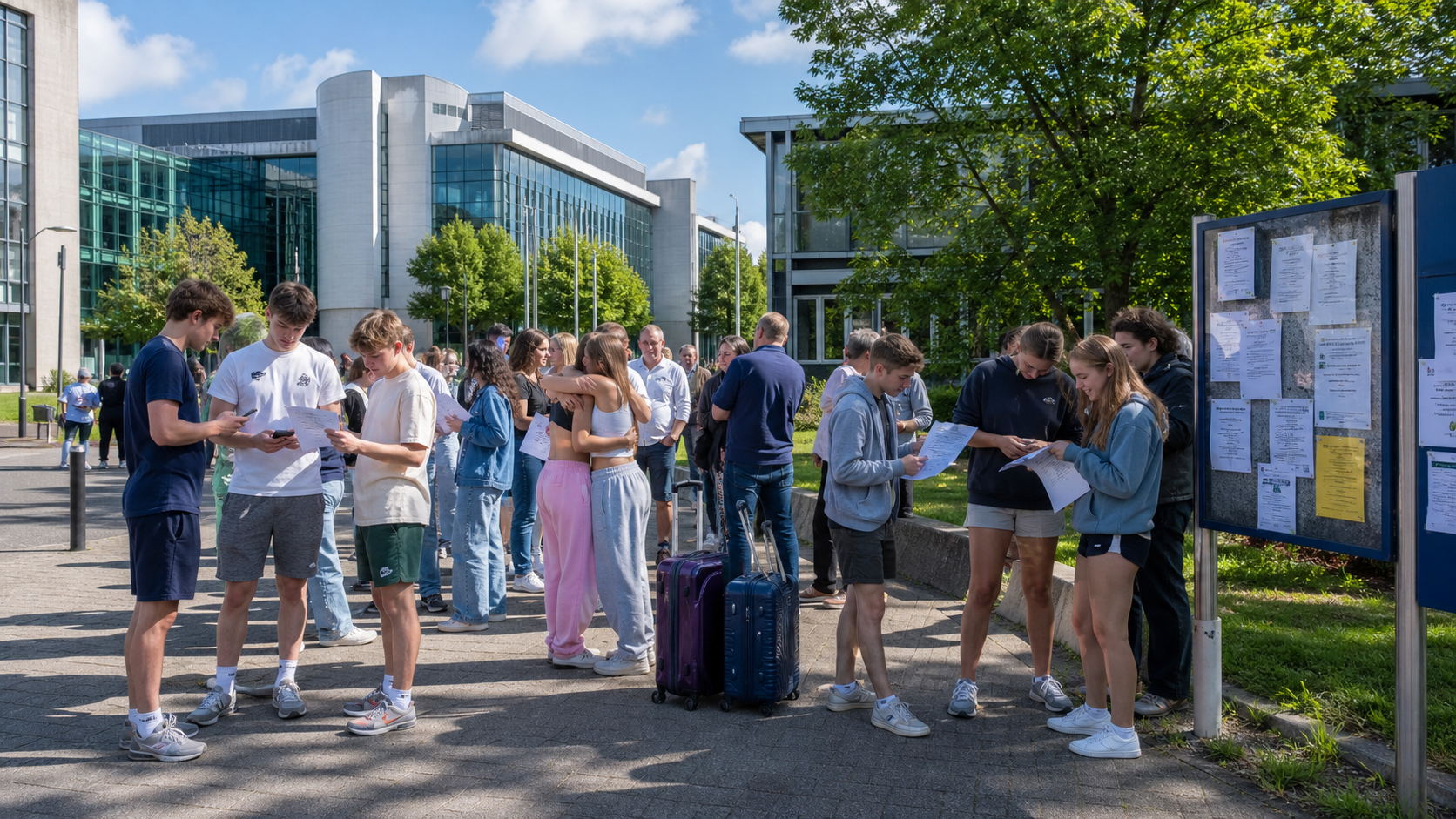
Over 70,400 Leaving Certificate students across the Republic of Ireland received their 2026 examination results this morning, Friday 21 August, with the State Examinations Commission's online portal opening at 10am to scenes of anticipation, relief, and celebration at schools nationwide. The class of 2026 is the largest in the history of the state, representing a 15 per cent increase in candidate numbers since 2024, and their results day marks the culmination of two years of study shaped by the ongoing normalisation of grades following the disruptions of the Covid-19 pandemic.
Background
The Leaving Certificate has served as Ireland's primary school-leaving qualification for over a century, functioning simultaneously as a measure of academic achievement and the principal gateway to third-level education through the Central Applications Office points system. Its significance in Irish life is difficult to overstate — results day is one of the few occasions that genuinely unites the country in a shared experience, with families, teachers, and communities all invested in the outcomes.
The 2026 cohort has navigated a particularly complex educational landscape. Students who sat their Junior Certificate in 2022 did so in the shadow of the pandemic's disruptions, and the grade inflation introduced during the Covid years — when calculated grades replaced traditional examinations — has cast a long shadow over subsequent cohorts. The State's decision to implement a phased "glide path" back to pre-pandemic grading norms, rather than an abrupt return, has been broadly welcomed by educators, though it has created a period of uncertainty for students and parents trying to understand what their results actually mean in comparative terms.
The post-marking adjustment (PMA) system, which artificially boosts grades to smooth the transition, was reduced to four per cent in 2026, down from 5.8 per cent in 2025. This resulted in 166,868 grades — 35.5 per cent of all grades — receiving an upward adjustment, compared to 52.4 per cent in 2025 and 68 per cent in 2024. The State Examinations Commission has confirmed that 2027 will be the final year of the PMA intervention.
Key Developments
The headline figure from this year's results is the continued reduction in top grades. The proportion of H1 grades — the highest available at higher level — fell from 12.1 per cent in 2025 to 10.1 per cent in 2026. H2 grades similarly declined, from 19.5 per cent to 17.8 per cent. At ordinary level, O1 grades dropped from 3.7 per cent to 2.7 per cent.
Subject-specific trends reflect the broader pattern. Higher-level mathematics, traditionally one of the most competitive subjects, saw its H1 rate fall from 11 per cent to 8.1 per cent. In English, the H1 rate declined from five per cent to 4.3 per cent, while Irish dropped from 11 per cent to 10 per cent. These figures will have implications for CAO points requirements, with round-one offers due on Wednesday 26 August.
At schools across the country, the human dimension of results day was on full display. In Wicklow, students at a special school celebrated results that reflected years of dedicated work by both pupils and staff. In Louth, a young butcher who had completed an apprenticeship rather than the traditional academic route spoke of the value of alternative pathways. The diversity of outcomes and journeys represented in this year's cohort reflects a broader shift in how Irish society is beginning to think about education and career development.
Why It Matters
The 2026 results carry particular significance because they represent the first year in which the full scale of the post-Covid grade normalisation is clearly visible to students and families. For those who received their Junior Certificate results in 2022 under inflated conditions, the comparison with their Leaving Certificate outcomes may feel jarring, even if the absolute grades are strong. This disconnect — between the grades students received at junior cycle and those they are receiving now — is one of the more complex legacies of the pandemic's impact on Irish education.
The government's announcement this week of 612 additional annual university places across healthcare disciplines, including 268 in nursing and midwifery, 151 in pharmacy, and 78 in medicine, provides some context for the competitive landscape facing this year's CAO applicants. The expansion is designed to address workforce shortages in the health service, but it also means that some courses which were previously highly competitive may become more accessible in the coming years.
Local Impact
Across Dublin, Cork, Galway, and Limerick, secondary schools opened their doors this morning for results collection, with many offering counselling and guidance services for students who did not achieve the grades they had hoped for. The National Parents Council and the Department of Education both emphasised the availability of support services, including the CAO's "Available Places" facility, which opens on Thursday 27 August and provides an additional route to third-level for students who missed their first-choice course.
In rural communities, where the local secondary school often serves as a focal point of community life, results day carries an additional weight. Teachers who have worked with students for five or six years share in the celebrations and disappointments in a way that is genuinely personal. The Irish second-level system, for all its pressures, retains a human dimension that is one of its most enduring strengths.
What's Next
CAO round-one offers will be released at 2pm on Wednesday 26 August, with a deadline for acceptance of 3pm on Tuesday 1 September. Students who wish to view their marked scripts can apply from 5pm on Tuesday 25 August, with the appeal window running from 10am on Sunday 30 August to 5pm on Monday 31 August. Appeal results are scheduled for Friday 25 September. The State Examinations Commission has confirmed that 2027 will be the final year of the post-marking adjustment, meaning next year's cohort will be the first to receive results under fully normalised conditions since 2019.