Irish Women Share Birth Stories as Maternity Care Crisis Deepens with Staffing Shortages and Transition to Public-Only Model
Irish women are sharing their birth stories in growing numbers as the country's maternity care system undergoes a fundamental and contested transition to a public-only model, with accounts of staffing shortages, inadequate support during labour, and a sense of vulnerability and powerlessness during pregnancy and birth revealing the human cost of a system under severe strain — and prompting calls from clinicians, midwives, and patient advocates for urgent and sustained reform.
Background
Ireland's maternity care system has been the subject of intense scrutiny and debate for several years, driven by a series of high-profile inquiries into maternal and infant deaths, the publication of damning reports on the culture and practices of individual maternity hospitals, and a growing public awareness of the gap between the care that women are entitled to expect and the care they are actually receiving. The Scally Report, the Portlaoise Report, and the Midland Regional Hospital inquiry have all contributed to a picture of a system that has too often failed the women and babies in its care.
The government's response to these failures has been to pursue a fundamental reform of the maternity care system, moving away from the two-tier model — in which women could pay to access private consultants and private rooms within public hospitals — toward a universal, single-tier public system in which all women receive the same standard of care regardless of their ability to pay. This transition, which is aligned with the broader Sláintecare reform programme, has been welcomed in principle by patient advocates and healthcare professionals, but its implementation has been fraught with difficulty.
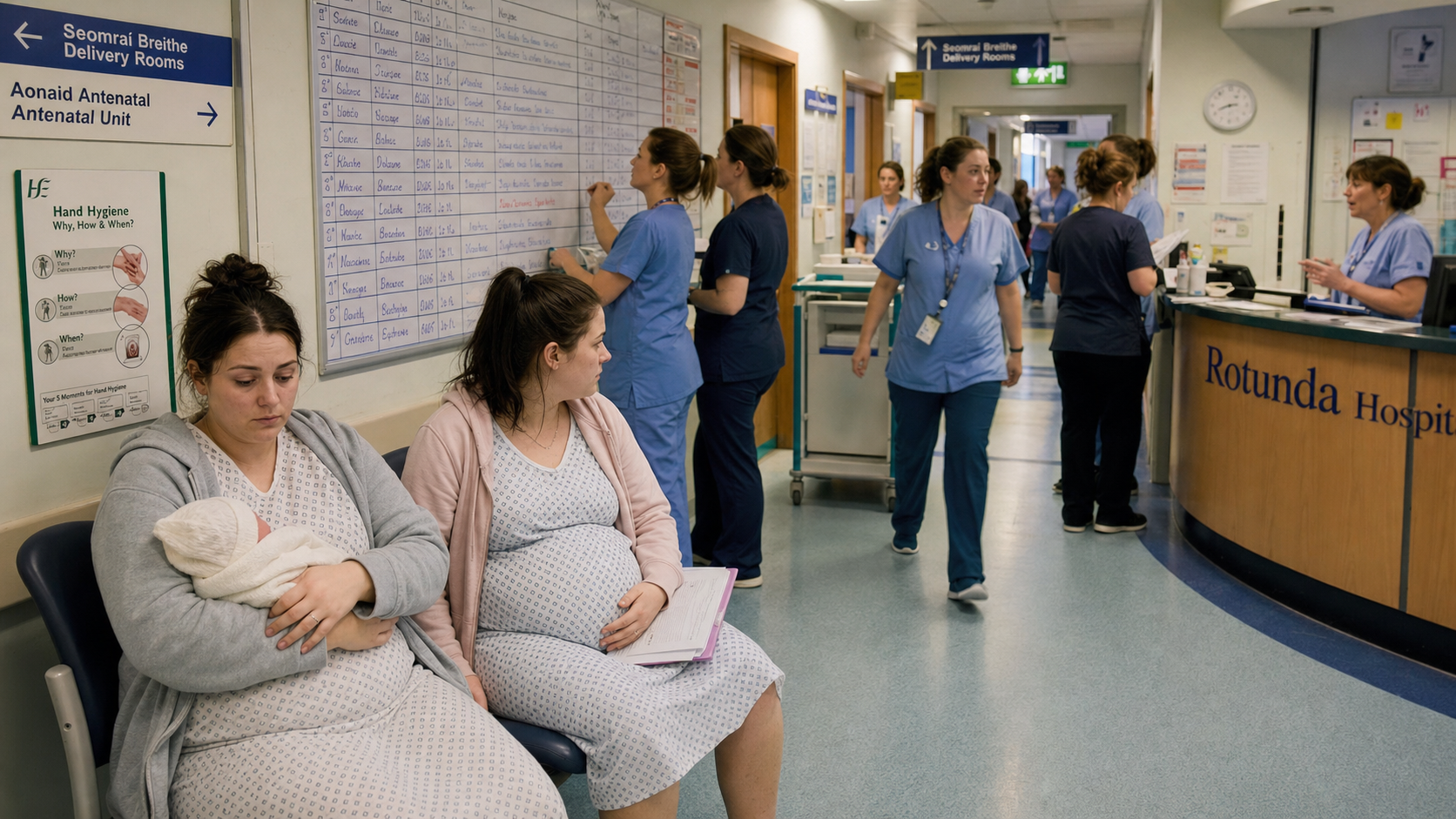
The transition has created friction between the state and some hospital management boards, particularly at the Rotunda Hospital in Dublin, where private maternity options were previously permitted. Consultants on new public-only contracts are barred from performing private work, a change that has led to some experienced obstetricians leaving the public system and has contributed to the staffing shortages that are now affecting the quality of care available to women.
Key Developments
The Irish Times has been collecting personal accounts from women about their experiences of pregnancy and birth in Ireland, and the stories that have emerged paint a picture of a system that is struggling to meet the needs of the women it serves. Common themes include long waiting times for antenatal appointments, inadequate support during labour, a sense of being rushed through the system, and a feeling of vulnerability and powerlessness at one of the most significant moments of a woman's life.
Retired obstetrician Peter Boylan has publicly called for an urgent revision of the National Clinical Practice Guidelines on Labour, specifically criticising the management of the "latent phase" of labour — the early stage before active labour begins — as potentially dangerous for women. Boylan has argued that the current guidelines, which can result in women being sent home or left without adequate support during this phase, are contributing to adverse outcomes and to the sense of abandonment that many women report.
The staffing situation in Irish maternity units has been described as "worryingly low" by healthcare professionals, with an obstetrician-to-patient ratio that falls below the levels recommended by international bodies. The shortage of midwives — which has been a persistent problem in the Irish health system for years — has been exacerbated by the transition to the public-only model, as some experienced midwives have left the public system in response to the changes in working conditions.
Why It Matters
The maternity care crisis matters because it affects one of the most fundamental experiences of human life — the birth of a child — and because the consequences of inadequate care can be severe and irreversible. Ireland has one of the lowest maternal mortality rates in the world, which is a genuine achievement, but the focus on this headline statistic can obscure the significant number of women who experience poor care, unnecessary interventions, or lasting physical and psychological harm as a result of their maternity experiences.
The transition to a public-only model, while the right direction of travel in principle, has been managed in a way that has created significant disruption without yet delivering the improvements in care that it was intended to produce. The government needs to ensure that the transition is accompanied by the investment in staffing, facilities, and training that is necessary to make the new model work effectively.
For context, Ireland has one of the highest caesarean section rates in Europe, at approximately 35% of all births. This rate — which is significantly above the World Health Organisation's recommended level of 10-15% — suggests that the system is over-medicalising birth in ways that may not be in the best interests of women or babies. The expansion of midwife-led care models, which are associated with lower intervention rates and higher levels of maternal satisfaction, is one of the key reforms that advocates are calling for.
Local Impact
The maternity care crisis affects women across Ireland, but its impact is felt most acutely in areas where access to services is most limited. In the west of Ireland — including counties Galway, Mayo, Roscommon, and Clare — women often face long journeys to reach their nearest maternity unit, and the limited availability of community midwifery services means that many women have little choice but to give birth in a hospital setting even when a home birth or midwife-led unit might be more appropriate for their needs.
In Dublin, where the three main maternity hospitals — the Rotunda, the National Maternity Hospital, and the Coombe — serve a large and growing population, the pressure on services is intense. Waiting times for antenatal appointments at these hospitals have been a persistent problem, and the transition to the public-only model has added to the administrative complexity of managing the patient pathway.
What's Next
The HSE is expected to publish a review of maternity services in the coming months, which will assess progress on the implementation of the National Maternity Strategy and identify areas where further investment and reform are needed. The Oireachtas Committee on Health is expected to hold hearings on maternity care in the autumn, with evidence from clinicians, midwives, and patient advocates. Budget 2027 is expected to include additional funding for maternity services, though the scale of the investment needed to address the staffing shortages and infrastructure deficits is significant.