Irish Scientists Develop Device to Prevent Ventilator-Associated Pneumonia in ICU Patients
A team of Irish scientists, clinicians, and engineers has developed a potentially life-saving medical device designed to prevent ventilator-associated pneumonia — one of the most common and deadly complications in intensive care units — by physically removing the bacterial biofilms that cause the infection before they can take hold.
Background
Ventilator-associated pneumonia, known in clinical settings as VAP, is a serious and frequently fatal complication that affects up to 25 per cent of patients on mechanical ventilation in intensive care units. It occurs when bacteria form communities — known as biofilms — on the internal surface of the endotracheal tube used to deliver oxygen to patients who cannot breathe independently. These biofilms develop within hours of intubation and, once established, are extremely difficult to eradicate. They impair the patient's immune response, increase the risk of death, and extend ICU stays by an average of several days — adding significant cost to healthcare systems and, more importantly, prolonging suffering for patients and their families.
The problem has been recognised for decades, and a range of interventions — including oral hygiene protocols, head-of-bed elevation, and antimicrobial coatings on tubes — have been deployed with varying degrees of success. But none has addressed the fundamental mechanism of biofilm formation in a direct and reliable way. The NOVAP Medical team identified this gap and set out to fill it with a fundamentally different approach.
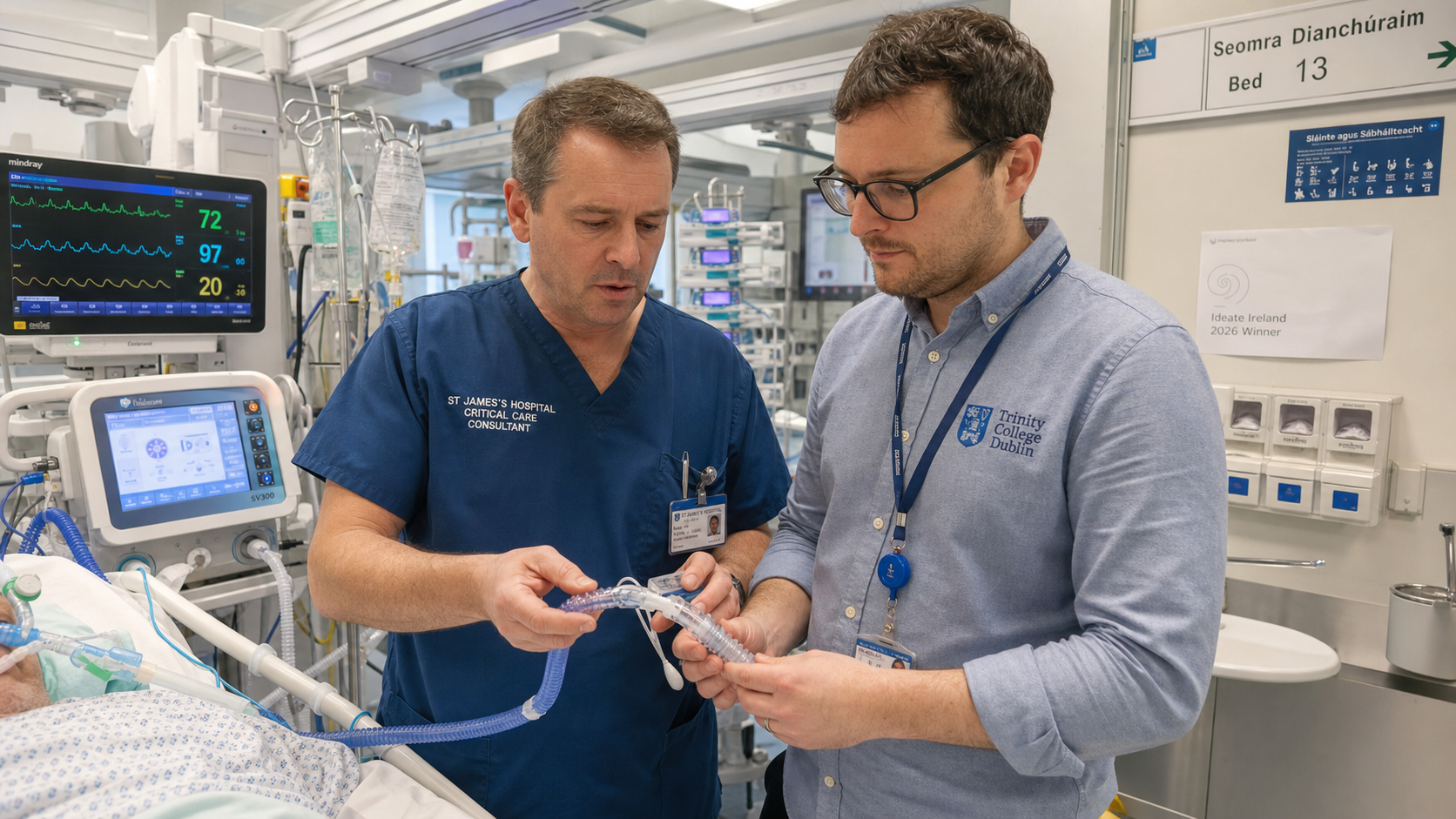
The team is led by Professor Ignacio Martin-Loeches, a consultant in intensive care medicine at St James's Hospital in Dublin and a professor of medicine at Trinity College Dublin, alongside Emily Naylor Jones, a co-founder of the NOVAP team and a former ICU nurse, and Professor Brooke Tornifoglio of Trinity's School of Engineering. Their combined clinical and engineering expertise has produced a device that approaches the problem from a mechanical rather than a pharmacological angle.
Key Developments
The NOVAP Medical device is a mechanically active endotracheal tube — one that is designed to physically remove biofilms from its internal surface rather than attempting to prevent their formation through chemical means. The precise mechanism involves a controlled mechanical action within the tube that disrupts and clears microbial communities before they can mature into the dense, infection-causing structures that lead to VAP.
The device won the 2026 Ideate Ireland entrepreneurship competition, which provides funding and connections to venture capitalists for early-stage medical technology companies. It has also received support from the Enterprise Ireland Commercialisation Fund and the Cork-based Health Innovation Hub Ireland. As of August 2026, the device is not yet in clinical use; the team is focused on moving the technology through further development stages toward clinical evaluation and eventual commercialisation.
Emily Naylor Jones, speaking about the project, described the motivation as deeply personal. "As an ICU nurse, I watched patients develop VAP and I knew that the existing tools weren't good enough," she said. "We wanted to build something that actually addressed the root cause, not just manage the symptoms of a problem we already knew how to prevent in theory."
Why It Matters
The scale of the VAP problem is difficult to overstate. In Ireland, the HSE estimates that healthcare-associated infections — of which VAP is one of the most serious — cost the health system tens of millions of euros annually in extended hospital stays, additional treatments, and increased mortality. Internationally, VAP is estimated to affect between 250,000 and 300,000 ICU patients per year in Europe alone, with mortality rates ranging from 20 to 50 per cent depending on the patient population and the causative organism.
A device that could reliably prevent VAP would represent a significant advance in critical care medicine — one comparable in impact to the introduction of hand hygiene protocols or the development of central line infection prevention bundles. Unlike pharmacological interventions, a mechanical solution does not carry the risk of contributing to antimicrobial resistance, which is itself one of the most pressing challenges facing global healthcare systems.
The Irish origins of the innovation are also significant. Trinity College Dublin and St James's Hospital have a strong track record in translational medical research — the kind of work that moves from laboratory discovery to clinical application — and the NOVAP project represents exactly the kind of collaboration between clinical insight and engineering expertise that produces genuinely useful innovations.
Local Impact
For ICU patients at St James's Hospital and other Irish hospitals, the eventual clinical deployment of the NOVAP device could mean shorter stays, reduced exposure to antibiotics, and lower mortality rates. St James's, which serves a large catchment area in Dublin and the surrounding counties, has one of the busiest ICUs in the country, and VAP is a persistent challenge in that setting.
More broadly, the project is a reminder that Irish medical research is capable of producing innovations with global relevance. The team's success in the Ideate Ireland competition has attracted attention from international investors, and there is a realistic prospect that the device could be manufactured and commercialised in Ireland — creating skilled employment in the medical technology sector, which is already one of the country's most important industries.
What's Next
The NOVAP Medical team is currently focused on completing the pre-clinical development work required before the device can enter clinical trials. The team expects to submit a clinical trial application within the next 18 months, with a view to beginning human trials in 2028. If the trials are successful, regulatory approval could follow in the early 2030s. The team is also in discussions with several European medical device manufacturers about potential licensing or partnership arrangements that could accelerate the commercialisation timeline.