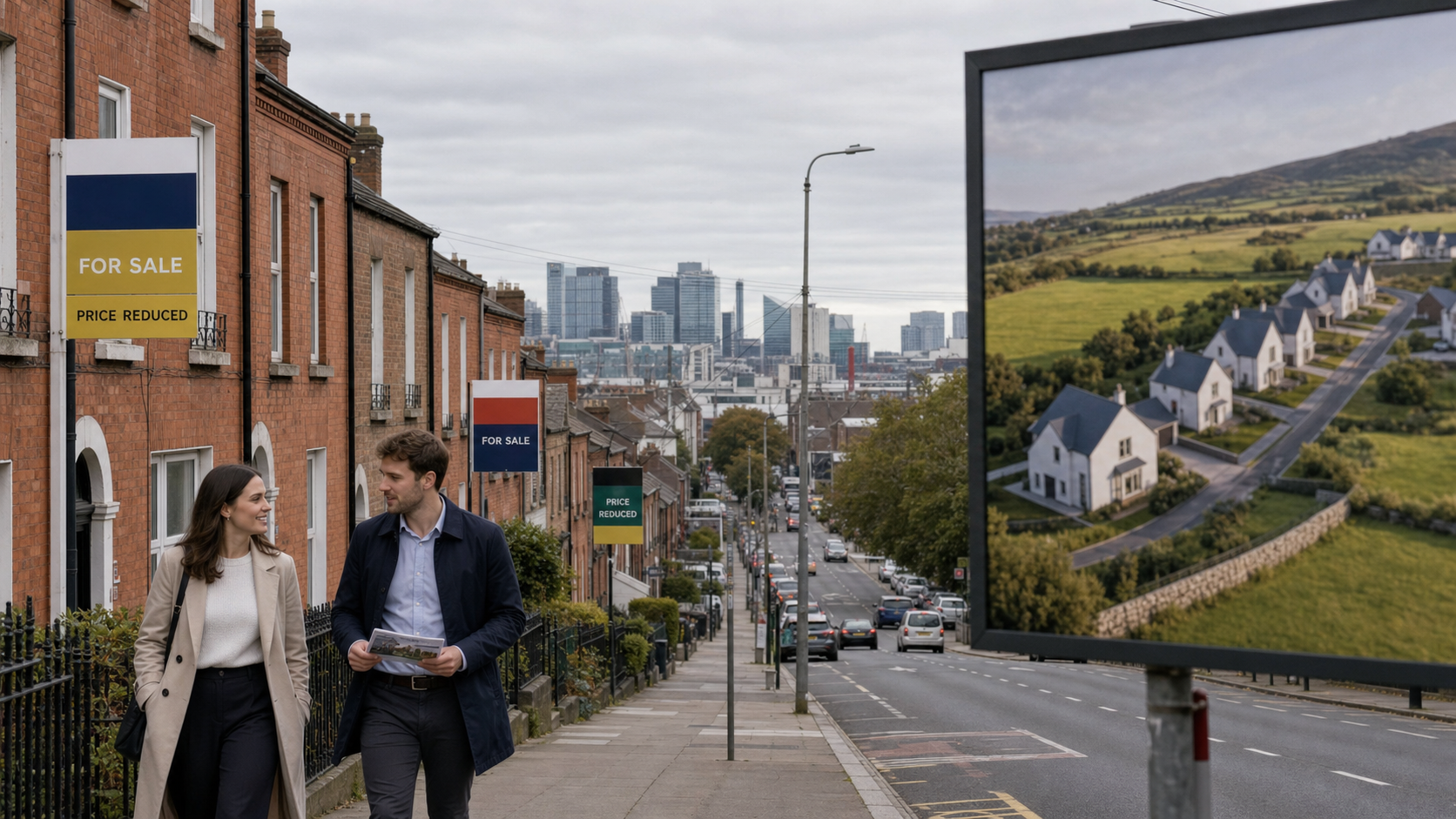
Irish Housing Market Splits in Two as Dublin Prices Fall While Rural and Regional Markets Surge
Ireland's residential property market has fractured into two sharply divergent realities in mid-2026, with house and apartment prices in Dublin recording their first annual decline since 2023 — down 2.3% year-on-year — while rural and regional markets in Connacht-Ulster and Munster are experiencing asking-price inflation of 8.8% and 6.3% respectively, creating a tale of two housing markets that defies simple characterisation.
Background
Ireland's housing crisis has been the defining domestic policy challenge of the past decade, driving political debate, shaping electoral outcomes, and affecting the life choices of hundreds of thousands of people. The crisis has its roots in a combination of factors: the collapse of construction activity following the 2008 financial crash, the slow recovery of the building sector, planning system constraints, infrastructure deficits, and the particular dynamics of a small, open economy that has attracted significant inward migration driven by foreign direct investment.
The market dynamics of 2026 represent a new phase in this ongoing story. After years of broadly uniform price growth across the country — driven by a fundamental mismatch between supply and demand — the market is now exhibiting a more complex pattern, with different forces operating in different parts of the country. Understanding this divergence is essential for policymakers, who must design interventions that address the specific challenges of both urban and rural markets rather than applying a one-size-fits-all approach.
The Central Statistics Office's residential property price index, published monthly, provides the most authoritative picture of market trends. The most recent data, covering the year to May 2026, shows national residential property prices rising by 6.2%, with the national median home price reaching €395,000. However, this national figure conceals the dramatic divergence between Dublin and the rest of the country.
Key Developments
In Dublin, the combination of improved new-build supply — driven by the government's planning reforms and the activation of large development sites in areas such as Cherrywood, Clongriffin, and the Docklands — and the affordability ceiling reached by many buyers has produced the first annual price decline since 2023. The average three-bedroom semi-detached home in the capital now costs €580,000, a figure that requires an estimated household income of €130,000 to service a standard mortgage. A concurrent slowdown in the high-paying technology sector, which has been a major driver of demand at the upper end of the Dublin market, has further reduced the pool of buyers able to compete at these price levels.
In stark contrast, rural and regional markets remain intensely competitive. Connacht-Ulster is experiencing asking-price inflation of 8.8%, driven by a chronic lack of second-hand supply — more than 60% below pre-pandemic levels in many areas — as existing homeowners are reluctant to sell into a market where finding a replacement property is extremely difficult. Munster is seeing similar dynamics, with 6.3% asking-price inflation reflecting strong demand from buyers priced out of Dublin and a persistent shortage of available homes.
New home construction is projected to reach as many as 40,000 units nationally in 2026, exceeding government targets for the first time. However, medium-sized developers have warned that planning uncertainty and a lack of finance for land acquisition are preventing them from scaling up output further, particularly in regional towns and cities where the economics of development are more challenging than in Dublin.
Why It Matters
The two-speed housing market matters because it creates different but equally serious problems in different parts of the country. In Dublin, falling prices are welcome news for first-time buyers who have been priced out of the market for years — but they also create risks for recent buyers who may find themselves in negative equity if the decline continues, and for developers whose business models depend on achieving certain price points. In rural and regional areas, the continued surge in prices is deepening the affordability crisis for local buyers, many of whom are competing against remote workers from Dublin and other cities who can afford to pay significantly more. This dynamic is reshaping communities, driving up rents, and making it increasingly difficult for essential workers — teachers, nurses, gardaí — to live in the areas where they work.
Local Impact
The divergence in market conditions is playing out in very specific ways across Ireland's cities, towns, and rural areas. In Cork city, where asking prices are rising strongly, the shortage of affordable homes is a major concern for the city council, which is struggling to attract and retain workers in key public services. In Galway, the combination of a buoyant tourism economy, a growing university population, and strong demand from remote workers has created one of the most competitive property markets outside Dublin. In smaller towns and villages across Connacht and Munster, the arrival of remote workers with Dublin salaries has transformed local property markets, pricing out local buyers and changing the social character of communities. In Dublin's outer suburbs — areas such as Tallaght, Clondalkin, and Blanchardstown — the easing of price pressure is providing some relief for first-time buyers, though affordability remains a significant challenge even at reduced prices.
What's Next
The government's Housing for All plan, now in its fourth year of implementation, will be reviewed in the autumn, with the two-speed market dynamics likely to prompt a reassessment of some of its key measures. The Help to Buy scheme, which has been criticised for inflating prices in some markets, may be modified to better target areas of genuine affordability need. The Land Value Sharing levy, designed to capture some of the uplift in land values created by planning permission, is due to come into effect in 2027 and will be closely watched as a potential tool for improving the economics of development in regional areas. The CSO will publish its next residential property price index in August, providing an updated picture of market trends as the summer selling season concludes.