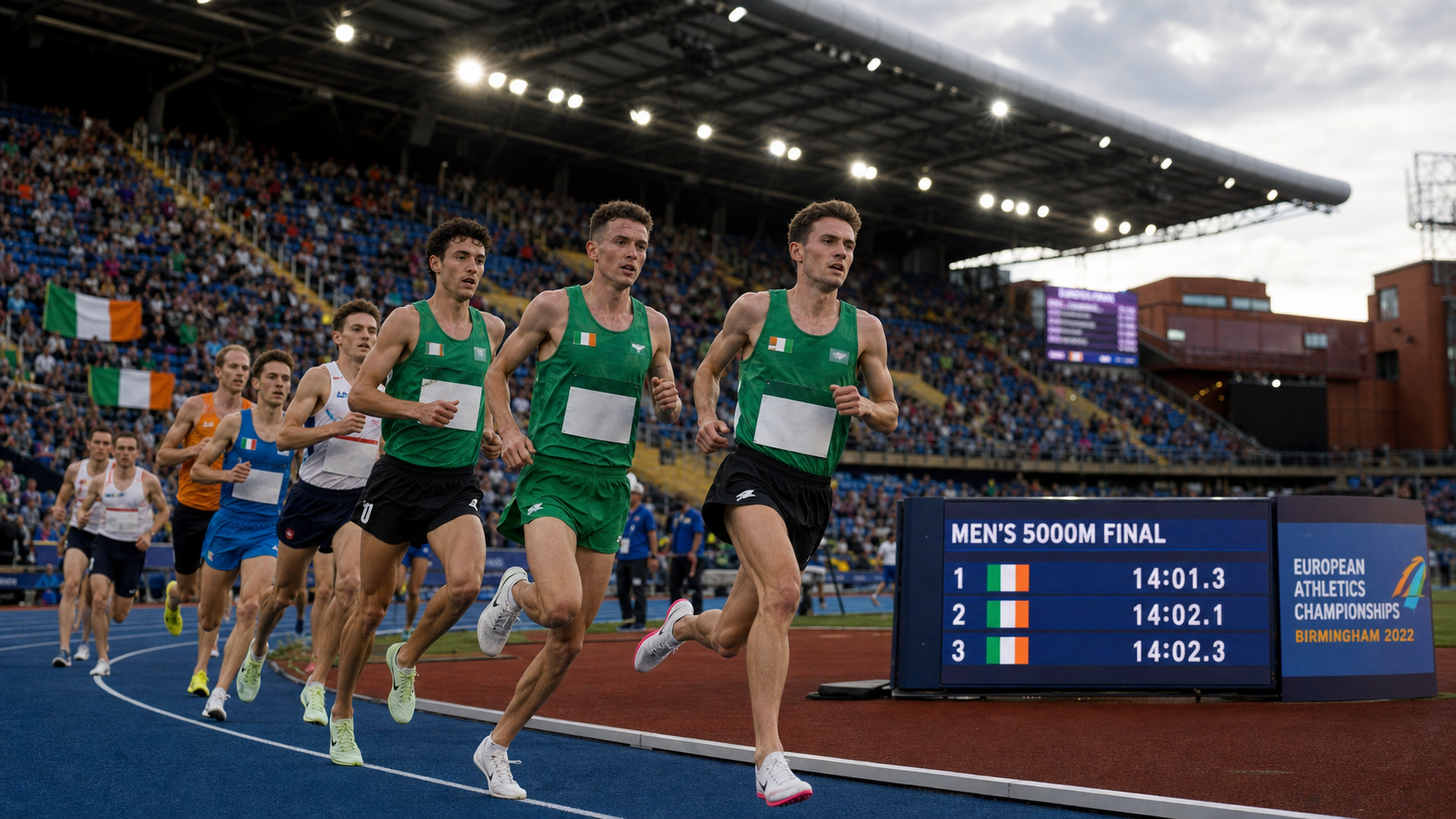
Ireland's 47-Strong Team Opens European Athletics Championships Campaign in Birmingham
Ireland's largest-ever team at a European Athletics Championships began their campaign at the Alexander Stadium in Birmingham on Monday, with 47 athletes representing the country across a wide range of track and field events. The opening day featured the 5,000m final, in which Nick Griggs, Darragh McElhinney, and Brian Fay competed against a field that included Olympic and world champion Jakob Ingebrigtsen, as Ireland targets its most successful European Championships in a generation.
Background
The 2026 European Athletics Championships, held at the Alexander Stadium in Birmingham from 10 to 16 August, represent a significant opportunity for Irish athletics. The sport has been enjoying a period of unprecedented success, with a generation of talented athletes emerging across multiple disciplines. The 47-strong squad — the largest Ireland has ever sent to the European Championships — reflects both the depth of talent available and the ambition of Athletics Ireland to compete at the highest level.
The team was selected through a combination of automatic qualification, relay panel selection, and European Athletics quota places. Twenty athletes qualified automatically by achieving the A-standard in their events, while a further 14 were allocated quota places after achieving the B-standard and being ranked within the European Athletics allocation system. The relay panels — men's and women's 4x100m and 4x400m — add further depth to the squad.
The championships come at a difficult moment for the team, following the withdrawal of Sharlene Mawdsley, who had been one of Ireland's strongest medal contenders in the 400m. Mawdsley sustained a hamstring tear during the National Championships at Santry and was ruled out of the Birmingham event, a significant blow to Ireland's medal prospects in the sprints. Her absence will be felt particularly in the 4x400m relay, where she had been expected to play a key role.
Key Developments
The opening day of the championships featured the 5,000m final as a straight final — one of the most eagerly anticipated events of the week. Nick Griggs, the Derry-born distance runner who has been one of the most exciting emerging talents in Irish athletics, lined up alongside Darragh McElhinney and Brian Fay in a race that also featured Jakob Ingebrigtsen, the Norwegian who has dominated European and world distance running for the past five years.
Griggs, who won the 3,000m at the Irish Indoor Athletics Championships in March and placed sixth in the 5,000m at the Commonwealth Games in Glasgow, was competing in his first senior European Championships final. McElhinney, the more experienced of the three, has been a consistent performer at international level and was expected to be Ireland's best hope of a top-five finish. Fay, who has been in excellent form throughout the 2026 season, completed a strong Irish contingent in the event.
Elsewhere on the opening day, Israel Olatunde competed in the 100m heats, while the women's heptathlon — featuring Kate O'Connor, who won gold at the Commonwealth Games — began with the 100m hurdles and high jump. Mona McSharry, meanwhile, is competing at the European Aquatics Championships in Paris, which runs concurrently with the athletics championships, targeting her first European long-course medal in the 100m and 200m breaststroke.
Why It Matters
The European Athletics Championships matter for Irish athletics because they provide a benchmark for the sport's development and a platform for athletes to establish themselves on the international stage. Ireland's previous best performance at the European Championships came in 2022, when the country won two medals, and the ambition for Birmingham is to match or exceed that total. The size of the squad — 47 athletes — reflects the genuine depth of talent that Irish athletics has developed over the past decade, and the championships provide an opportunity to demonstrate that depth on the biggest stage in European athletics.
The presence of Nick Griggs in the 5,000m final is particularly significant. Griggs is one of the most exciting young distance runners in Europe, and his performance in Birmingham will be closely watched by coaches and selectors across the continent. If he can produce a top-five finish against a field that includes Ingebrigtsen, it will confirm his status as one of the athletes to watch in the build-up to the 2028 Los Angeles Olympics.
The championships are also the first European Athletics Championships to be held in Britain, at the Alexander Stadium in Birmingham — the same venue that hosted the 2022 Commonwealth Games. The proximity to Ireland means that a significant number of Irish supporters have made the trip to Birmingham, and the atmosphere in the stadium for Irish events is expected to be excellent.
Local Impact
For athletics clubs across Ireland — from Clonliffe Harriers in Dublin to City of Derry AC in the north-west — the European Championships provide a focal point for the sport and an inspiration for the next generation of athletes. The athletes competing in Birmingham have come through the club system, and their success reflects the work of coaches, volunteers, and administrators at every level of the sport. Athletics Ireland has invested significantly in high-performance programmes in recent years, and the size and quality of the Birmingham squad is a return on that investment. Coverage of the championships is available on RTÉ television and the RTÉ Player throughout the week.
What's Next
The European Athletics Championships continue until Sunday, 16 August, with medal events taking place each day. Ireland's key medal hopes include Kate O'Connor in the heptathlon, Mark English and Cian McPhillips in the 800m, Sarah Healy in the 1500m and 5000m, and the relay teams. The championships conclude with the marathon on the final day, where Fionnuala McCormack will represent Ireland in the women's event. Full results and updates are available on the Athletics Ireland website and on RTÉ Sport.