Ireland Recruits 300 Civil Servants to Prepare for EU Council Presidency with Cybersecurity and Migration as Key Priorities
The Irish government is in the midst of one of the most significant expansions of its civil service in recent years, hiring 300 additional staff to manage the demands of its upcoming EU Council Presidency. With preparations now entering their most intensive phase, the government has identified three key priorities for Ireland's term at the helm of the Council: boosting EU cybersecurity, enhancing online safety for children, and managing migration policy. The recruitment drive reflects the scale of the logistical and diplomatic challenge involved in leading the Council, and the government's determination to ensure that the Presidency does not come at the expense of domestic policy delivery.
Background
The Presidency of the Council of the European Union rotates among member states on a six-monthly basis, with each country taking the chair of Council meetings and playing a central role in shaping the EU's legislative agenda during its term. For a small country like Ireland, the Presidency represents both a significant opportunity — to shape EU policy in areas of national interest — and a significant challenge, requiring the deployment of substantial diplomatic and administrative resources at a time when those resources are also needed for domestic purposes.
Ireland has held the EU Presidency on several previous occasions, most recently in 2013, when it played a key role in managing the EU's response to the financial crisis. The experience of previous Presidencies has informed the government's approach to preparation, with a particular emphasis on ensuring that the civil service has the capacity to manage the additional workload without drawing resources away from domestic policy delivery.
The three priority areas identified for Ireland's Presidency — cybersecurity, online child safety, and migration — reflect both Ireland's national interests and the broader EU policy agenda. Cybersecurity is an area where Ireland has developed significant expertise, partly as a result of hosting the European headquarters of many of the world's largest technology companies. Online child safety is a priority that has strong cross-party support in the Dáil and resonates with the public. Migration policy is one of the most contested areas of EU politics, and Ireland's approach to it during the Presidency will be closely watched.
Key Developments
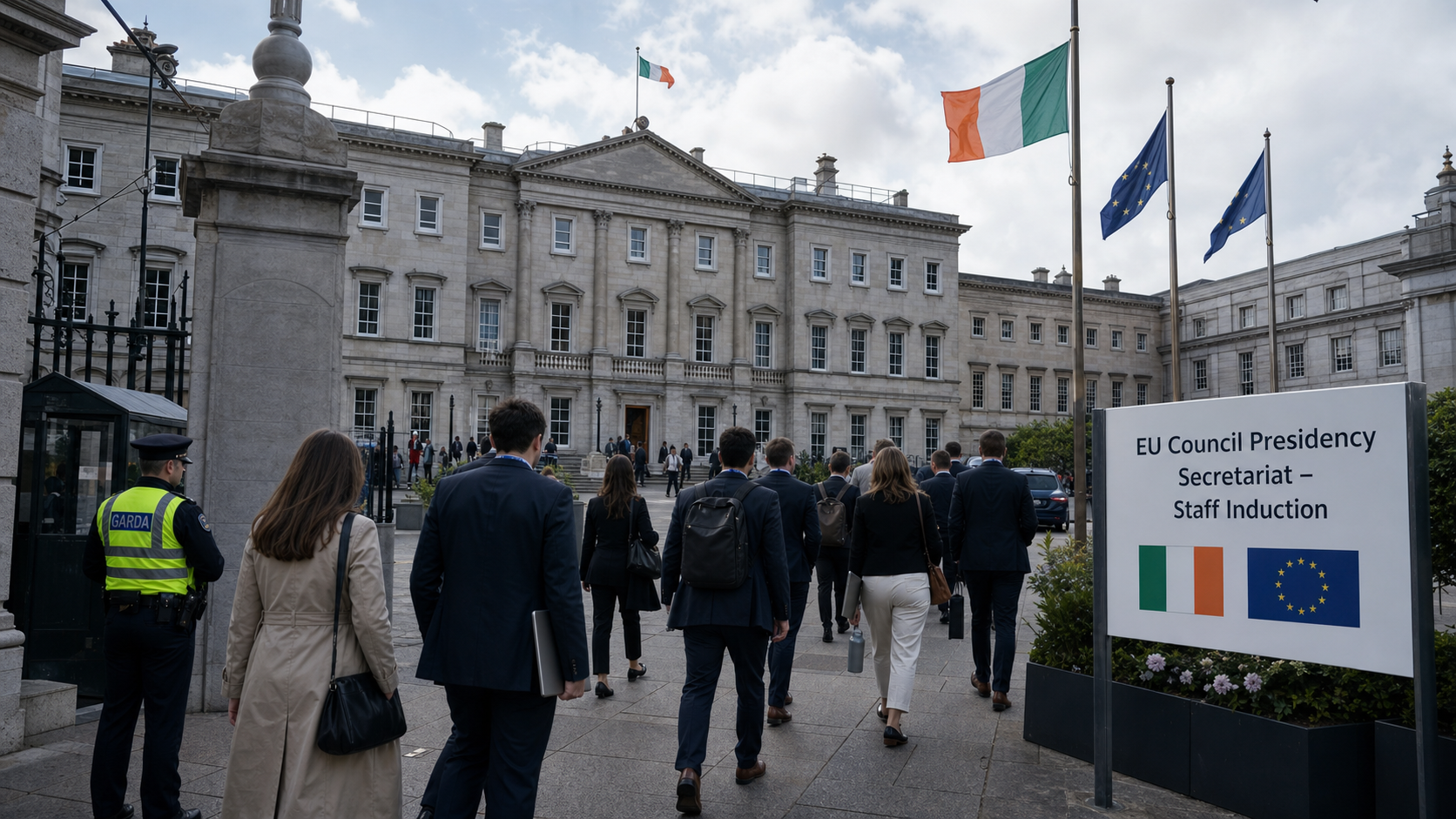
The Irish Examiner reported on June 11 that the government is hiring 300 additional civil servants specifically to manage the Presidency workload. The recruitment is being coordinated by the Department of the Taoiseach, which has overall responsibility for Presidency preparations, in conjunction with the Department of Foreign Affairs and the other departments that will be most heavily involved in Council meetings during Ireland's term.
The 300 new hires will be deployed across a range of roles, from policy advisers and legal experts to logistics coordinators and communications specialists. Many will be based in Brussels, where Ireland's Permanent Representation to the EU will need to be significantly expanded to manage the volume of Council meetings and negotiations that the Presidency entails. Others will be based in Dublin, supporting the domestic coordination of Presidency business.
The government has also been investing in the physical infrastructure needed to host Presidency events in Ireland, with a series of informal ministerial meetings and other high-level gatherings planned for Dublin and other Irish cities during the term. The Convention Centre Dublin has been booked for several major events, and a programme of cultural activities showcasing Irish arts and heritage is being developed to accompany the formal Presidency programme.
Why It Matters
The EU Presidency matters for Ireland for several reasons. Most immediately, it provides an opportunity to shape the EU's legislative agenda in areas of direct national interest — from the regulation of technology companies to the management of the Common Agricultural Policy. Ireland's position as a small, open economy that is deeply integrated into the EU single market means that EU policy decisions have a disproportionate impact on Irish economic and social life, and the Presidency provides a rare opportunity to influence those decisions from the chair.
The Presidency also matters for Ireland's international standing. Holding the Presidency of the Council of the EU is a significant diplomatic responsibility, and Ireland's performance in the role will be closely watched by its EU partners. A successful Presidency — one that advances the EU's legislative agenda, manages difficult negotiations effectively, and maintains good relations with all member states — would enhance Ireland's reputation as a constructive and capable EU partner.
The recruitment of 300 additional civil servants is also significant from a domestic policy perspective. It represents a substantial investment in the capacity of the Irish civil service, and the skills and experience gained during the Presidency will remain within the system after Ireland's term ends. Previous Presidencies have been credited with accelerating the development of Ireland's diplomatic and administrative capacity in ways that have had lasting benefits.
Local Impact
The Presidency will have a direct economic impact on Dublin and other Irish cities that host Presidency events. The influx of EU officials, ministers, and their delegations will generate significant business for hotels, restaurants, and other hospitality businesses, providing a welcome boost to a sector that has been under pressure from rising costs. The Convention Centre Dublin and other major venues will be in high demand throughout the Presidency term.
For Irish civil servants, the Presidency represents a significant professional development opportunity. Those selected to work on Presidency business will gain experience of EU-level negotiations and policymaking that is difficult to acquire in any other context. The Department of the Taoiseach has indicated it is prioritising the selection of civil servants who will benefit most from this experience and who are likely to remain in the public service after the Presidency ends.
What's Next
The recruitment process for the 300 additional civil servants is expected to be completed by the end of the summer, with the new staff in place and trained before Ireland's Presidency term begins. The government is also finalising the detailed programme for the Presidency, including the schedule of Council meetings, informal ministerial gatherings, and cultural events. A formal launch of the Presidency programme is expected in the autumn, with the Taoiseach and the Minister for Foreign Affairs presenting Ireland's priorities to the Oireachtas and to EU partners.