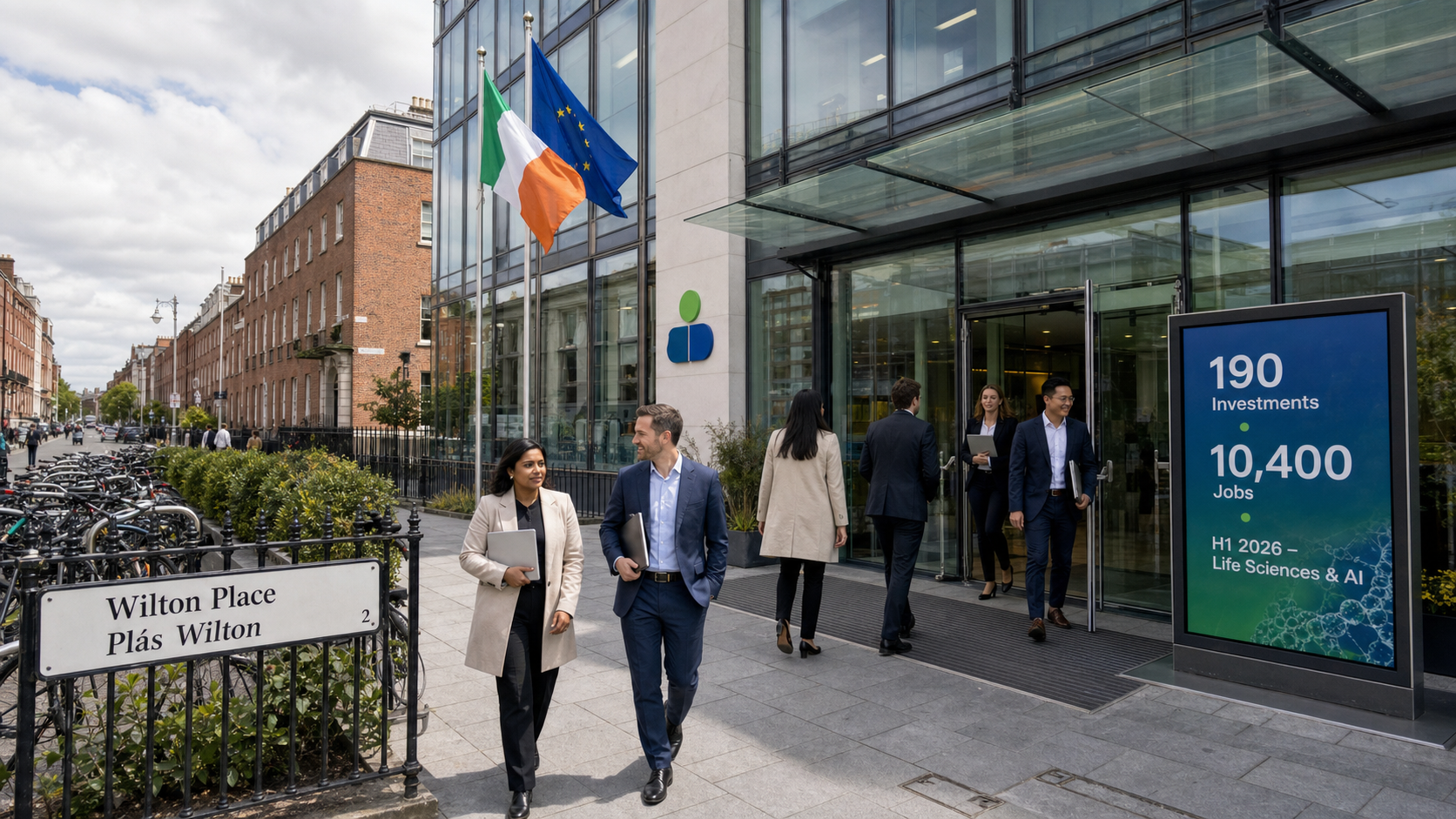
IDA Ireland Secures 190 Investments and 10,400 Jobs in Strong First Half of 2026 Led by Life Sciences and AI
IDA Ireland has reported a strong first half of 2026, securing 190 new investments projected to support the approval of over 10,400 new jobs — a performance that demonstrates sustained confidence from multinational corporations in Ireland's economic fundamentals, even as the global investment climate becomes more competitive and the domestic economy undergoes a period of normalisation.
Background
IDA Ireland, the state agency responsible for attracting foreign direct investment, has been the engine of Ireland's economic transformation over the past four decades. Its success in attracting major multinational corporations — from the early days of attracting US technology companies in the 1980s and 1990s to the more recent focus on life sciences, financial services, and digital technology — has fundamentally reshaped the Irish economy and created hundreds of thousands of well-paid jobs across the country.
The FDI model has faced increasing scrutiny in recent years, as the global tax environment has changed and as the concentration of employment in a small number of large multinationals has created structural vulnerabilities. The OECD's global minimum tax agreement, which Ireland has implemented, has reduced some of the tax advantages that previously made Ireland particularly attractive to multinationals. Despite these headwinds, IDA Ireland has continued to attract significant investment, adapting its pitch to emphasise Ireland's talent pool, its membership of the European Union, and its established ecosystem of multinational companies and supporting services.
The first half of 2026 has been a period of significant activity for IDA Ireland, with the agency working to maintain Ireland's competitive position in a global market for investment that is becoming increasingly contested. Countries across Europe and Asia are competing aggressively for the same pool of multinational investment, and IDA Ireland's ability to continue delivering strong results in this environment is a testament to the strength of Ireland's underlying proposition.
Key Developments
The headline figures for the first half of 2026 — 190 investments and over 10,400 jobs — represent a solid performance by historical standards, even if the pace of job creation has moderated slightly compared to the exceptional years of the mid-2020s. The quality and strategic nature of the investments is arguably more significant than the raw numbers, with several of the major announcements pointing to Ireland's growing strength in the most dynamic sectors of the global economy.
The most significant individual investment is the €432 million expansion by Novo Nordisk at its facility in Athlone, County Westmeath. Novo Nordisk, the Danish pharmaceutical giant that has become one of the world's most valuable companies on the back of its weight-loss and diabetes medications, is expanding its Irish manufacturing capacity to meet surging global demand. The Athlone facility is one of the company's key production sites, and the investment will create hundreds of new jobs in the Midlands region.
In the technology sector, Qualcomm's €125 million commitment to its Cork operations — focused on enhancing its AI-driven chipmaking capabilities — and OpenText's €105 million expansion focused on sovereign cloud and agentic AI technologies are both significant signals of confidence in Ireland's tech ecosystem. These investments reflect the broader trend towards AI-related activity that is reshaping the global technology sector, and Ireland's ability to attract investment in this space suggests that its position as a European hub for technology companies remains strong.
Why It Matters
IDA Ireland's first-half results matter because they provide evidence that Ireland's FDI model continues to deliver, even in a more challenging global environment. The 190 investments and 10,400 jobs represent real economic activity — real people employed in real jobs, paying real taxes that fund public services. The geographic spread of the investments, with major projects in Athlone, Cork, and other regional locations, also reflects IDA Ireland's ongoing effort to distribute the benefits of FDI more evenly across the country, rather than concentrating them in Dublin.
The focus on life sciences and AI is strategically significant. These are sectors where Ireland has established genuine competitive advantages — in life sciences, through decades of investment in manufacturing capacity and a deep pool of skilled workers; in AI, through the presence of major technology companies and a growing ecosystem of AI-focused startups and research institutions. By continuing to attract investment in these areas, Ireland is positioning itself for the next phase of the global economy rather than simply defending the gains of the past.
Local Impact
The Novo Nordisk expansion in Athlone is the most significant regional investment of the first half, with the potential to transform the economic landscape of the Midlands. Athlone, which has developed into a significant pharmaceutical hub over the past two decades, will see further growth in its skilled workforce as the expansion creates new roles in manufacturing, quality assurance, and engineering. In Cork, the Qualcomm investment builds on the city's established reputation as a technology hub, adding to the cluster of major tech companies that have made Cork their European base. IDA Ireland has indicated that it is actively working to attract further investment to regional locations, with Derry/Londonderry, Galway, and Limerick all identified as priority targets for the second half of 2026.
What's Next
IDA Ireland will publish its full first-half results report later this month, providing a more detailed breakdown of the investments secured and the jobs approved. The agency's chief executive has indicated that the pipeline of potential investments for the second half of 2026 remains strong, with several major announcements expected before the end of the year. The government's review of the IDA's strategy, which is scheduled for completion in the autumn, will set out the agency's priorities and targets for the period to 2030.