Government Faces 'Undemocratic' Charge as LNG and Airport Bills Rushed Through Dáil
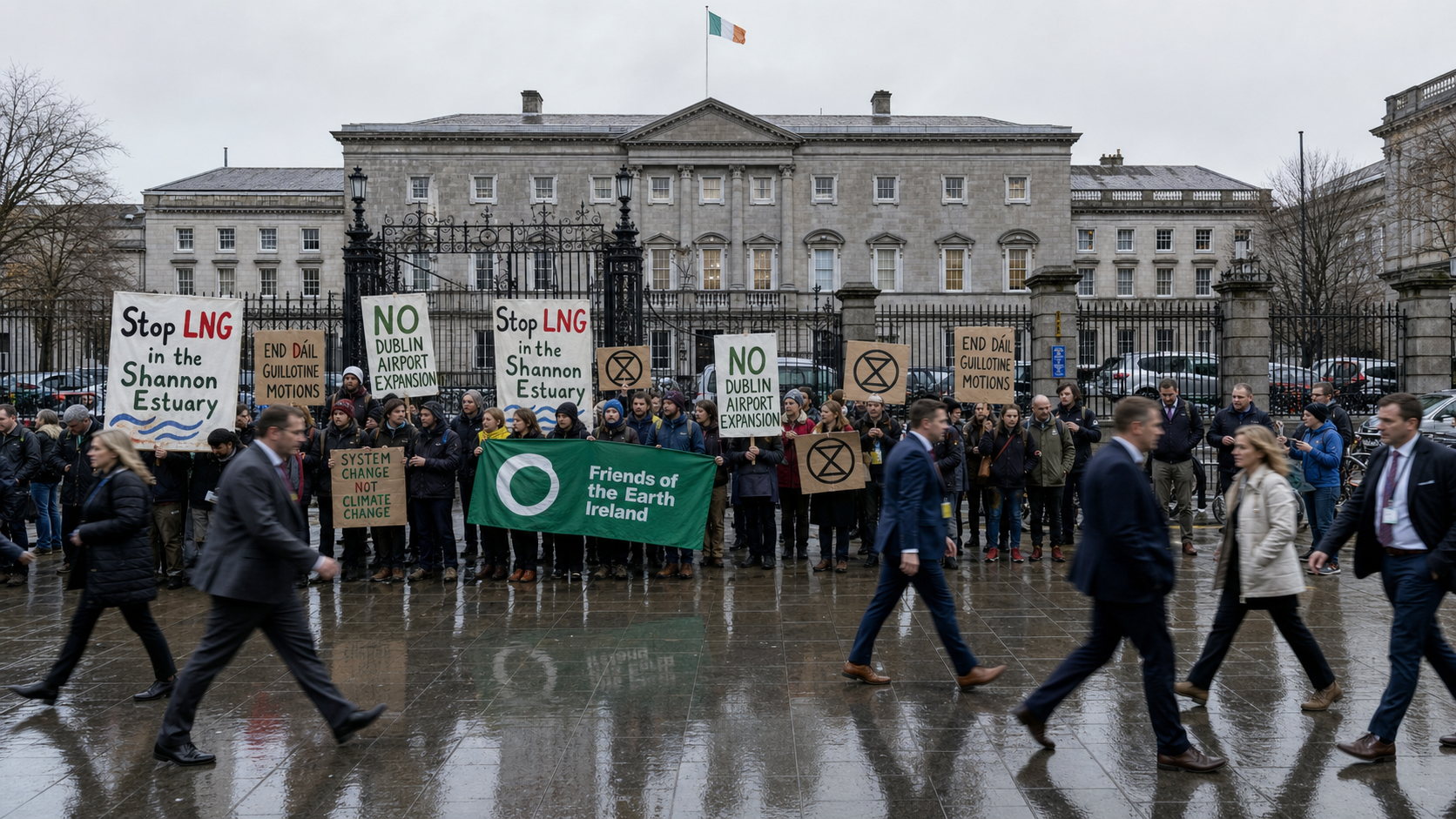
The Irish government has been accused of acting in an "undemocratic" and "anti-climate" manner after invoking the guillotine motion to severely curtail Dáil debate on two pieces of legislation with significant and long-lasting environmental consequences — the Strategic Gas Reserve Bill, which facilitates a floating liquefied natural gas storage unit in the Shannon Estuary, and legislation to remove the 32-million passenger cap at Dublin Airport.
Background
The guillotine motion is a parliamentary procedure that allows a government to impose a time limit on debate, forcing a vote on legislation regardless of whether all TDs who wish to speak have had the opportunity to do so. It is a legitimate tool of parliamentary management, used in legislatures across the world to prevent filibustering and ensure that the government's legislative programme can be advanced. However, its use on legislation of significant public interest and environmental consequence is invariably controversial, and the government's decision to apply it to both the LNG and airport bills on the same day has drawn unusually sharp criticism.
The Strategic Gas Reserve Bill has been one of the most contested pieces of legislation in the current Dáil term. The proposal to establish a floating LNG storage unit in the Shannon Estuary — a facility that would allow Ireland to import liquefied natural gas from overseas, including potentially from the United States — has been opposed by environmental groups on the grounds that it locks Ireland into fossil fuel dependency at a time when the state has committed to achieving net-zero emissions by 2050. Proponents argue that the facility is necessary to ensure energy security, particularly in light of the disruption to European gas supplies caused by the war in Ukraine.
The Dublin Airport passenger cap legislation is similarly contested. The cap of 32 million passengers per year was imposed by An Bord Pleanála as a condition of planning permission for the airport's development, and its removal has been sought by the Dublin Airport Authority and the aviation industry for several years. Environmental groups argue that removing the cap will lead to a significant increase in aviation emissions, undermining Ireland's climate commitments.
Key Developments
The government applied the guillotine motion to both bills on 29 June, allocating just two hours of debate to each piece of legislation. The decision was immediately condemned by opposition parties across the political spectrum. Labour TD Ciarán Ahern described the move as "undemocratic," arguing that two hours was wholly inadequate for legislation that will have consequences for Ireland's energy infrastructure and climate trajectory for decades to come.
Friends of the Earth Ireland was among the environmental groups that responded most forcefully, describing the government's approach as "anti-climate" and accusing ministers of prioritising economic interests over Ireland's legally binding climate obligations. The organisation noted that Ireland is already significantly off-track in meeting its 2030 emissions reduction targets, and that the combination of LNG infrastructure and airport expansion will make the task of meeting those targets even more difficult.
Government ministers defended the use of the guillotine on the grounds that both bills had been subject to extensive pre-legislative scrutiny and committee examination, and that the time allocated for Dáil debate was proportionate to the stage the legislation had reached. This argument was rejected by opposition TDs, who noted that committee scrutiny is not a substitute for full Dáil debate and that the guillotine prevents TDs from raising issues that may not have been adequately addressed at committee stage.
Why It Matters
The use of the guillotine on these two bills raises fundamental questions about the quality of democratic deliberation in the Oireachtas. Ireland's climate legislation — the Climate Action and Low Carbon Development Act 2021 — commits the state to achieving a 51% reduction in greenhouse gas emissions by 2030 and net-zero by 2050. These are legally binding targets, and the Climate Change Advisory Council has repeatedly warned that Ireland is not on track to meet them.
Against this backdrop, the decision to fast-track legislation that will expand fossil fuel infrastructure and increase aviation emissions without adequate parliamentary scrutiny is difficult to defend on either democratic or environmental grounds. The government's argument that energy security requires the LNG facility may have merit, but that argument deserves to be tested in full Dáil debate rather than compressed into a two-hour window.
Local Impact
The Shannon Estuary LNG facility, if built, will be located in the Clare/Limerick area, with significant implications for the local environment and economy. Communities along the estuary have been divided on the proposal, with some welcoming the potential economic activity and others concerned about the environmental impact. In Dublin, the removal of the airport passenger cap will affect communities in the Fingal area — Swords, Malahide, Portmarnock — that are already affected by aircraft noise and are concerned about the impact of increased traffic on local air quality and quality of life.
What's Next
Both bills are expected to pass the Dáil and proceed to the Seanad, where they will face further scrutiny. Environmental groups have indicated they will challenge the LNG legislation through the courts if it is enacted, arguing that it is incompatible with Ireland's climate obligations. The European Commission is also monitoring Ireland's compliance with EU climate law, and the LNG facility may face scrutiny under the EU's taxonomy for sustainable finance. The airport cap legislation is expected to face legal challenges from local residents' groups in Fingal.