Gerry The Monk Hutch to Register as Candidate in Dublin Central By-Election
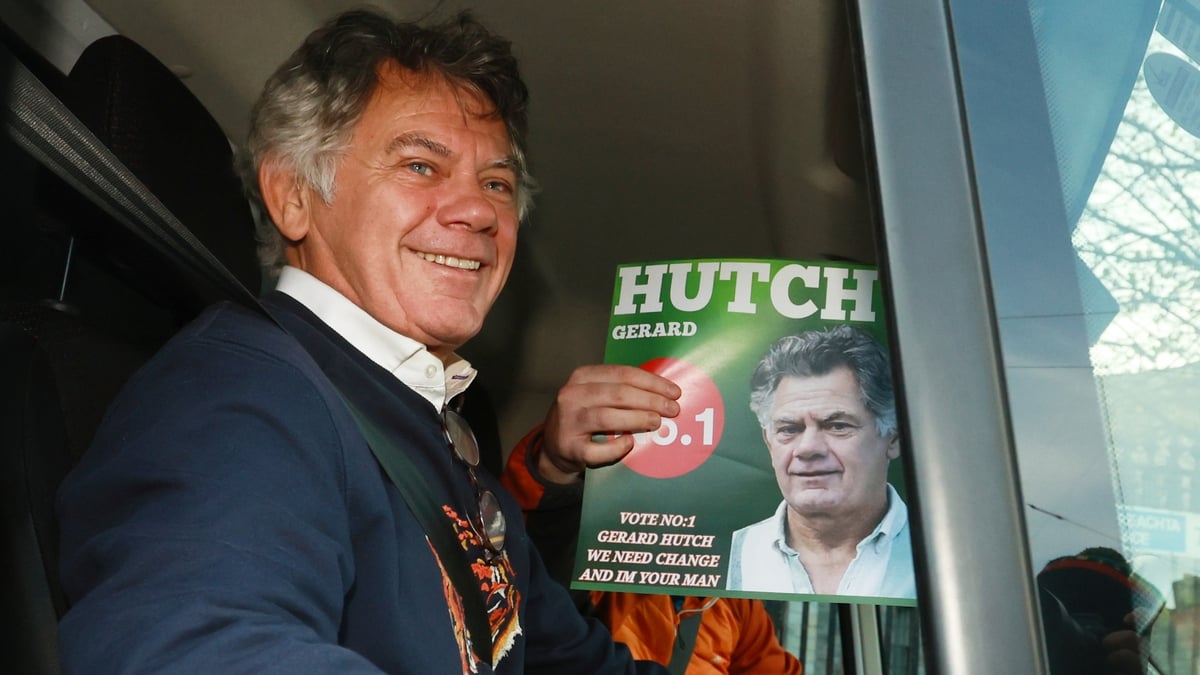
Gerry Hutch, the Dublin man acquitted of murder charges in one of Ireland's most high-profile criminal trials, has confirmed his intention to register as an independent candidate in the Dublin Central by-election scheduled for 22 May 2026 — a candidacy that has generated significant public and political reaction and adds a dramatic dimension to an already competitive contest.
The by-election was called following the resignation of former Minister for Finance Paschal Donohoe, who has accepted a senior role at the World Bank. Hutch, known as "The Monk," is seeking a running mate to help maximise his vote through transfers, mirroring the strategy he employed in the 2024 general election, when he secured 3,098 first-preference votes — 9.5% of the total — and was only eliminated on the 11th and final count.
Background
Gerry Hutch's emergence as a political figure is one of the most extraordinary stories in recent Irish public life. Acquitted in 2023 of the murder of David Byrne at the Regency Hotel in Dublin — a killing that took place in the context of the bloody Kinahan-Hutch feud that claimed 18 lives — Hutch returned to Ireland and, within a year, stood for election to the Dail. The Special Criminal Court, in acquitting him, nonetheless described him as the head of an organised crime group, a characterisation that has followed him into his political career.
His 2024 general election campaign in Dublin Central attracted intense media attention and a surprisingly strong vote, reflecting deep disillusionment with mainstream politics among some voters in the historically working-class constituency. Hutch cultivated a "folk hero" image through community engagement and a populist platform focused on housing, drug dealing, community safety, and the cost of living — issues that resonate strongly in a constituency that has experienced significant social change in recent decades.
The Dublin Central by-election is set to be highly competitive, with declared candidates including Dublin's Lord Mayor Ray McAdam for Fine Gael, Janice Boylan for Sinn Fein, Ruth O'Dea for Labour, and representatives from the Social Democrats, Green Party, and People Before Profit. Hutch's entry into the race adds an unpredictable element to a contest that was already expected to be closely fought.
Key Developments
Hutch confirmed his candidacy on 25 April 2026, announcing his intention to register and return to Ireland for the campaign. He has used social media to launch his campaign and encourage voter registration, and is reportedly seeking a running mate to help maximise his vote through the transfer system. His campaign themes mirror those of his 2024 run: improving community safety, tackling drug dealing, addressing the housing crisis, and combating the rising cost of living.
The reaction to his candidacy has been sharply divided. Some voters in Dublin Central express deep disillusionment with mainstream politics and see Hutch as an agent of change who is "one of us" — a sentiment that drove his strong showing in 2024. Others are "appalled" at his candidacy, arguing that a man described by the courts as the head of an organised crime group has no place in democratic politics. Political parties have largely declined to engage directly with Hutch, preferring to focus on their own candidates and platforms.
Why It Matters
Hutch's candidacy raises profound questions about the relationship between criminal justice, democratic participation, and public trust in institutions. His acquittal means he is legally entitled to stand for election, and his strong showing in 2024 demonstrates that a significant minority of voters in Dublin Central are willing to support him. The by-election will test whether that support holds in a lower-turnout contest, and whether his search for a running mate can translate into a seat in the Dail.
More broadly, Hutch's political career reflects a wider phenomenon of voter disillusionment with mainstream parties that has been observed across Ireland and Europe in recent years. His ability to attract nearly 10% of the vote in a general election — despite, or perhaps because of, his extraordinary background — speaks to a deep frustration with conventional politics that established parties ignore at their peril.
Local Impact
In Belfast and across Northern Ireland, the Dublin Central by-election is being watched with considerable interest, not least because of the cross-border dimensions of the Kinahan-Hutch feud, which had connections to criminal networks operating across the island. Hutch's political career is a reminder of the complex relationship between organised crime, community politics, and democratic participation that exists in parts of both jurisdictions.
For observers of Irish politics more broadly, the by-election offers a fascinating case study in how democratic systems respond to candidates whose backgrounds sit far outside the conventional political mainstream. The result on 22 May will be closely scrutinised for what it reveals about the state of Irish public opinion.
What's Next
The Dublin Central by-election is scheduled for 22 May 2026. Hutch is expected to formally register his candidacy in the coming days and begin active campaigning. Full details of the contest are available from RTE News and Wikipedia's by-election page.