Four Courts Dome Restoration Unveiled After Decade-Long Project
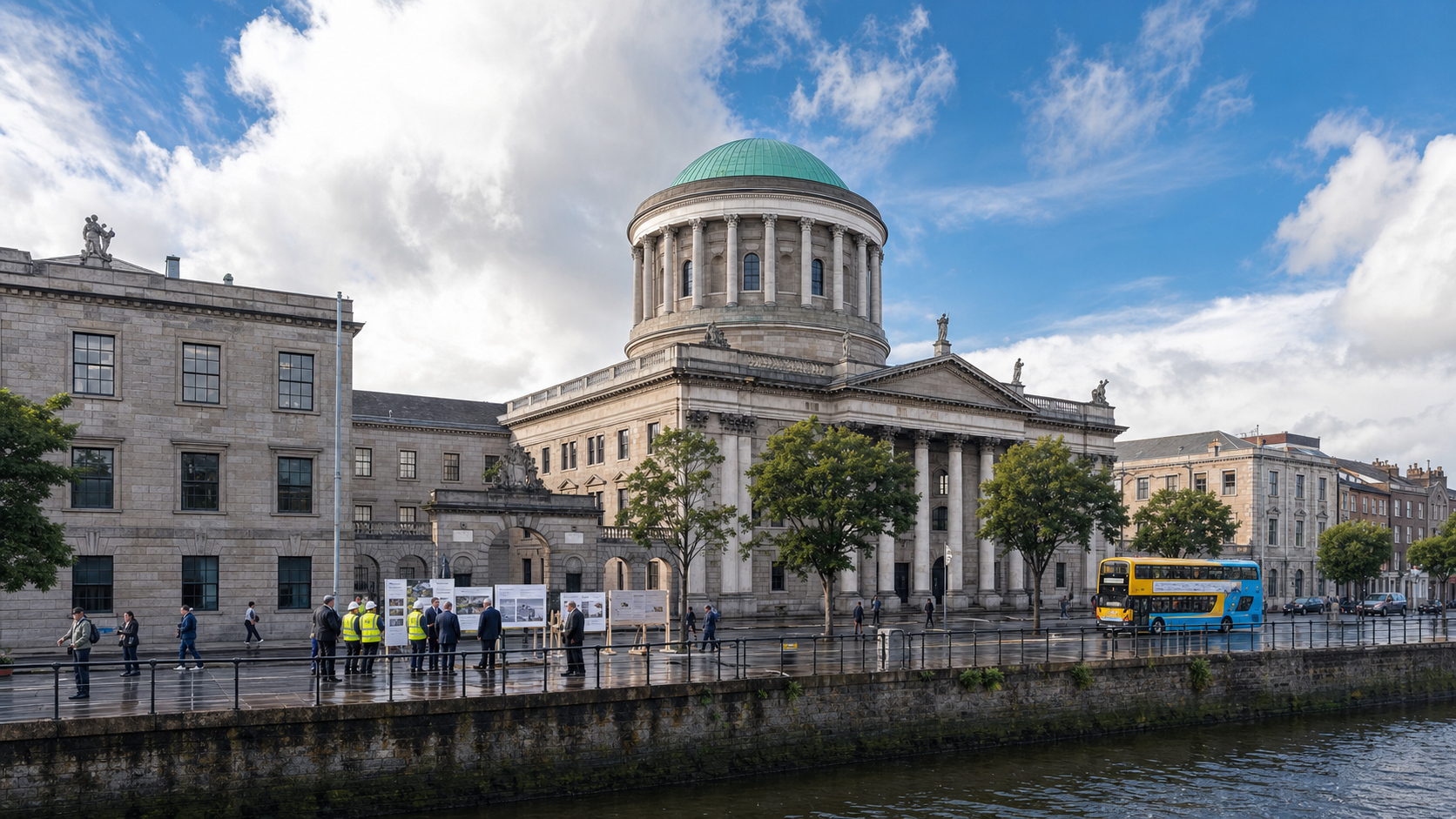
The restored copper dome of the Four Courts, James Gandon's neoclassical masterpiece completed in 1802 and one of Dublin's most recognisable landmarks, has been unveiled after a decade-long conservation project that has returned the building to its original splendour and secured its structural integrity for at least another century, in what the Office of Public Works has described as the most significant heritage conservation project in the history of the Irish state.
Background
The Four Courts on Inns Quay has been the centre of the Irish legal system since its completion in 1802. Designed by James Gandon — the English-born architect who also designed the Custom House and the eastern portico of the Bank of Ireland on College Green — the building is considered one of the finest examples of neoclassical architecture in the British Isles. Its central drum and copper dome, rising 44 metres above the Liffey quays, has been a defining element of Dublin's skyline for more than two centuries.
The building suffered catastrophic damage during the Irish Civil War in 1922, when anti-Treaty forces who had occupied it were shelled by Free State troops using artillery borrowed from the British Army. The resulting fire and explosion destroyed the Public Record Office, which was housed in the building's western wing, along with centuries of irreplaceable historical documents. The building was subsequently rebuilt, but the restoration was not entirely faithful to Gandon's original design, and the dome in particular suffered from the use of inferior materials in the post-Civil War reconstruction.
The current restoration project, which began in 2016, was prompted by a structural survey that found significant deterioration in the dome's copper cladding, the cast-iron framework beneath it, and the stone drum on which it sits. The survey estimated that without intervention, the dome would require emergency closure within ten years.
Key Developments
The restoration project, managed by the Office of Public Works in partnership with conservation architects Shaffrey Associates, involved the complete removal and replacement of the dome's copper cladding, the repair and reinforcement of the cast-iron framework, and the cleaning and repointing of the stone drum. The project also included the restoration of the building's four corner pavilions and the cleaning of the Portland stone facade, which had accumulated more than a century of atmospheric pollution.
The new copper cladding was fabricated by specialist craftsmen in Germany and installed by a team of Irish and European conservation specialists over a period of three years. The copper has been treated with a patination process that will allow it to develop the characteristic green verdigris of aged copper over the next decade, eventually matching the appearance of the original dome.
Minister for Public Expenditure Paschal Donohoe, who attended the unveiling ceremony on Friday, described the project as "a gift to future generations" and said it demonstrated the Government's commitment to preserving Ireland's built heritage. He confirmed that the total cost of the project was €47 million, funded entirely by the Exchequer.
The Courts Service, which administers the building, confirmed that the restoration had also included significant improvements to the building's accessibility, including the installation of a new lift serving all floors and the creation of a dedicated public gallery in the Round Hall beneath the dome. The gallery, which will open to the public on weekdays, will include an exhibition on the history of the building and the Irish legal system.
Why It Matters
The Four Courts dome restoration matters because it represents a commitment to the long-term stewardship of Ireland's built heritage at a time when the pressure to prioritise immediate economic needs over cultural conservation is intense. The €47 million investment is substantial, but it is dwarfed by the cost of losing the building — a cost that would be measured not just in financial terms but in the irreplaceable loss of a cultural and historical asset that belongs to all Irish people.
The project also matters as a demonstration of what is possible when conservation expertise, public funding, and institutional commitment are aligned. The decade-long timeline reflects the complexity and care required to restore a building of this significance, and the result — a dome that will be structurally sound for at least another century — justifies the investment.
For Dublin's skyline, the restoration is a visual statement about the city's relationship with its own history. The Four Courts dome, visible from the quays and from many points across the city, is one of the landmarks that gives Dublin its distinctive character. Its restoration in pristine condition is a reminder that the city's Georgian and neoclassical heritage is not a burden to be managed but an asset to be celebrated.
Local Impact
The restoration has been welcomed by residents and businesses along the Inns Quay and the surrounding area, who have lived with the scaffolding and construction activity for the better part of a decade. The removal of the scaffolding has transformed the view from the quays, with the dome now visible in its full glory for the first time since 2016. The new public gallery in the Round Hall is expected to attract significant visitor numbers, with the OPW estimating 50,000 visitors per year. Local tourism businesses — hotels, restaurants, and tour operators — have welcomed the gallery as a new attraction that will draw visitors to the north quays, an area that has historically been less visited than the south side of the city centre. The Law Society of Ireland has said it will incorporate the restored building into its heritage education programme for law students.
What's Next
The public gallery in the Round Hall will open to visitors from Monday June 22, with free admission on weekdays between 10am and 4pm. The OPW will publish a detailed conservation report on the project in September, which will be made available to heritage professionals and researchers. The Courts Service has confirmed that the building will be included in this year's European Heritage Open Days programme in September, with special guided tours of areas not normally accessible to the public. The OPW is also planning a photographic exhibition documenting the restoration process, which will tour to venues across Ireland from October.