Fórsa, SIPTU and INMO Announce September 30 Health Worker Industrial Action Over Pay Agreement Failure
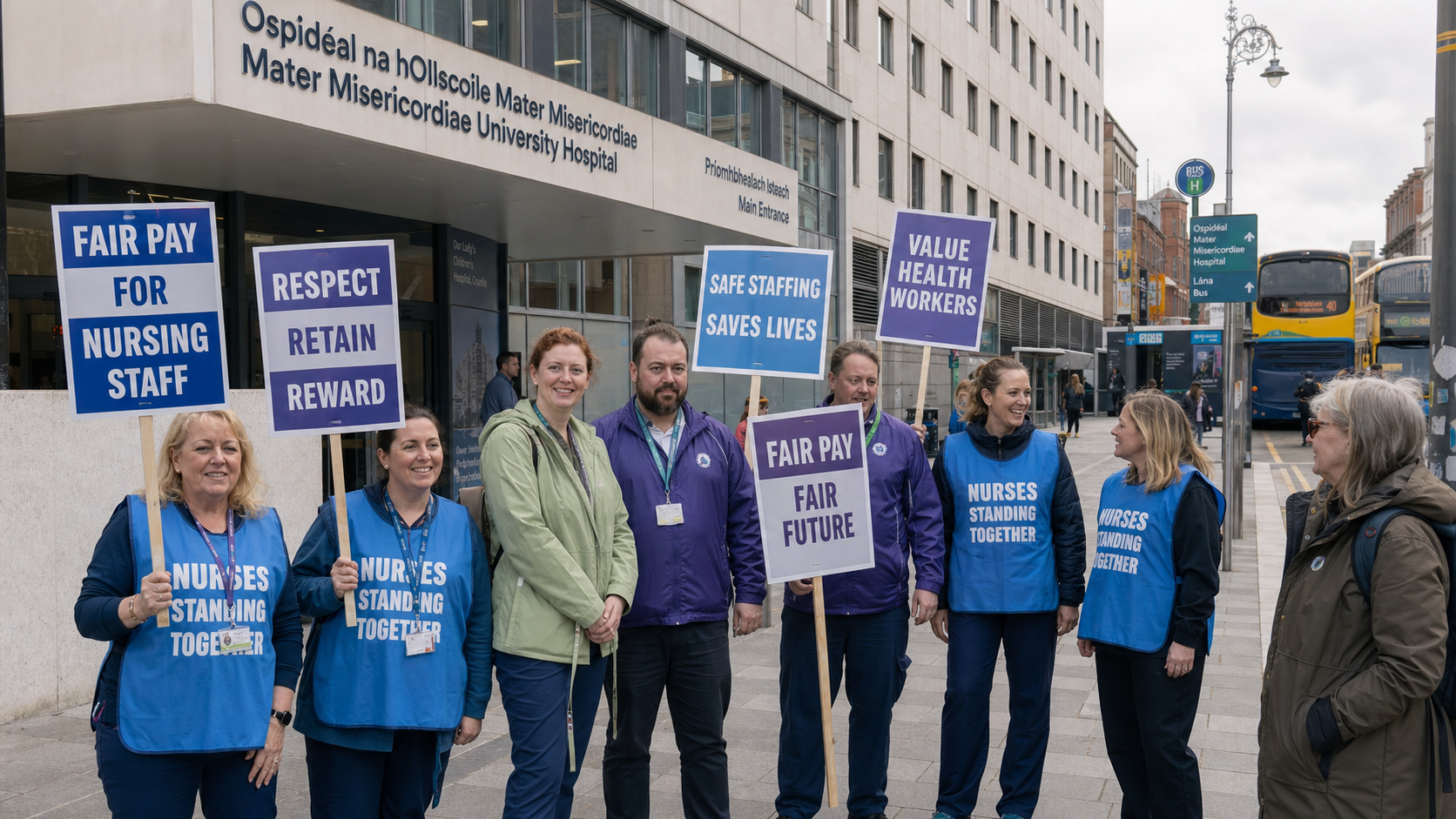
Three of Ireland's largest health worker unions — Fórsa, SIPTU, and the Irish Nurses and Midwives Organisation — have announced a campaign of industrial action beginning September 30, after the government failed to establish a forum for negotiating a successor to the public service pay agreement that expired in June 2026. The action, which will affect services across the HSE's network of hospitals and community health facilities, comes as the health service faces a projected year-end spending overrun of approximately €700 million and as the government prepares to announce Budget 2027 on October 6.
Background
The public service pay agreement that expired in June 2026 covered a wide range of workers across the health, education, and civil service sectors, and its expiry has left tens of thousands of health workers without a framework for pay negotiations. The three unions — Fórsa, which represents a range of health and public service workers; SIPTU, the country's largest trade union; and the INMO, which represents nurses and midwives — have been seeking the establishment of a new negotiating forum since the summer, but the government has been slow to respond, citing the complexity of the fiscal situation and the need to manage the HSE's projected spending overrun.
The HSE's financial situation has been a source of significant concern throughout 2026. An internal audit published earlier this week identified a projected year-end spending overrun of approximately €700 million, with the health service already over budget by that amount by late August. The audit also raised concerns about the appointment of non-EU doctors without adequate checks on English language proficiency or police clearance, and the HSE is expected to appear before the Dáil Public Accounts Committee to account for a reported €1 billion deficit in its 2025 financial statements.
The industrial action announced by the three unions is the latest in a series of disputes affecting the Irish public service, following the Garda Representative Association's announcement of overtime refusals in October and the ongoing dispute between the government and SIPTU over the October 14 health worker strike. The cumulative effect of these disputes is a public services landscape under significant strain as the government prepares its most important annual fiscal event.
Key Developments
The industrial action announced by Fórsa, SIPTU, and the INMO will begin on September 30 and will involve a range of measures designed to disrupt non-essential services while maintaining emergency and critical care. The specific measures have not yet been fully detailed, but union leaders have indicated that the action will escalate if the government does not engage meaningfully with their demands before the end of September. The unions have called on the government to establish a new pay negotiating forum before October 6 — Budget Day — and have warned that the failure to do so will result in a significant intensification of the action.
Minister for Health Jennifer Carroll MacNeill has expressed concern about the scale of the HSE's projected spending overrun, and has indicated that the government is implementing strict controls on recruitment and spending in the health service. The minister has also acknowledged that the transition to public-only contracts in hospitals has resulted in an estimated income shortfall of nearly €56 million, adding to the financial pressure on the health service. The government has indicated that it will engage with the unions through the appropriate industrial relations channels, but has stopped short of committing to the establishment of a new pay negotiating forum before Budget Day.
The INMO has been particularly vocal in its criticism of the government's approach, arguing that nurses and midwives — who were at the forefront of the response to the Covid-19 pandemic — are being asked to accept a pay freeze at a time when the cost of living continues to rise and when the health service is struggling to recruit and retain staff. The union has pointed to the significant number of nursing posts that remain unfilled across the HSE's network as evidence that the current pay levels are not sufficient to attract and retain the workforce that the health service needs.
Why It Matters
The health worker industrial action matters because it threatens to disrupt services that are already under severe pressure. Northern Ireland's waiting lists have reached record levels, and the Republic's HSE is facing a similar crisis, with hundreds of thousands of patients waiting for outpatient appointments, diagnostic tests, and elective procedures. Any disruption to health services — even if limited to non-emergency care — will add to the backlog and will have real consequences for patients who are already waiting longer than they should for treatment.
The broader significance of the dispute lies in what it says about the sustainability of the Irish public service pay model. The government's approach — of managing pay through a series of time-limited agreements, with the threat of industrial action as the primary mechanism for forcing engagement — has been criticised by unions and by independent analysts as inefficient and damaging to staff morale. The failure to establish a new pay negotiating forum before the expiry of the previous agreement reflects a degree of complacency about the importance of maintaining good industrial relations in the public service, and the consequences of that complacency are now becoming apparent.
Local Impact
The industrial action will be felt across the HSE's network of hospitals and community health facilities, from the major teaching hospitals in Dublin, Cork, and Galway to the smaller district hospitals and primary care centres in rural areas. In Dublin, the Mater Hospital, St Vincent's University Hospital, and Beaumont Hospital have all been in contact with their staff about the implications of the action for service delivery. In Cork, the Cork University Hospital and the Mercy University Hospital have similarly been preparing contingency plans. In Galway, University Hospital Galway has indicated that it will maintain emergency and critical care services throughout the action, but that some elective procedures may need to be rescheduled. The HSE has confirmed that it will publish a detailed contingency plan before September 30, setting out the specific services that will be affected and the arrangements that will be in place to maintain patient safety.
What's Next
The industrial action is scheduled to begin on September 30, with the unions reviewing the situation after the first day of action and deciding whether to escalate or to suspend the measures if the government engages meaningfully with their demands. The government is expected to make a statement on the dispute before the end of September, and the Labour Court has indicated that it is available to assist the parties in reaching a resolution. Budget 2027, due to be announced on October 6, will be a key moment for the government to signal its intentions on public service pay, and the unions will be watching closely to see whether the budget includes any measures that address their concerns. The SIPTU-led October 14 health worker strike, which was announced separately, remains on course, and the government will be anxious to avoid a situation where multiple health worker disputes are running simultaneously in the weeks before and after Budget Day.