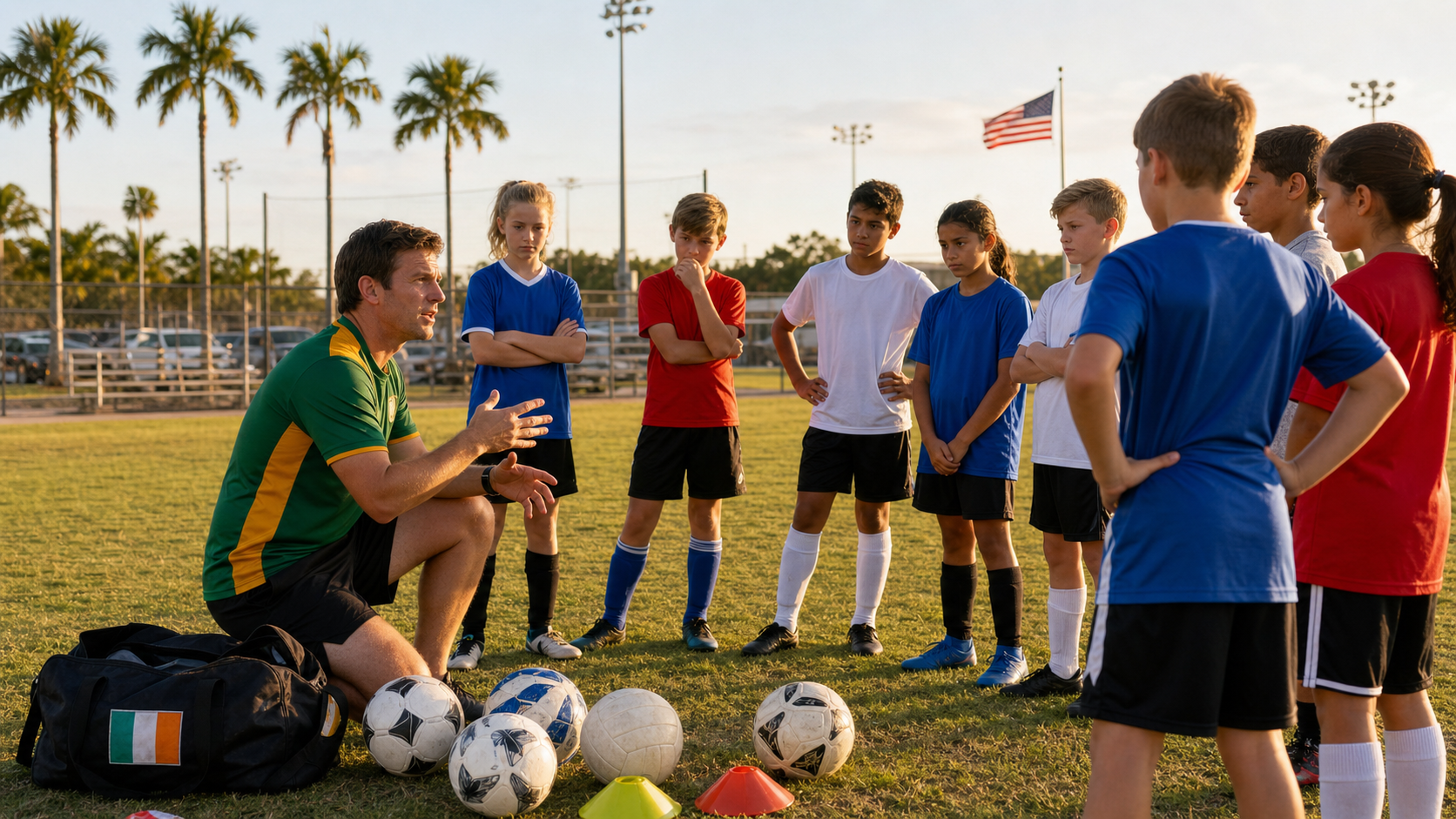
On the sun-drenched training pitches of central Florida, a Donegal-born soccer coach is quietly doing what generations of Irish emigrants have always done — bringing the values, discipline, and passion of home to a new country and making it their own.
Seán Gallagher, who grew up playing GAA football in the Donegal Gaeltacht before emigrating to the United States six years ago, now coaches youth soccer teams in the Orlando area, working with players aged between eight and sixteen across several local clubs. His approach, shaped by years of GAA training and the distinctive culture of Donegal football, has made him one of the most sought-after youth coaches in the region.
"The GAA gave me everything," Gallagher told The Irish Times from his home in Orlando. "The discipline, the teamwork, the sense of community — those values don't change just because you're coaching soccer instead of football. Kids respond to the same things everywhere. They want to be challenged, they want to feel part of something, and they want to know that someone believes in them."
Gallagher's story is one that resonates across the Irish diaspora in the United States, where a growing number of Irish coaches, teachers, and sporting figures are making their mark on American youth sport. From soccer to athletics, swimming to rugby, Irish emigrants are bringing their distinctive sporting culture to communities across the country, often finding that the values instilled by the GAA and other Irish sporting organisations translate remarkably well to the American context.
The Irish consulate in Chicago recently published its Greenlight Newsletter for June/July 2026, highlighting the activities of Irish communities across the Midwest and noting the significant contribution that Irish emigrants are making to sporting and cultural life in their adopted communities. Similar stories are emerging from Irish communities in Boston, New York, San Francisco, and across the Sun Belt states, where Irish emigration has accelerated in recent years.
For Gallagher, the connection to home remains strong despite the distance. He returns to Donegal each summer, bringing some of his American players with him for coaching camps that give them a taste of Irish sporting culture. Several of his former players have gone on to earn college scholarships, a source of enormous pride for a coach who arrived in Florida with little more than his coaching badges and a determination to make a go of it.
"The kids here are incredibly talented and incredibly motivated," he says. "But what I try to give them is something beyond technique — a sense of what sport is really about, what it means to be part of a team, to sacrifice for each other, to keep going when things are hard. That's what the GAA taught me, and it's what I try to pass on."
The Irish government's diaspora strategy, launched at Croke Park earlier this month, includes specific commitments to support Irish sporting and cultural figures working abroad, recognising the important role they play in maintaining connections between Ireland and its global community. Gallagher said he was encouraged by the strategy's ambitions, though he noted that practical support for Irish coaches working overseas remained limited.
The strategy commits to expanding the network of Irish cultural and sporting organisations abroad and to providing greater resources for diaspora communities to maintain their connections with home. For coaches like Gallagher, who operate largely on their own initiative and without formal institutional support, the prospect of greater engagement from the Irish government is welcome, if long overdue.
Back in Donegal, Gallagher's family follow his progress with pride. His mother, who still lives in the Gaeltacht village where he grew up, watches videos of his training sessions on her phone and marvels at the transformation her son has undergone since leaving home. "He was always passionate about sport," she says. "But to see him doing this, building something in America — it makes us very proud."
As the 2026 World Cup captures the imagination of sports fans across the globe, Gallagher's young players are more excited about soccer than ever. Several of them have been following Ireland's qualification campaign with interest, and Gallagher has been using the tournament as a teaching tool, drawing lessons from the performances of international teams to illustrate the tactical and psychological aspects of the game.
For the Irish diaspora in Florida and beyond, coaches like Gallagher represent something important — a living connection to home, a reminder of where they came from, and a demonstration that the values of Irish sporting culture can thrive and flourish in the most unexpected of places. In the sun-drenched suburbs of Orlando, a little piece of Donegal lives on.