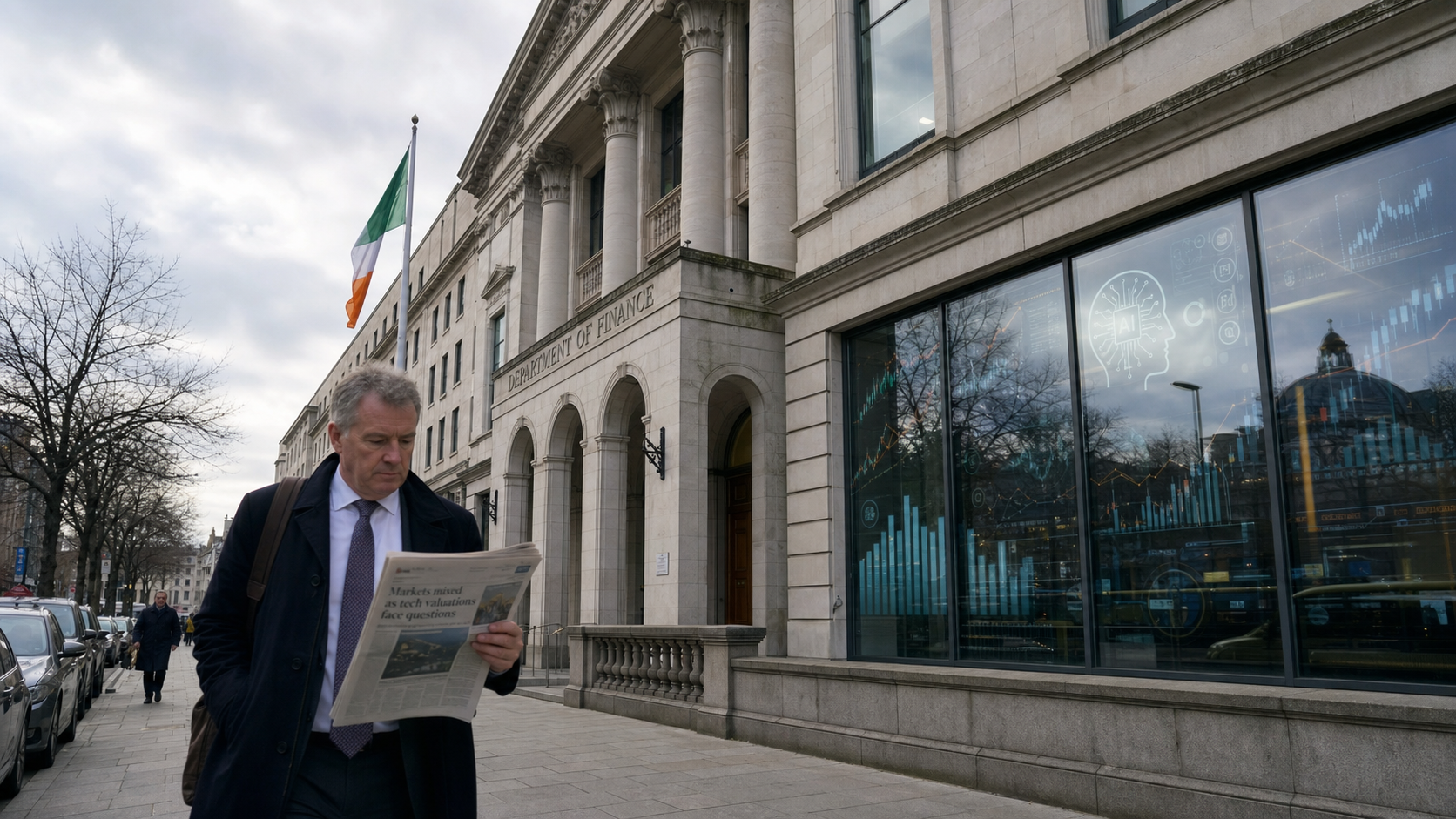
Department of Finance Warns AI Bubble Burst Could Threaten Irish Economic Stability
The Department of Finance has published research warning that a bursting of the current technology investment bubble — driven in part by elevated expectations around artificial intelligence — could pose a significant risk to the Irish economy, with potential declines in employment and weakened growth if US stock markets experience a major correction, even as the government finalises a €1.5 billion tax package for Budget 2027.
Background
Ireland's economy has become deeply intertwined with the fortunes of the global technology sector over the past three decades. The country's success in attracting major US technology companies — including Apple, Google, Meta, Microsoft, and many others — has transformed the Irish economy, generating substantial corporation tax revenues, creating tens of thousands of high-paying jobs, and establishing Ireland as one of the most significant technology hubs in Europe. However, this concentration of economic activity in a single sector and a single geographic source — the United States — has also created significant vulnerabilities.
The current period of elevated technology valuations, driven in large part by investor enthusiasm for artificial intelligence and related technologies, has created conditions that some economists regard as characteristic of an asset bubble. The rapid appreciation of technology stocks, the high valuations placed on AI-related companies, and the concentration of investment in a relatively small number of large technology firms have drawn comparisons with previous periods of speculative excess, including the dot-com bubble of the late 1990s.
Ireland's exposure to a potential technology sector correction is particularly acute given the structure of its economy. Corporation tax revenues from the technology sector account for a disproportionate share of the Irish exchequer's income, and any significant reduction in the profitability of major technology companies — whether through a market correction, regulatory action, or changes in business models — would have immediate and significant consequences for the Irish public finances.
Key Developments
The Department of Finance research, published as part of its ongoing economic monitoring programme, identifies the potential bursting of the technology investment bubble as one of the primary downside risks to the Irish economic outlook. The research warns that a significant correction in US stock markets — particularly in the technology sector — could lead to declines in employment in Ireland's technology sector, reduced corporation tax revenues, and weakened economic growth across the broader economy.
The research notes that the Irish economy has demonstrated considerable resilience in the face of previous external shocks, including the global financial crisis of 2008 and the Covid-19 pandemic. However, it cautions that the current level of concentration in the technology sector creates a specific vulnerability that is different in character from the risks that Ireland has successfully managed in the past. The department recommends continued diversification of the economic base and the maintenance of fiscal buffers — including the National Reserve Fund — as insurance against a potential technology sector downturn.
The warning comes as the government is finalising a €1.5 billion tax package for Budget 2027, which is expected to be the tightest budget since the pre-Covid period. The tax package, which is intended to improve disposable income for workers, is being developed against a backdrop of intense internal government discussions about the appropriate balance between tax cuts and public spending increases.
Why It Matters
The Department of Finance's warning is a significant intervention in the ongoing debate about the sustainability of Ireland's economic model. The country's dependence on corporation tax revenues from a small number of large technology companies has been a recurring concern for economists and fiscal analysts, and the current period of elevated technology valuations has intensified those concerns. A major correction in technology stocks would not only reduce corporation tax revenues but could also trigger significant job losses in the sector, with knock-on effects for the broader economy.
The timing of the warning — as the government is preparing Budget 2027 — is significant. The budget process requires the government to make decisions about public spending and taxation based on assumptions about future economic performance, and the Department of Finance's assessment of the risks to those assumptions will inform those decisions. A more cautious approach to spending commitments, driven by concern about the sustainability of current revenue levels, could have significant implications for public services and infrastructure investment.
The broader question of Ireland's economic model — and the extent to which the country should seek to diversify away from its dependence on the technology sector — is one that has been debated for years without a clear resolution. The Department of Finance's research adds urgency to that debate and may prompt renewed political attention to the question of how Ireland can build a more resilient and diversified economic base.
Local Impact
For workers in Ireland's technology sector — concentrated primarily in Dublin but with significant presences in Cork, Limerick, and Galway — the Department of Finance's warning is a reminder of the potential fragility of their employment situation. The technology sector has been a source of high-paying, stable employment for tens of thousands of Irish workers, and the prospect of a significant correction in the sector is a source of genuine anxiety for those whose livelihoods depend on it.
For the Irish exchequer, the implications of a technology sector downturn would be severe. Corporation tax revenues have been running at historically high levels in recent years, providing the government with the fiscal space to increase public spending and reduce taxes simultaneously. A significant reduction in those revenues would force difficult choices about the pace of public investment and the sustainability of current spending commitments.
What's Next
Budget 2027 is expected to be presented to the Dáil in October 2026, with the Department of Finance's economic assessment providing the framework within which the government's fiscal decisions will be made. The National Reserve Fund, which has been built up over recent years as a buffer against future economic shocks, will be a key element of the government's response to any technology sector downturn. The Department of Finance is expected to publish its full pre-budget economic outlook in September 2026, which will provide a more detailed assessment of the risks and opportunities facing the Irish economy in the coming year.