Dalymount Park's €63.75 Million Redevelopment Moves Forward Under Revised Construction Plan
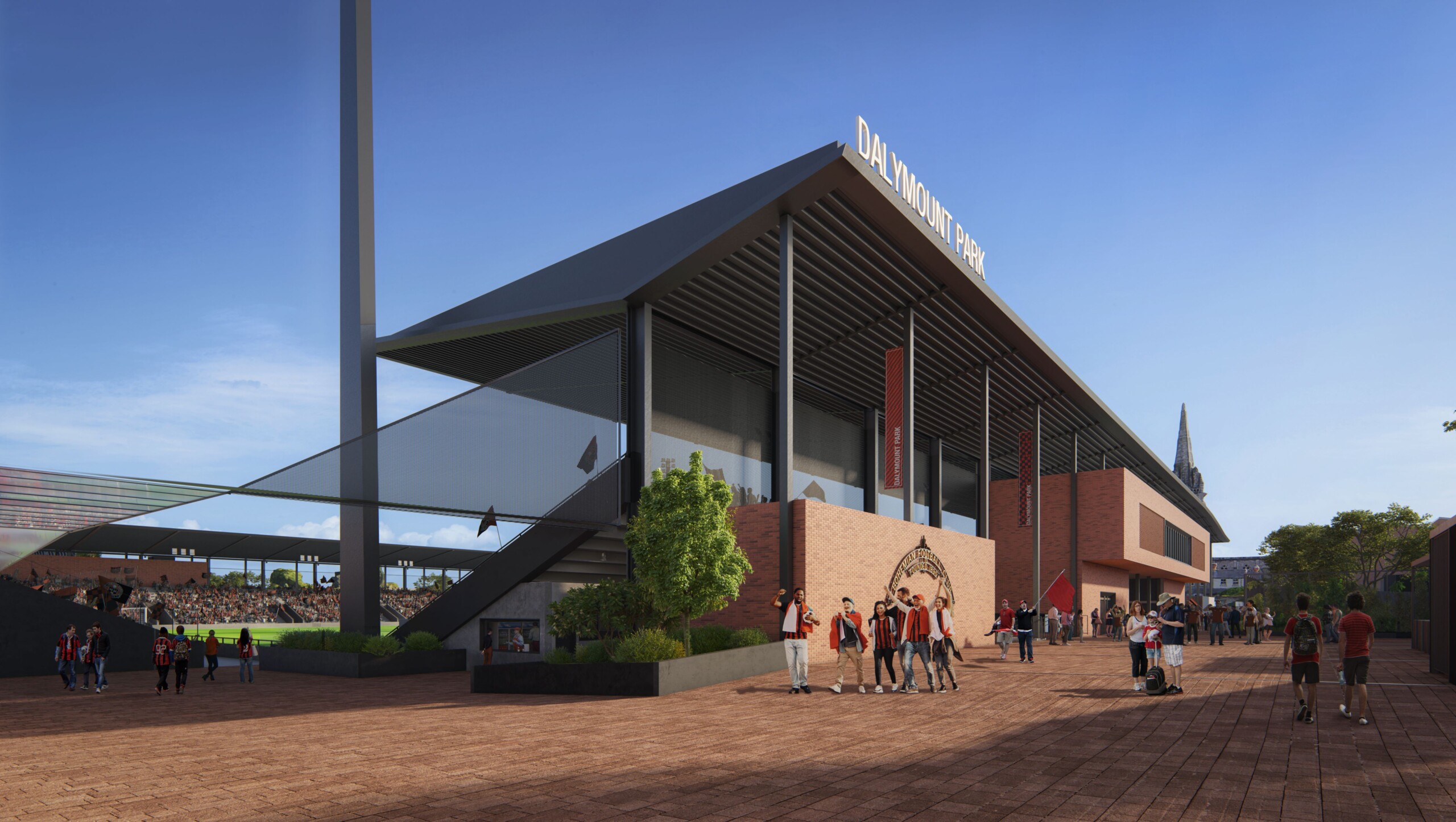
Dublin City Council has adopted a revised construction plan for the €63.75 million redevelopment of Dalymount Park, clearing the way for construction to begin following the conclusion of the 2026 League of Ireland season in October. The scaled-back design, which removes a 622 square metre basement area and relocates player facilities to a new single-storey building at the northern end of the West Stand, maintains the stadium's capacity at 8,039 and is expected to deliver practical completion by the end of 2028.
Background
Dalymount Park occupies a unique place in Irish football history. The ground in Phibsborough, north Dublin, has hosted international matches, cup finals, and decades of League of Ireland football since its opening in 1901, and its name carries a weight of association that no modern stadium can replicate. But the weight of history has not protected it from the ravages of time and underinvestment. By the early 2020s, Dalymount was one of the most dilapidated football grounds in the country — a crumbling monument to a sport that had failed to invest in its own infrastructure.
The redevelopment project, which will see Dalymount transformed into a modern, accessible stadium for Bohemian FC, has been in planning for years. The original design envisaged a more ambitious structure, but escalating construction costs — a problem that has affected infrastructure projects across Ireland — forced a redesign. The revised plan, which went through a Part 8 planning process earlier in 2026, strips back some of the more complex elements while preserving the core ambition: a stadium that Bohemian supporters can be proud of and that serves the Phibsborough community as a genuine civic asset.
The funding package is a patchwork of public and private sources. The government has contributed €25.6 million, with €2.6 million from development levies, €1 million from a long-term lease of Tolka Park to Shelbourne FC, and €500,000 from UEFA. The remaining shortfall of over €34 million will be covered by Dublin City Council borrowing, repaid through match-day and non-match-day revenue from the completed stadium.
Key Developments
The revised design, confirmed by Dublin City Council on Wednesday, introduces several modifications to manage costs without compromising the stadium's fundamental character. The removal of the basement area simplifies the construction process considerably, while the relocation of player facilities to a new single-storey building at the northern end of the West Stand reduces the structural complexity of the main stand. The roof design for the East and West stands has been altered to a simpler V-shaped steel structure, and the concourse areas have been reconfigured to improve spectator flow and segregation.
Despite the scaling back, the stadium's capacity will actually increase slightly from the original 8,000 to 8,039, comprising 6,245 seated and 1,794 standing places. The project also includes an updated attenuation drainage system, a new groundwater well for pitch irrigation, and improved accessibility throughout the ground, ensuring that Dalymount will be fully compliant with modern disability access standards for the first time in its history.
Construction is scheduled to begin in October 2026, following the conclusion of the League of Ireland season, with practical completion targeted for the end of 2028. Bohemian FC will play their home matches at an alternative venue during the construction period; discussions with Dublin City Council about a temporary home are ongoing.
Why It Matters
The Dalymount redevelopment matters because it represents a commitment to the League of Ireland as a sport worth investing in. For too long, Irish football has operated in facilities that communicate, however unintentionally, a message of second-class status. A modern, well-appointed stadium in the heart of north Dublin sends a different message — that domestic football deserves the same quality of infrastructure as any other sport, and that the communities that support it deserve better than crumbling terraces and inadequate facilities.
The project also has significance for the Phibsborough area, which has undergone considerable change in recent years as Dublin's housing market has pushed development northward from the city centre. A revitalised Dalymount Park, with its community facilities and year-round programming, will be an anchor for the neighbourhood in a way that the current ground, for all its history, cannot be. Unlike the redevelopment of the Aviva Stadium, which serves a national rather than a local function, Dalymount is explicitly conceived as a community asset for north Dublin.
Local Impact
For Bohemian supporters in Phibsborough, Cabra, Glasnevin, and the wider north Dublin catchment, the confirmation of the revised plan is a relief after years of uncertainty. The club's temporary relocation during construction will be an inconvenience, but the prospect of returning to a transformed Dalymount in 2029 provides a clear horizon. Dublin Bus routes 9, 38, and 122 serve the Phibsborough area, and the council has committed to reviewing transport arrangements for match days once the new stadium is operational. Local businesses along the Phibsborough Road are anticipating increased footfall once the redeveloped ground opens.
What's Next
Construction is scheduled to begin in October 2026. Dublin City Council will publish a detailed construction programme and community liaison plan before work commences. Bohemian FC will confirm their temporary home ground arrangements by the end of August. The project will be subject to quarterly progress reviews, with the first due in January 2027. Practical completion is targeted for the end of 2028, with the stadium expected to host its first competitive match in the 2029 League of Ireland season.