Dáil Recalled Early from Summer Recess as Government Moves to Pause Fuel Excise Increases
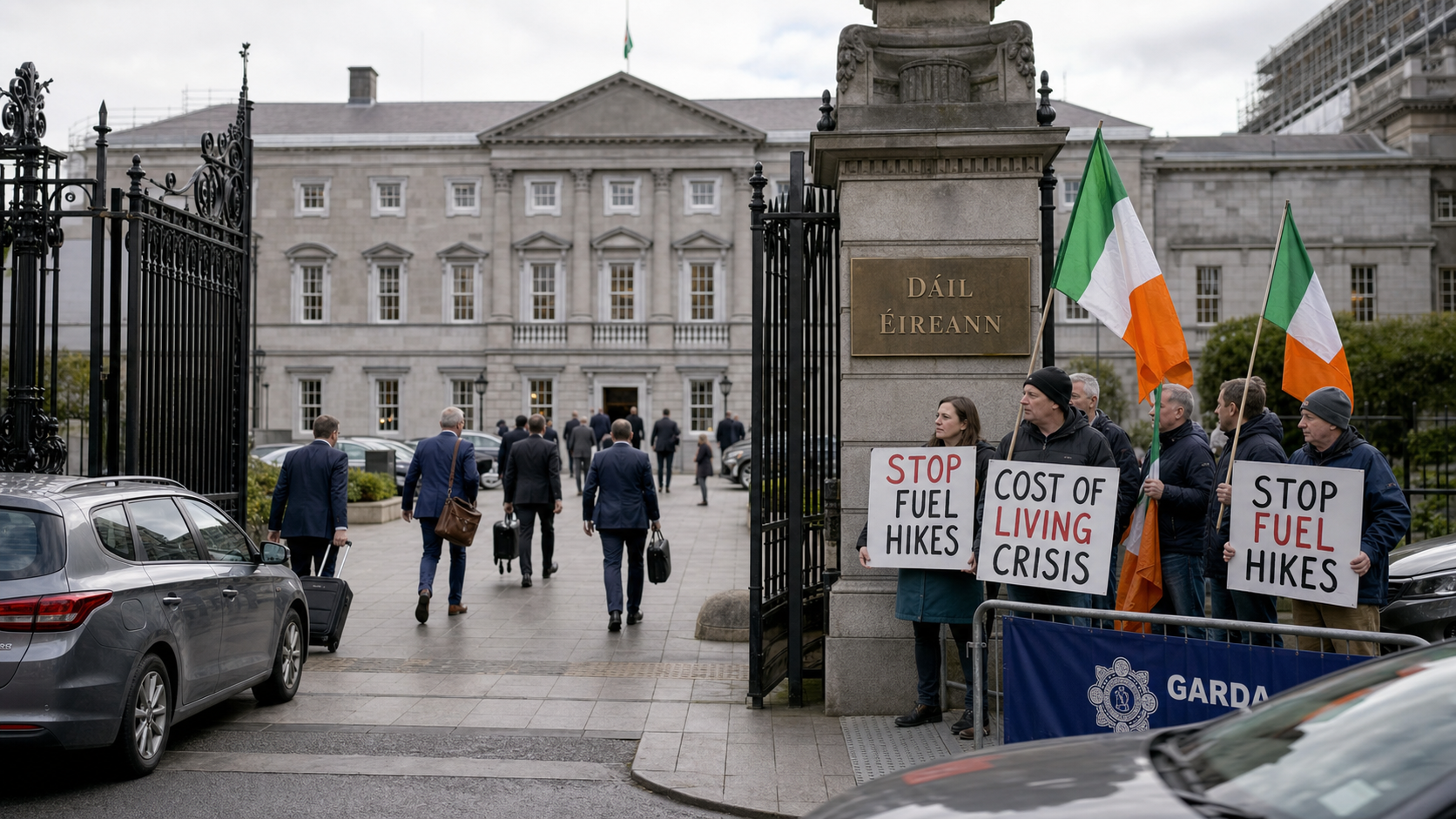
The Dáil is to return early from its summer recess on Friday, 28 August, to pass a financial resolution pausing planned fuel excise duty increases, as the government responds to rising oil prices driven by ongoing instability in the Middle East and mounting pressure from opposition politicians, government backbenchers, and the agriculture and haulage sectors.
Background
The Irish government introduced temporary reductions in fuel excise duty in early 2026 in response to price spikes linked to international conflict and supply disruptions. These reductions — amounting to 27 cent per litre on petrol and 32 cent per litre on diesel — were extended in June 2026 until 1 September, with a phased restoration of full excise rates planned over four months to avoid a "cliff edge" removal of the supports.
The phased restoration schedule, approved by Cabinet in June, provided for increases of 9 cent on petrol and 10 cent on diesel from 1 September, followed by further increases in October, November, and December. The plan was designed to gradually return excise rates to their pre-reduction levels while giving households and businesses time to adjust. However, the continued volatility of global oil prices — driven by the ongoing conflict in the Middle East and its impact on supply routes — has made the September increase politically and economically difficult to defend.
The recall of the Dáil from its summer recess is a relatively rare event, used only when the government judges that legislative action cannot wait until the scheduled return of the House. The last significant summer recall was in 2022, when the Dáil was brought back to address the energy crisis triggered by the Russian invasion of Ukraine. The decision to recall the House reflects the government's assessment that the political and economic cost of allowing the September excise increase to proceed outweighs the disruption of an early return.
Key Developments
The government confirmed on Sunday, 24 August, that the Dáil would return on Friday, 28 August, to pass a financial resolution pausing the planned excise increases for September and October. Minister for Enterprise Peter Burke acknowledged that the cost of pausing the duty hikes would be "significant" but emphasised the need to remain agile in response to global geopolitical instability.
The decision followed pressure from Sinn Féin leader Mary Lou McDonald, who had called for the recall, as well as concerns raised by government backbench TDs representing rural constituencies where the cost of fuel is a particularly significant household expense. The Irish Farmers' Association and the Irish Road Haulage Association had both lobbied strongly for the pause, arguing that the planned increases would have a disproportionate impact on sectors that are heavily dependent on diesel.
The financial resolution to be passed on Friday will pause the September and October increases — totalling 17 cent per litre on petrol and 18 cent per litre on diesel — while the government assesses the situation ahead of the October budget. The November and December increases remain on the schedule for now, but officials have indicated that these will be reviewed in light of oil price developments.
Why It Matters
The recall of the Dáil is a significant political moment that reflects the government's sensitivity to the cost-of-living issue ahead of the October budget. Fuel prices are one of the most visible and politically salient components of household costs, and the government has been acutely aware of the electoral consequences of being seen to allow pump prices to rise when it has the power to prevent it. The decision also reflects a broader tension in Irish fiscal policy: the government has been under pressure from the Irish Fiscal Advisory Council to reduce its reliance on temporary cost-of-living measures and to allow excise rates to return to normal levels, but the political reality of rising fuel prices has made this difficult to sustain. For the agriculture and haulage sectors, the pause is a welcome reprieve, but both industries have indicated that they want a longer-term commitment to fuel cost stability rather than a series of short-term extensions.
Local Impact
The pause in excise increases will benefit motorists across the country, but will have a particularly significant impact in rural areas where car dependency is highest and where public transport alternatives are limited. In counties like Roscommon, Leitrim, and Longford — where average commuting distances are among the highest in the country and where household incomes are below the national average — the cost of fuel represents a disproportionate share of household budgets. The Irish Road Haulage Association has estimated that the pause will save the average haulage operator approximately €3,000 per vehicle per year, a significant sum for smaller operators running fleets of five to ten trucks. Petrol station operators across the country have welcomed the decision, noting that the planned increases had been causing customers to reduce their fuel purchases in anticipation of the September rise.
What's Next
The Dáil will sit on Friday, 28 August, to pass the financial resolution. The session is expected to be brief, with the resolution passing with the support of the government parties and, in all likelihood, Sinn Féin, which had called for the recall. The government will then assess the situation ahead of the October budget, at which point a decision will be made on whether to extend the pause further or to allow the November and December increases to proceed. The Minister for Finance has indicated that any further extension would need to be costed and factored into the overall budget package.