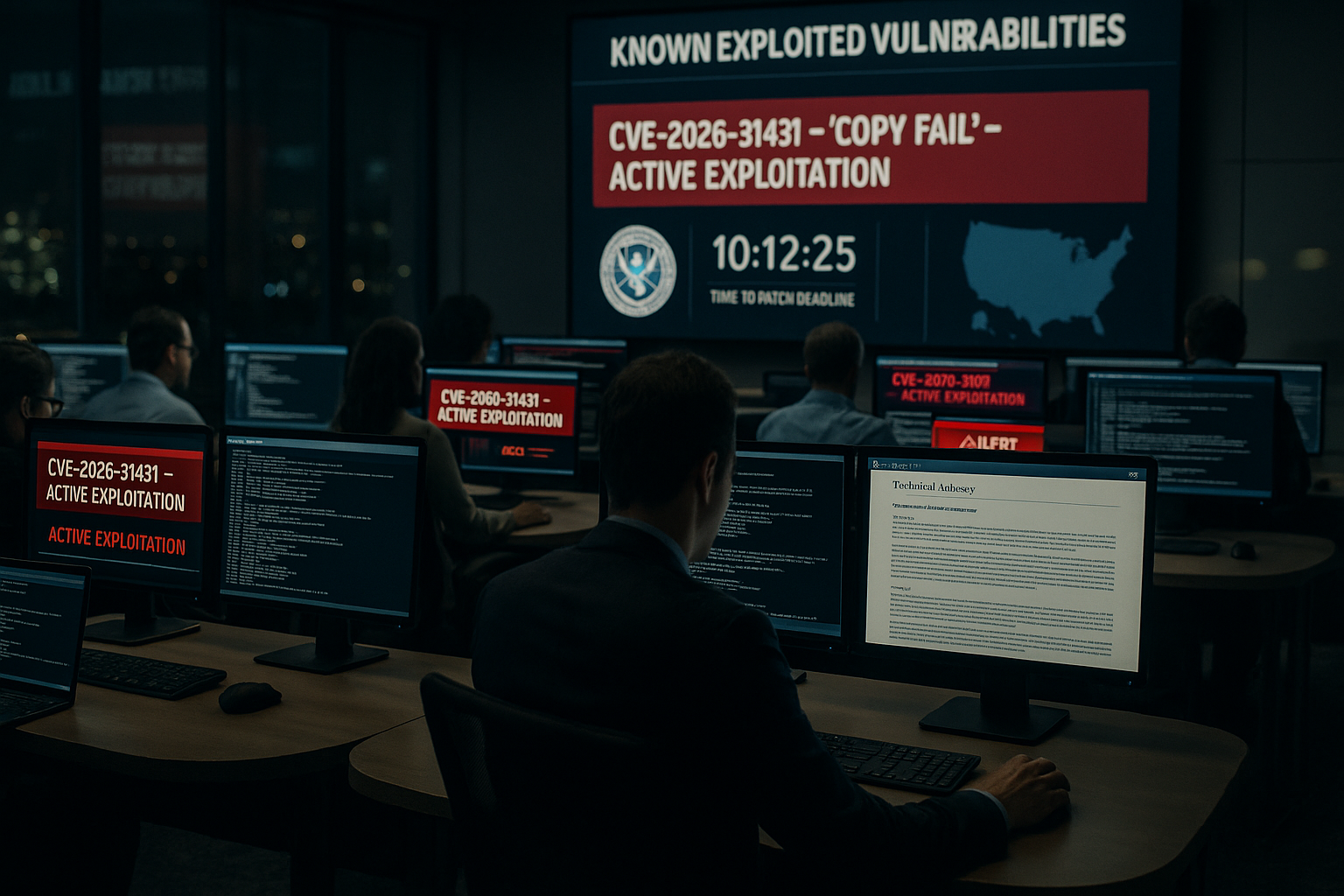
CISA Orders Federal Agencies to Patch Nine-Year-Old Linux Root Access Flaw Actively Exploited in the Wild
The US Cybersecurity and Infrastructure Security Agency added a high-severity Linux kernel vulnerability to its Known Exploited Vulnerabilities catalog on May 3, 2026, confirming that attackers are actively using the flaw — tracked as CVE-2026-31431 and nicknamed 'Copy Fail' — to gain full root access on unpatched systems. The bug, which has existed in the Linux kernel for nine years, affects all versions prior to 6.18.22 and carries a CVSS severity score of 7.8 out of 10.
Background
The Known Exploited Vulnerabilities catalog, maintained by CISA since November 2021, serves as the federal government's authoritative list of security flaws that have been confirmed as actively exploited by threat actors. When CISA adds a vulnerability to the KEV catalog, federal civilian executive branch agencies are legally required under Binding Operational Directive 22-01 to remediate the flaw within a specified timeframe — typically 14 to 21 days. The catalog has become a critical resource for private sector security teams as well, who use it to prioritize patching decisions across their own infrastructure.
Linux powers the vast majority of the world's servers, cloud infrastructure, and embedded systems. Unlike Windows, which has a centralized update mechanism, Linux distributions are maintained by dozens of independent vendors — Red Hat, Ubuntu, Debian, SUSE, and others — each of which must independently backport security patches to their supported kernel versions. This fragmentation means that even after a patch is available, deployment across enterprise environments can take weeks or months.
Key Developments
CVE-2026-31431, dubbed 'Copy Fail' by the researchers who discovered it, exploits a race condition in the Linux kernel's copy-on-write memory management subsystem. A local, unprivileged user — someone with basic access to a system but no administrative rights — can trigger the vulnerability to escalate their privileges to root, gaining complete control over the affected machine. CISA confirmed that specific instances of exploitation have been observed in Southeast Asia, though the agency did not attribute the attacks to a specific threat actor or nation-state.
The flaw was introduced into the Linux kernel approximately nine years ago and remained undetected until security researchers identified it earlier this year. Patches are available in Linux kernel versions 6.18.22, 6.19.12, 7.0, and newer releases. Major Linux distribution vendors including Red Hat, Canonical, and SUSE have released updated packages, but deployment across the installed base of enterprise Linux systems remains incomplete. CISA's addition to the KEV catalog triggers mandatory remediation timelines for all federal civilian agencies.
Why Americans Should Care
Linux underpins critical infrastructure across every sector of the American economy. The power grid, water treatment systems, financial exchanges, hospital networks, and federal government databases all run on Linux-based systems. In states like Virginia — home to the largest concentration of data centers in the world — and Texas, where energy infrastructure relies heavily on Linux-based control systems, an unpatched privilege escalation vulnerability represents a direct threat to operational continuity. For the millions of Americans whose personal data sits in federal databases — Social Security records, tax filings, veterans' health records — the mandatory federal patching requirement is a direct line of defense. State and local governments, which often run older Linux deployments with slower patch cycles, face particular exposure and should treat CISA's KEV addition as an urgent signal to audit their own systems.
Why It Matters
The 'Copy Fail' vulnerability illustrates a structural challenge in open-source software security that has no easy solution: the same decentralized development model that makes Linux resilient and adaptable also creates gaps in vulnerability discovery and patch deployment. The nine-year window between the bug's introduction and its discovery is not unusual — the Heartbleed OpenSSL vulnerability existed for two years before discovery in 2014, and the Log4Shell flaw lurked in widely used logging software for eight years before it was weaponized in 2021. Each of those incidents caused billions of dollars in remediation costs and exposed sensitive data across thousands of organizations. The pattern suggests that the software supply chain — the chain of open-source components that underlies virtually all modern software — requires more systematic security investment than the current volunteer-driven model provides. The Biden administration's 2021 executive order on cybersecurity and the subsequent CISA directives represent the most aggressive federal response to this challenge in history, but the pace of exploitation continues to outrun the pace of remediation.
What's Next
Federal agencies have until the CISA-specified deadline to apply patches or implement mitigating controls. CISA has published detailed remediation guidance on its website, including specific package versions for major Linux distributions. Private sector organizations, particularly those in critical infrastructure sectors, should treat the KEV addition as a high-priority signal and audit their Linux deployments immediately. Security researchers are continuing to analyze the full scope of exploitation activity, and additional threat intelligence is expected in the coming days.
Sources: The Hacker News; CISA KEV Catalog