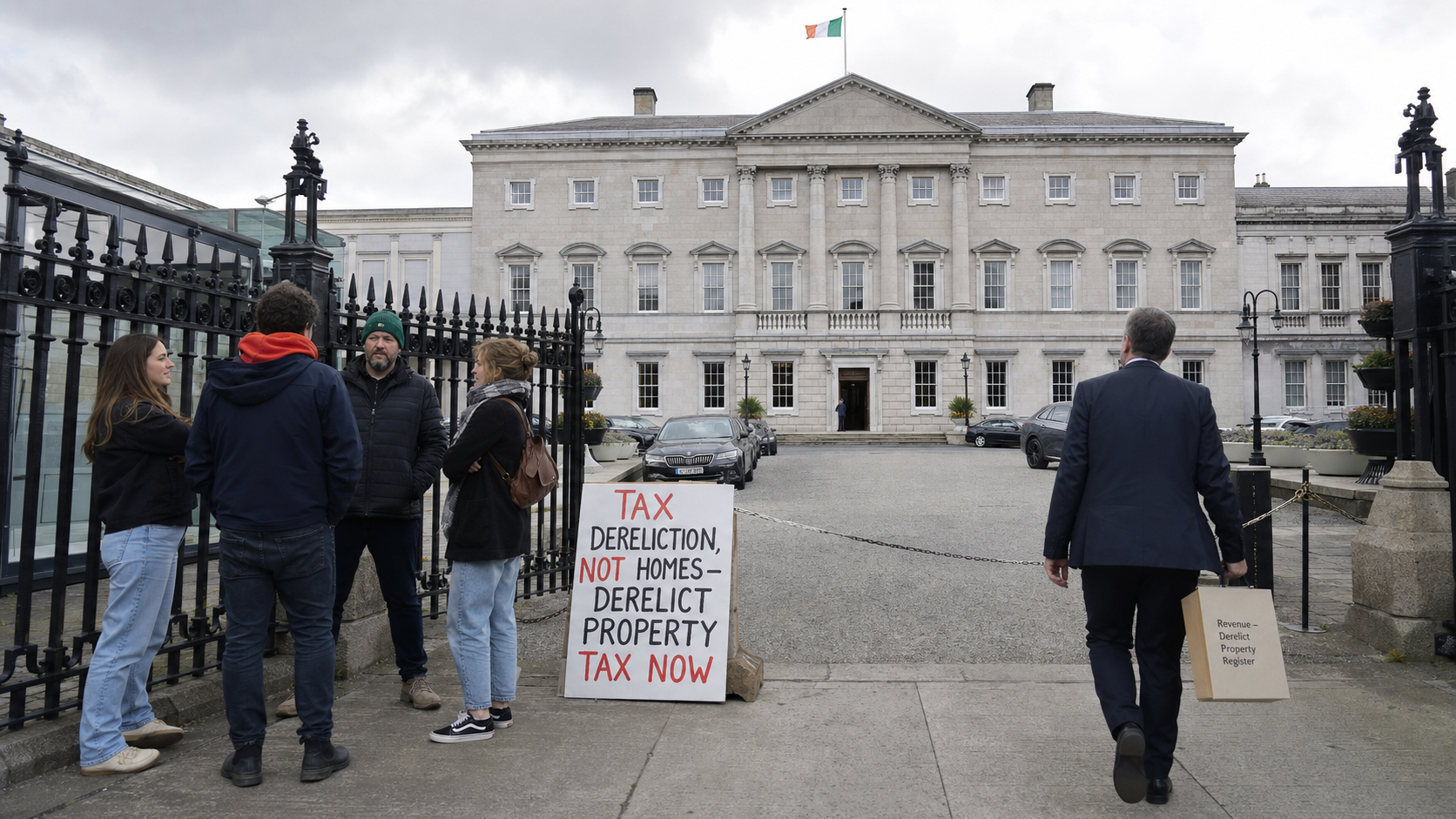
Cabinet Approves Derelict Property Tax as Government Targets 107 Urban Areas
The Irish Cabinet has approved legislation introducing a Derelict Property Tax of at least 7 per cent of market value annually, targeting vacant and derelict buildings across 107 designated urban areas, with the Revenue Commissioners set to begin enforcement from January 2027 in what the Government describes as its most aggressive intervention yet against property hoarding.
Background
Ireland has an estimated 166,000 vacant properties and a further 23,000 classified as derelict, according to the most recent GeoDirectory data. Despite the existence of the Vacant Homes Tax — introduced in 2023 at a rate of three times the Local Property Tax — the number of properties returning to use has been modest, with critics arguing that the financial penalty was insufficient to change behaviour among speculative landholders and institutional investors.
The new Derelict Property Tax represents a significant escalation. Unlike the Vacant Homes Tax, which applies to all vacant residential properties, the new measure targets buildings that have been classified as derelict under the Derelict Sites Act 1990 or that have been vacant for more than three consecutive years in designated urban regeneration zones. The 107 urban areas identified span every county, with the highest concentrations in Dublin, Cork, Limerick, Waterford, and Galway city centres.
Key Developments
The Cabinet approved the Derelict Property Tax Bill 2026 on Thursday morning following a lengthy discussion in which several ministers raised concerns about the administrative burden on local authorities. The bill sets a minimum rate of 7 per cent of market value per annum, with local authorities empowered to apply a higher rate of up to 10 per cent in areas of acute housing pressure. The Revenue Commissioners will be responsible for collection, with local authorities providing the underlying property valuations.
Minister for Housing James Browne described the measure as "a fundamental shift in how we treat dereliction in this country." He said the Government had been advised by Revenue that the 7 per cent rate would make it financially irrational to hold a derelict property in most urban markets, given that the annual tax liability would exceed the carrying cost of renovation in most cases within three to four years.
The bill also introduces a new Derelict Property Register, to be maintained by each local authority and published online, allowing members of the public to identify and report derelict properties in their area. Properties on the register will be subject to the tax from the date of registration, with a twelve-month grace period for owners who submit a credible renovation plan.
Opposition parties broadly welcomed the measure but raised questions about enforcement capacity. Sinn Féin housing spokesperson Eoin Ó Broin said the bill was "long overdue" but warned that local authorities lacked the staffing to maintain accurate derelict property registers. "The history of the Derelict Sites Act is one of chronic under-enforcement," he said. "Unless Revenue has the data, the tax cannot be collected."
Why It Matters
The Derelict Property Tax addresses a structural problem that has persisted through multiple housing strategies: the financial incentive to hold land and property vacant in rising markets. In Dublin city centre, where commercial property values have recovered strongly since 2020, the opportunity cost of renovation has often been lower than the potential gain from waiting for planning conditions to change or values to rise further. A 7 per cent annual charge fundamentally alters that calculation.
The measure also has symbolic importance. The sight of derelict buildings in city centres — particularly in Dublin's north inner city and in Cork's historic core — has become a focal point for public anger about the housing crisis. The Government's willingness to impose a substantial financial penalty on property owners signals a departure from the more consensual approach that characterised earlier housing strategies.
The 107 urban areas designation is also significant because it includes many smaller towns — Tullamore, Carlow, Tralee, Letterkenny — where dereliction has hollowed out town centres without attracting the same political attention as the major cities. The inclusion of these areas reflects a recognition that the housing crisis is not solely an urban phenomenon.
Local Impact
In Dublin, the measure is expected to affect an estimated 3,400 properties in the city centre and inner suburbs, including a significant number of Georgian terraces on the north side that have been vacant for decades. Cork City Council has identified 847 properties that would fall within the new regime. In Limerick, the Derelict Sites Register currently lists 312 properties, many of them concentrated in the Newtown Pery area. Waterford City and County Council has welcomed the measure, noting that its own regeneration efforts in the Viking Triangle have been hampered by adjacent derelict properties held by private owners.
What's Next
The Derelict Property Tax Bill will be introduced to the Dáil in the autumn term, with the Government aiming for enactment before the end of 2026. Revenue will begin building its enforcement infrastructure over the summer, including a data-sharing agreement with local authorities. The first tax assessments are expected to issue in January 2027, with payment due by March 31, 2027. The Government has said it will review the rate structure after two years of operation.