Belfast Youth Project Gives School Leavers Construction Skills and Qualifications in New Lodge and Ardoyne
Sixteen young people from some of Belfast's most disadvantaged communities have gained their first formal qualifications through a pioneering programme that put them to work renovating the very youth centres their own neighbourhoods depend on — a scheme that its participants describe simply as "letal" and that its organisers believe could be replicated across Northern Ireland.
Background
The challenge of youth unemployment in Belfast's inner-city communities is not new, but it has proved stubbornly resistant to conventional solutions. Young people who leave school without qualifications and without a clear pathway into employment or further education — those classified as NEET, not in employment, education or training — face a particularly difficult set of circumstances in a city where the labour market has changed dramatically but where the skills infrastructure in some communities has not kept pace.
New Lodge and Ardoyne, two north Belfast communities with long histories of social and economic challenge, are among the areas where youth unemployment has remained persistently high. Both communities have strong youth centre networks that provide vital services — from after-school programmes to mental health support — but those facilities have often struggled to secure the funding needed for basic maintenance and renovation.
The idea behind the Volunteer It Yourself (VIY) programme was to address both problems simultaneously: give young people practical construction skills and formal qualifications while using their labour to improve the community facilities that serve them. It is a model that has been piloted in other parts of the UK, but its application in Belfast — in partnership with the Screwfix Foundation — represents its most ambitious deployment in Northern Ireland to date.
Key Developments
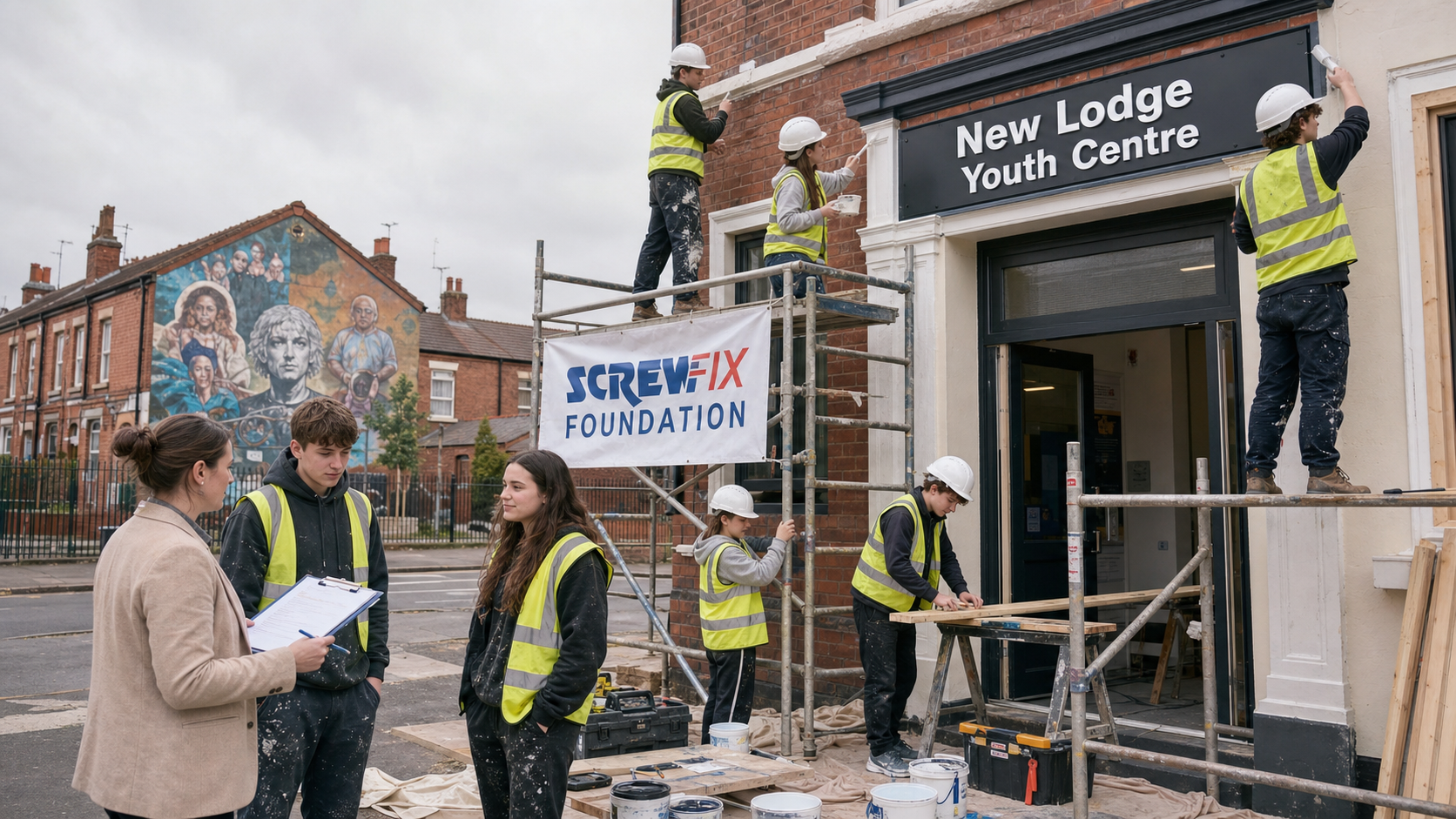
The 16 participants, all of whom were NEET at the start of the programme, worked on the renovation of the New Lodge Youth Centre and the Ardoyne Youth Club over the course of several weeks. Under the supervision of qualified tradespeople, they carried out painting, decorating and carpentry work, gaining hands-on experience in skills that are in high demand across the construction sector.
On completion of the programme, each participant received a City and Guilds Entry Level 3 qualification in painting, decorating and carpentry — their first formal accreditation and a credential that opens doors to apprenticeships and further training. For many, it was the first time they had received any kind of official recognition for their abilities.
Darragh Loughran, one of the participants, was characteristically direct about the experience. "It has been letal," he said. "The feeling of achievement is worth everything." His sentiment was echoed by others who completed the programme, several of whom have since expressed interest in pursuing apprenticeships in the construction trades.
Why It Matters
The programme's significance extends beyond the 16 individuals who completed it. Northern Ireland faces a well-documented construction skills shortage — the Federation of Master Builders has reported that 72 per cent of NI construction firms are struggling to recruit skilled tradespeople, with carpenters, bricklayers and plumbers among the hardest to find. The pipeline of young people entering the trades has not kept pace with demand, and schemes that create clear pathways from school-leaving into construction qualifications are precisely what the sector needs.
The dual benefit model — community facilities improved, young people qualified — also addresses a criticism sometimes levelled at skills programmes: that they train people for jobs that do not exist in their immediate area. Construction work is, by definition, local. The skills gained in New Lodge and Ardoyne are directly applicable to the renovation and maintenance work that those communities need. This is the third such VIY project to be delivered in Northern Ireland, and the results have been consistent across all three: completion rates are high, and a significant proportion of participants move into further training or employment within six months.
Local Impact
The immediate beneficiaries of the renovation work are the young people and families who use the New Lodge Youth Centre and the Ardoyne Youth Club on a daily basis. Both facilities had been in need of significant maintenance work, and the improvements carried out by the programme participants have extended the useful life of buildings that serve as genuine community anchors in their respective areas. Youth workers at both centres have reported that the improved facilities have already attracted higher attendance figures.
For the participants themselves, the impact is more personal. Several have spoken about the change in their sense of purpose and self-worth that came from completing a structured programme and receiving a recognised qualification. In communities where the transition from school to work can be particularly difficult, that shift in confidence is not a small thing.
What's Next
The Screwfix Foundation and VIY are in discussions about expanding the programme to additional Belfast communities, with Shankill Road and east Belfast identified as potential locations for future cohorts. A funding application to the Department for Communities is expected to be submitted before the end of June, with a decision anticipated in the autumn. If successful, a second Belfast cohort could begin in early 2027, with the ambition of eventually running the programme simultaneously in multiple locations across Northern Ireland.