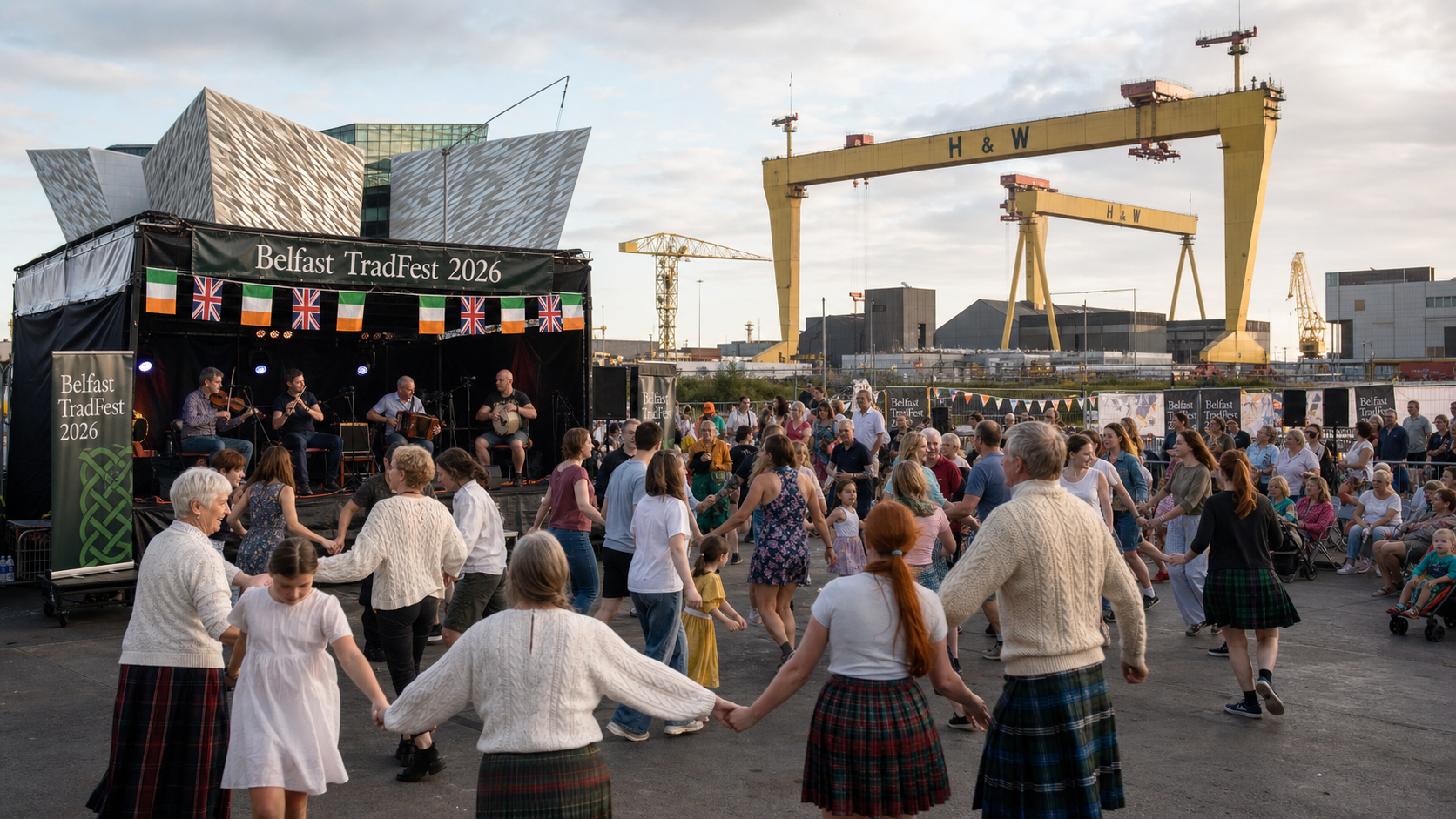
Belfast TradFest 2026 Opens This Weekend with 600 Events, 1,000 Artists, and Free Titanic Céilí
Belfast TradFest 2026, the eighth edition of the city's most ambitious celebration of traditional music, song, and dance, opens this Sunday at the Titanic Slipways with a free céilí featuring the Blackwater Céilí Band, Jack Warnock, and Niamh McGlinchey, before spreading across 40 venues throughout the city for a week-long programme of nearly 600 events that will bring over 1,000 artists to Belfast and cement the festival's reputation as one of the most significant gatherings of traditional music in the world.
Background
Belfast TradFest was established eight years ago with a clear ambition: to position Belfast as a world-class destination for traditional music and to use the art form as a vehicle for community cohesion and cultural pride in a city still navigating the complexities of its post-conflict identity. The festival has grown steadily in scale and ambition with each edition, and the 2026 programme represents its most expansive offering to date.
The festival's inclusion in the Arts Council of Northern Ireland's Annual Funding Programme — confirmed for the 2026 edition — marks a significant milestone in its institutional development. Annual funding provides the stability that allows the festival to plan multi-year programming, commission new work, and invest in the summer school that has become one of its most distinctive features. The partnership with Ulster University, which hosts the summer school, has created a model that combines world-class performance with genuine educational provision.
Belfast's designation as a UNESCO City of Music provides the broader context for TradFest's ambitions. The festival is one of the flagship events through which Belfast demonstrates the substance behind that designation, and its ability to attract international artists of the calibre of Cherish the Ladies and Solas — both celebrating significant anniversaries — reflects the reputation it has built in the global traditional music community.
Key Developments
The festival opens on Sunday, July 26, with the free Titanic Céilí at the Titanic Slipways — one of the most evocative outdoor venues in Belfast — before the full programme gets underway across the city's 40 participating venues. The headline concert programme includes the Michael McGoldrick Big Band, Cherish the Ladies, Solas (celebrating their 30th anniversary), Four Men and a Dog, and Flook, alongside performances from Barry Kerr, Pauline Scanlon, Gerry O'Beirne, and The Bonny Men.
The Dunville's Irish Whiskey Session Trail offers over 130 free-admission listening sessions featuring approximately 400 musicians in more than 20 local pubs, including Madden's Bar and Kelly's Cellars — two of Belfast's most celebrated traditional music venues. The trail is one of the festival's most popular features, providing accessible entry points for visitors who may not be familiar with the formal concert programme.
The summer school, partnering with Ulster University, is expected to accommodate 1,000 students across a range of instruments and disciplines. The programme also includes over 80 talks, lectures, and screenings, alcohol-free sessions, bodhrán circles, and pop-up céilís at Grand Central Station. The festival concludes on August 2, immediately before the Fleadh Cheoil na hÉireann, which runs in Belfast from August 2 to August 9.
Why It Matters
TradFest's significance extends beyond its cultural programming. The festival generates substantial economic activity for Belfast's hospitality and tourism sectors, with thousands of visitors travelling from across Ireland, Britain, and further afield. The concentration of traditional music events in the city over a single week creates a critical mass of activity that benefits venues, accommodation providers, and restaurants across the city centre and beyond.
The timing of TradFest immediately before the Fleadh Cheoil na hÉireann — which is itself expected to bring 800,000 visitors to Belfast — creates an extended period of cultural tourism that is unprecedented in the city's recent history. The combination of the two events represents a statement about Belfast's capacity to host major cultural gatherings and its ambition to be recognised as a destination of choice for Irish cultural tourism. Unlike the Republic's approach to traditional music festivals, which tends to be more geographically dispersed, Belfast's concentration of events in a single week maximises the impact on the city's profile.
Local Impact
The festival's 40 venues span the city centre, the Cathedral Quarter, the Titanic Quarter, and surrounding neighbourhoods. Venues in the Cathedral Quarter — including the Black Box, the Duke of York, and the Commercial Court — will host a significant portion of the session trail, while the Ulster Hall and the Waterfront Hall will anchor the headline concert programme. The festival's free events, including the Titanic Céilí and the session trail, ensure that TradFest is accessible to Belfast residents regardless of income, a principle that the organisers have maintained since the festival's founding.
What's Next
TradFest runs from July 26 to August 2, with the full programme available on the festival's website and through the Belfast City Council events portal. The Fleadh Cheoil na hÉireann follows immediately, running from August 2 to August 9. Festival organisers are already in early planning discussions for TradFest 2027, with the Arts Council of Northern Ireland's annual funding providing the stability to begin that process earlier than in previous years.