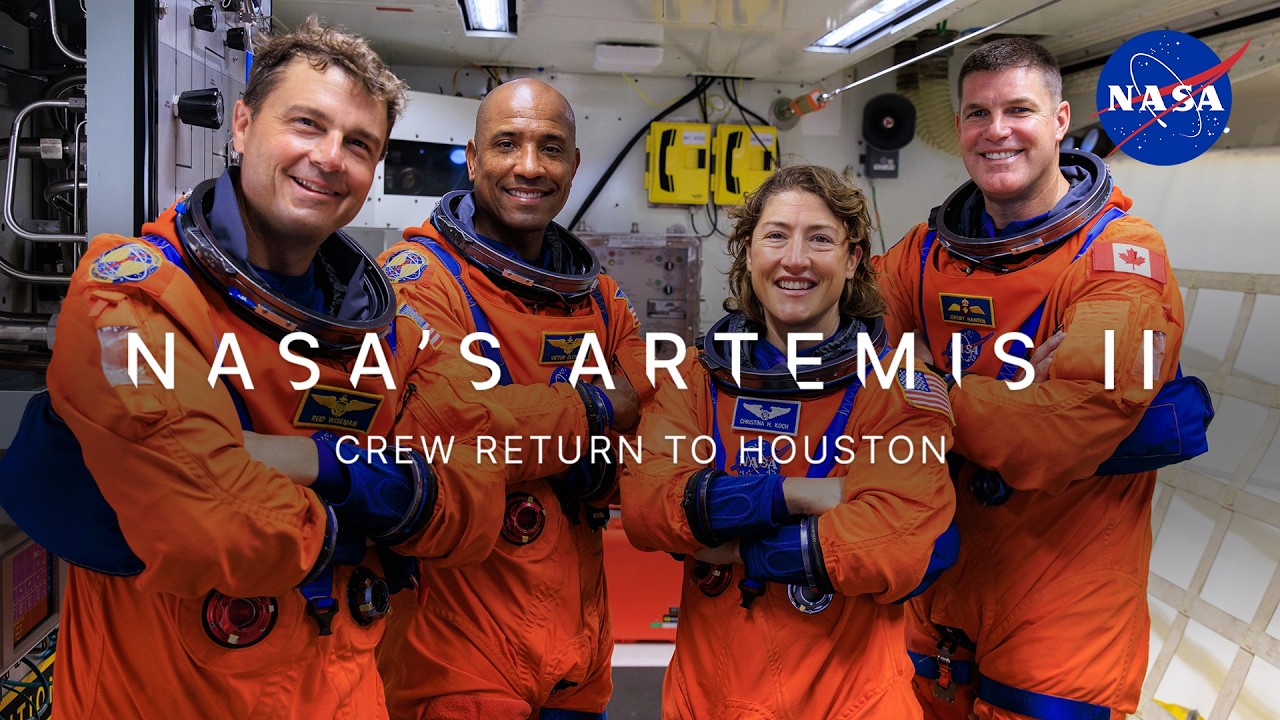
Artemis II Crew Returns to Houston After Historic Moon Mission, Completing NASA's First Crewed Lunar Journey in 53 Years
The crew of NASA's Artemis II mission returned to Ellington Field near Johnson Space Center in Houston to a hero's welcome, completing the first crewed journey to the vicinity of the Moon since Apollo 17 touched down on the lunar surface in December 1972. The mission — which sent Commander Reid Wiseman, Pilot Victor Glover, Mission Specialist Christina Koch, and Canadian Space Agency astronaut Jeremy Hansen on a free-return trajectory around the Moon — validated the Orion spacecraft and Space Launch System for the crewed lunar landing planned for Artemis III.
Background
The Artemis program represents NASA's most ambitious human spaceflight initiative since the Apollo era, designed to return American astronauts to the Moon and establish a sustainable presence in the lunar environment. Artemis I, an uncrewed test flight in November 2022, validated the Space Launch System rocket and Orion capsule in a successful 25-day mission that traveled 270,000 miles from Earth. Artemis II built on that foundation by adding a crew of four, testing the life support systems, navigation, and human factors that will be essential for the longer Artemis III landing mission.
The mission carried particular symbolic weight as the first time humans have traveled beyond low Earth orbit since the final Apollo mission more than five decades ago. The crew's composition — including Victor Glover, the first Black astronaut to travel to the Moon's vicinity, and Christina Koch, the first woman to make the journey — reflected NASA's commitment to a more inclusive exploration program than the all-white, all-male Apollo crews of the 1960s and 1970s.
Key Developments
The Artemis II crew splashed down in the Pacific Ocean before being transported to Houston, where thousands of NASA employees, their families, and members of the public gathered at Ellington Field to welcome them home. The mission lasted approximately ten days, during which the crew conducted systems checks, tested manual piloting capabilities, and captured imagery of the lunar surface that will inform planning for the Artemis III landing.
Commander Reid Wiseman described the view of Earth from lunar distance as "the most profound experience of my life," echoing the sentiments of Apollo astronauts who spoke of the "overview effect" — the cognitive shift that occurs when humans see their home planet as a small, fragile sphere against the blackness of space. Pilot Victor Glover noted that the mission's success validated years of work by thousands of engineers, technicians, and scientists across NASA's network of centers.
The Orion spacecraft performed as designed throughout the mission, with all critical systems functioning within parameters. The heat shield, which must withstand temperatures of approximately 5,000 degrees Fahrenheit during reentry, performed successfully — a crucial validation given that Artemis III will require the same protection after a longer mission. NASA officials confirmed that no significant anomalies were recorded during the flight.
Why Americans Should Care
The Artemis program is centered in Houston, where Johnson Space Center serves as mission control and the primary training facility for NASA astronauts. The program supports tens of thousands of jobs across Texas, Florida, Alabama, and Mississippi — states where NASA's major facilities are concentrated. Kennedy Space Center in Florida, where the Space Launch System launches, and Marshall Space Flight Center in Huntsville, Alabama, where the rocket was developed, are economic anchors for their surrounding communities.
Beyond the direct employment impact, the Artemis program drives investment in the broader aerospace supply chain. Companies in Ohio, California, and across the industrial Midwest manufacture components for the Orion capsule and Space Launch System. The program's success also strengthens the case for continued NASA funding in congressional appropriations battles, where space exploration competes with other federal priorities for limited discretionary dollars.
Why It Matters
The Artemis II mission's success positions the United States to maintain its lead in the intensifying competition for lunar presence. China's Chang'e program has made significant progress toward a crewed lunar landing, with Chinese officials targeting the early 2030s for their first taikonauts on the Moon. The race is not merely symbolic — the Moon's south pole contains water ice deposits that could support long-duration human presence and serve as a resource for deep space missions. Whoever establishes a sustainable lunar presence first will have significant advantages in defining the norms and governance frameworks for lunar resource utilization.
The Apollo program's legacy demonstrates both the transformative potential and the fragility of sustained space exploration commitments. Apollo 17 in 1972 was supposed to be a waypoint, not an endpoint — but budget pressures and shifting political priorities ended the program before its successors could fly. The Artemis program has been designed with sustainability in mind, incorporating commercial partnerships with SpaceX and Blue Origin that distribute costs and create private sector incentives for continued investment. Whether that model proves more durable than Apollo's government-only approach will determine whether Artemis II is remembered as a milestone or a high-water mark.
What's Next
NASA will spend the coming months analyzing data from the Artemis II mission and incorporating lessons learned into preparations for Artemis III, which will attempt the first crewed lunar landing since Apollo 17. The Artemis III mission, targeting the Moon's south polar region, will use SpaceX's Starship Human Landing System to transport two astronauts from lunar orbit to the surface. A launch date has not been formally announced, but NASA officials have indicated the agency is targeting no earlier than 2027. The Artemis II crew will undertake an extensive post-mission tour, including congressional briefings and public appearances designed to build support for the program's continued funding.
Sources: NASA / Flickr; Spectrum Local News; Associated Press