Ambulances Took Over an Hour to Respond on 20,000 Occasions in Five Years, FOI Data Reveals
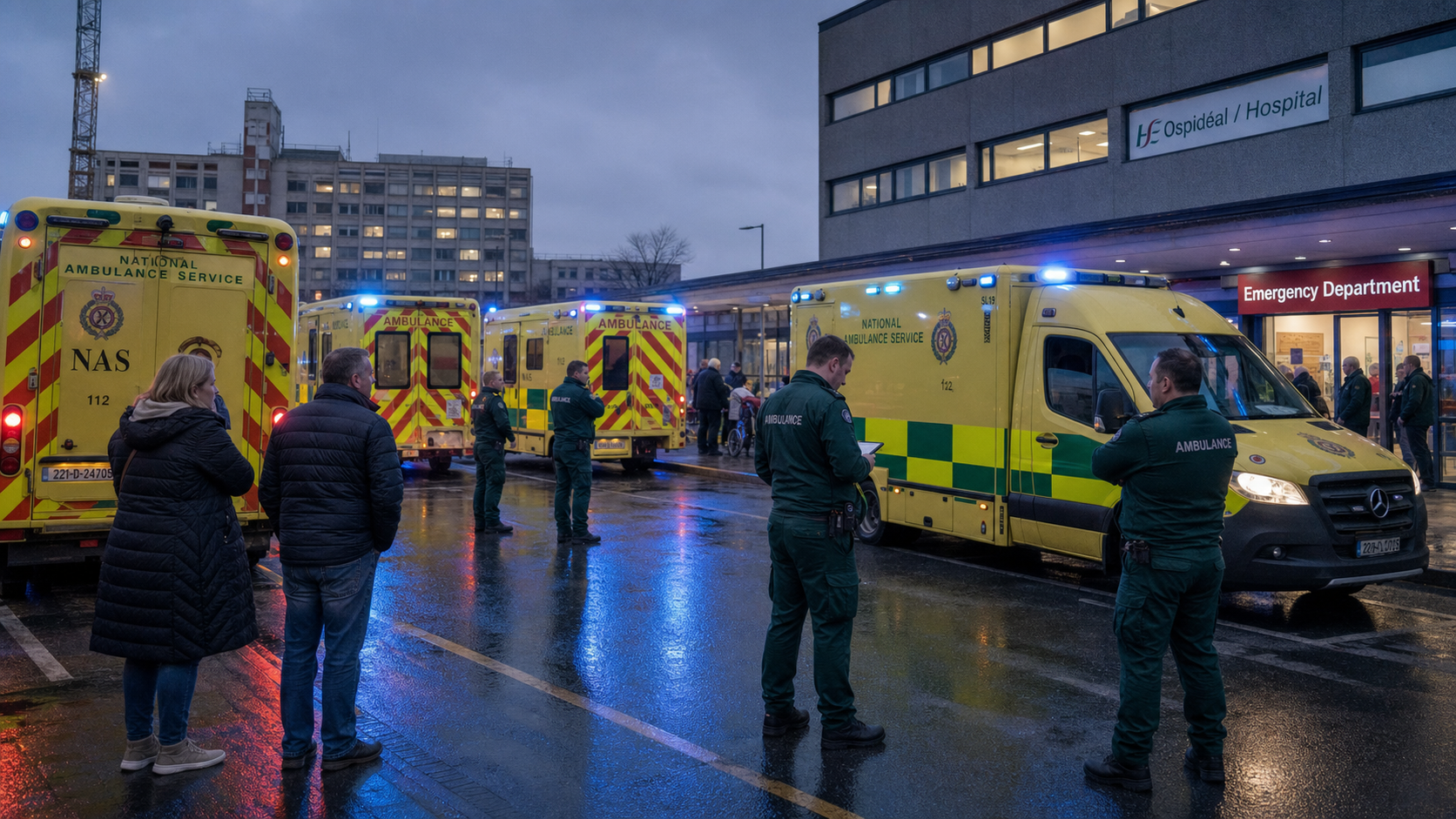
Freedom of Information data obtained by RTÉ has revealed that ambulances in Ireland took more than an hour to respond to emergency calls on 20,244 occasions between 2021 and 2025, including 46 instances involving the most critical "purple" calls for cardiac or respiratory arrest and 129 cases where the response time exceeded four hours. The figures, which the HSE has cautioned require careful interpretation, have prompted renewed calls from Sinn Féin and trade unions for an emergency investment in the National Ambulance Service, which is operating with a workforce of 2,920 approved posts against a plan target of 4,780.
Background
The National Ambulance Service is the statutory provider of pre-hospital emergency care in Ireland, responding to approximately 450,000 emergency calls per year across the 26 counties of the Republic. The service operates a fleet of ambulances, rapid response vehicles, and intermediate care vehicles from a network of stations across the country, and is responsible for providing emergency medical treatment and transport to hospital for patients in life-threatening situations.
The NAS has been under sustained pressure for many years, driven by a combination of increasing demand, staffing shortages, and the structural challenge of providing timely emergency care across a country with a dispersed rural population and significant distances between many communities and the nearest hospital. The service has been the subject of repeated reviews and reports, all of which have identified the need for significant investment in staffing, vehicles, and infrastructure to bring response times to acceptable levels.
The FOI data obtained by RTÉ covers the period from 2021 to 2025, a period during which the NAS experienced a 23% increase in demand — from approximately 365,000 calls in 2021 to 450,000 in 2025. This increase in demand has not been matched by a corresponding increase in staffing or resources, creating a growing gap between the service's capacity and the needs of the population it serves.
Key Developments
The FOI data reveals that between 2021 and 2025, there were 20,244 instances where an ambulance took more than one hour to respond to an emergency call. These figures specifically involve "purple" calls — the most critical category, covering cardiac or respiratory arrest — and "red" calls, which cover other life-threatening emergencies. Among the 20,244 instances, 46 involved purple calls, where a response time of more than an hour represents a potentially fatal delay. In 129 instances, the response time exceeded four hours, with some patients waiting up to seven hours for an ambulance.
The HSE has advised that the figures require cautious interpretation, noting that call priorities can be upgraded if a patient's condition deteriorates during the wait, and that some of the longer response times may reflect situations where a patient's condition was reassessed as less critical after the initial call. However, the HSE has not disputed the overall picture presented by the data, which shows a service that is struggling to meet the demand placed upon it.
Sinn Féin health spokesperson David Cullinane and trade union representatives have argued that at least 2,000 additional paramedics are required to meet current and future demand. The NAS's workforce plan for 2026 set a target of 4,780 posts, but only 2,920 had been approved as of April 2026 — a shortfall of more than 1,800 posts. Staff have reported high levels of burnout and frustration, exacerbated by "stacking" at emergency departments, where ambulances are delayed because hospitals are unable to accept patients due to bed shortages.
Why It Matters
The ambulance response time data matters because it represents a direct measure of the state's ability to protect the lives of its citizens in medical emergencies. A response time of more than an hour for a cardiac arrest call is, in most cases, incompatible with survival: the clinical evidence is clear that the chances of surviving a cardiac arrest fall by approximately 10% for every minute without defibrillation. The 46 purple calls that waited more than an hour for an ambulance represent 46 situations where the delay may have been the difference between life and death.
The data also matters because it illustrates the consequences of the chronic underinvestment in the NAS that has persisted across successive governments. The workforce plan target of 4,780 posts was set on the basis of a careful analysis of the service's needs; the fact that only 2,920 posts have been approved reflects a failure to prioritise emergency care in the allocation of health resources. This failure has real consequences for real people, and the FOI data makes those consequences visible in a way that is difficult to ignore.
Local Impact
The impact of ambulance response time delays is felt most acutely in rural areas, where distances are greater and the nearest ambulance station may be many kilometres away. In counties like Mayo, Roscommon, Donegal, and Kerry, response times are structurally longer than in urban areas, and the data is likely to show a disproportionate concentration of long response times in these regions. The HSE has been working to address this through the deployment of community first responders — trained volunteers who can provide basic life support while waiting for an ambulance — but this is a supplement to, not a substitute for, adequate ambulance provision. In Dublin, the problem is different but equally serious: high call volumes and hospital stacking mean that ambulances are frequently unavailable to respond to new calls because they are waiting outside emergency departments to offload patients.
What's Next
The Oireachtas Health Committee is expected to invite the NAS director and the HSE's chief operations officer to appear before it to explain the response time data and to set out the plans for addressing the staffing shortfall. The committee is also expected to seek a commitment from the Minister for Health that the NAS workforce plan will be fully funded in Budget 2027. The NAS has indicated that it is working to accelerate recruitment, with a new paramedic training programme expected to produce additional graduates in 2027. However, given the scale of the shortfall, it is likely to be several years before the service reaches its planned staffing levels.