£80 Million Ringfenced for Northern Ireland Waiting Lists as Digital Records Rollout Hits Turbulence
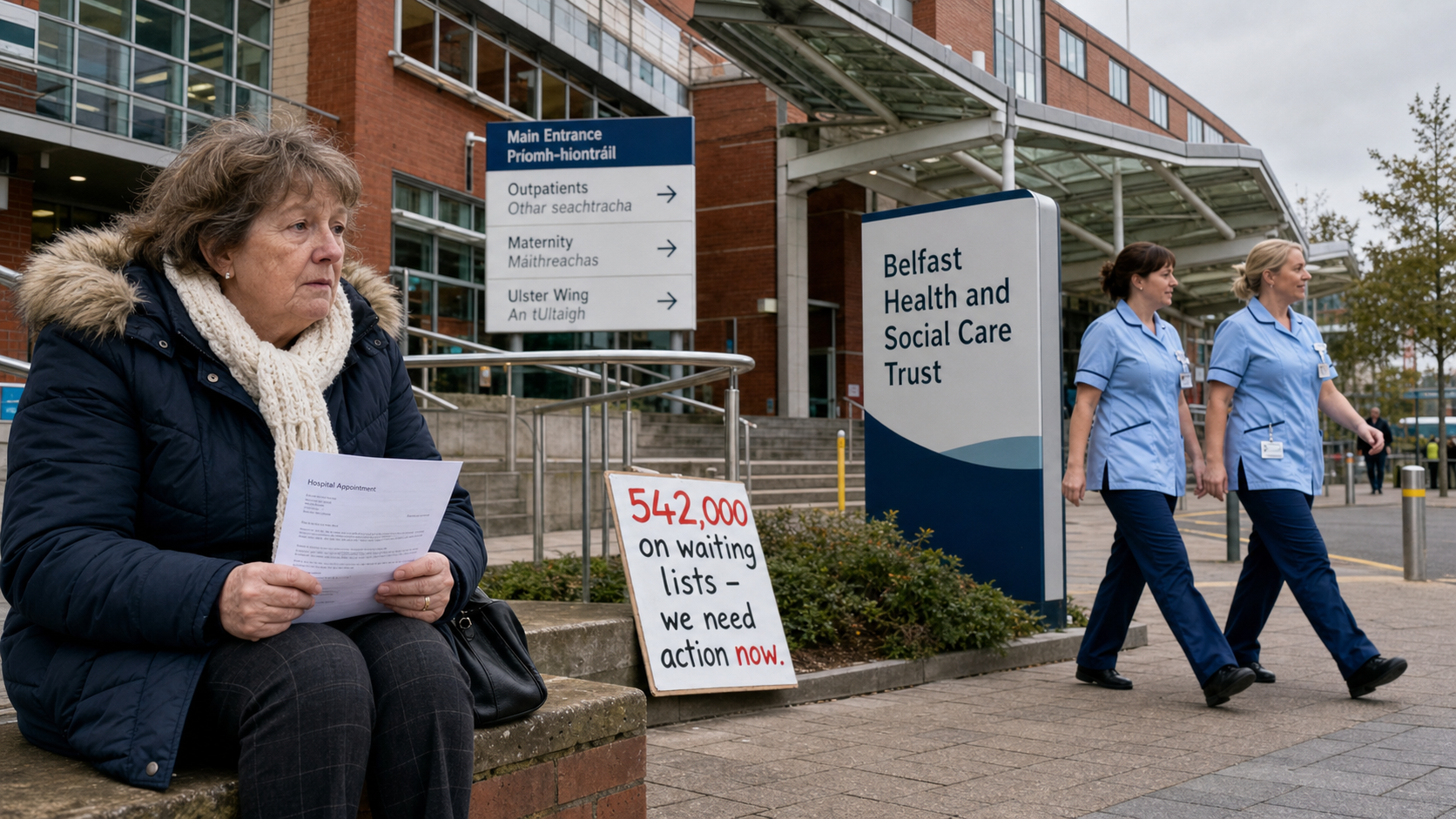
An additional £80 million has been ringfenced for Northern Ireland's health service in the 2026/27 financial year to sustain momentum on reducing waiting lists that exceeded 542,000 patients at the end of 2025 — but the rollout of the Encompass digital patient record system has created significant operational turbulence for health trusts across the province, compounding pressures from staffing shortages and consultant industrial action.
Background
Northern Ireland's health waiting list crisis has been building for years, but the scale of the problem became impossible to ignore during the pandemic, when elective procedures were suspended for extended periods and backlogs accumulated at a rate that the system has struggled to address ever since. By the end of 2025, more than 542,000 patients were on waiting lists across the five health and social care trusts — Belfast, South Eastern, Southern, Western, and Northern — a figure that represents a significant proportion of the province's total population of approximately 1.9 million.
The Department of Health had set a target of eliminating all long waits by March 2026, a goal that was not achieved. However, the period since the restoration of the Stormont Executive in early 2024 has seen a more sustained effort to address the crisis, with ringfenced funding allocated specifically for waiting list reduction and a regional strategy overseen by Regional Clinical Director Professor Mark Taylor, who was appointed in July 2025.
The strategy has centred on the use of Elective Overnight Stay Centres — facilities designed to handle planned procedures separately from the emergency and urgent care pathways that dominate the main hospital sites. The centre at Belfast's Mater Hospital has been a key part of this approach, providing additional surgical capacity in a dedicated environment. Similar facilities have been developed or expanded at sites across the province.
Key Developments
The £80 million allocation for 2026/27 builds on a period in which over 385,000 additional procedures and assessments were delivered through targeted investment. The results in specific areas have been striking: endoscopy waiting lists have fallen by 68% from their 2022 peak, and a 99% reduction has been achieved for certain long-wait procedures including tonsillectomies and primary hip replacements. These figures represent genuine progress, even if the overall waiting list total remains at a historically high level.
However, the rollout of the Encompass digital patient record system — a major IT project designed to replace the fragmented paper-based records that have long hampered care coordination across the trusts — has created significant new challenges. Belfast Health and Social Care Trust, which was among the first to implement the system, has reported operational difficulties as staff adapt to new workflows and processes. The transition period has been disruptive, with some clinicians reporting that the system has slowed down administrative processes rather than speeding them up, at least in the short term.
Industrial action by hospital consultants in June 2026 added further pressure, with hundreds of appointments cancelled across the trusts during the dispute. The action, which centred on pay and working conditions, was resolved after several weeks, but the backlog created by the cancellations has added to the challenge facing trust managers as they attempt to maintain progress on waiting list reduction.
Staffing shortages remain a structural problem across the system. The trusts are competing for a limited pool of clinical staff, and the cost of agency and locum cover — which is significantly higher than the cost of permanent employment — is a major drain on budgets that are already under pressure from the pay settlements agreed with nursing and other staff groups in recent years.
Why It Matters
The waiting list crisis in Northern Ireland is not simply a management problem — it is a public health emergency with real consequences for real people. Patients waiting years for orthopaedic procedures are living with chronic pain that affects their ability to work, care for their families, and participate in community life. Those waiting for cancer diagnostics face anxiety and, in some cases, delayed treatment that can affect outcomes. The human cost of the crisis is immense and largely invisible in the aggregate statistics.
The £80 million ringfenced allocation is significant, but it needs to be understood in context. Northern Ireland's health service is chronically underfunded relative to comparable systems in England, Scotland, and Wales, and the structural problems — workforce shortages, ageing infrastructure, fragmented IT systems — cannot be solved by a single year's additional investment. The Encompass rollout, despite its short-term difficulties, is a necessary step towards a more integrated and efficient system, but the transition costs are real and are being felt by patients and staff alike.
The comparison with the Republic of Ireland is instructive. The HSE's waiting list crisis is, if anything, even more severe, with projections suggesting that the total number of patients on public hospital lists in the Republic will exceed one million. Both systems are grappling with the same fundamental challenges: an ageing population, rising demand, workforce shortages, and the legacy of decades of underinvestment in infrastructure and capacity.
Local Impact
For patients across Northern Ireland, the practical impact of the waiting list crisis varies significantly by geography and by condition. The Western Health and Social Care Trust, which covers Derry/Londonderry, Omagh, and the wider west of the province, has historically had some of the longest waits, reflecting the challenges of delivering services across a large and sparsely populated area. The Southern Trust, covering Armagh, Newry, and Banbridge, has faced particular pressures in orthopaedics and ophthalmology.
In Belfast, the concentration of major hospital facilities — the Royal Victoria Hospital, Belfast City Hospital, the Mater, and the Ulster Hospital in Dundonald — means that patients in the greater Belfast area generally have shorter waits than those in more rural parts of the province. However, the pressure on emergency departments at the Royal and Belfast City Hospital remains intense, with trolley waits a persistent problem during periods of high demand.
What's Next
The Department of Health will publish its quarterly waiting list statistics for Northern Ireland in the coming weeks, providing an updated picture of progress across the trusts. Professor Taylor's regional strategy will be reviewed at the end of the 2026/27 financial year, with a decision on future funding to be taken as part of the Stormont budget process. The Encompass rollout is expected to continue across the remaining trusts through 2026 and into 2027, with the full system expected to be operational province-wide by the end of next year.