1926 Irish Census Records Released: A Window Into the Birth of a Nation
A significant cultural and historical milestone has been reached with the public release of the 1926 census records — the first conducted in the independent Irish State — sparking immense public interest as families across Ireland and the diaspora discover a unique snapshot of their ancestors' lives in the years immediately following the foundation of the state, with the records revealing a surprisingly diverse and internationally connected society that challenges long-held perceptions of early independent Ireland.
Background
The 1926 census was the first to be conducted in the newly independent Irish Free State, making it a document of profound historical significance. Conducted just four years after the foundation of the state and in the aftermath of the Civil War — no census was taken in 1921 — the census captured Irish society at a pivotal moment of transition and reconstruction. The records have been preserved for a century and their release has been eagerly anticipated by genealogists, historians, and members of the public. The digitisation project was a monumental undertaking, with a dedicated 50-strong team at the National Archives spending years meticulously restoring, cataloguing, digitising, and transcribing over 700,000 pages of historical documents, at a cost of €5 million.
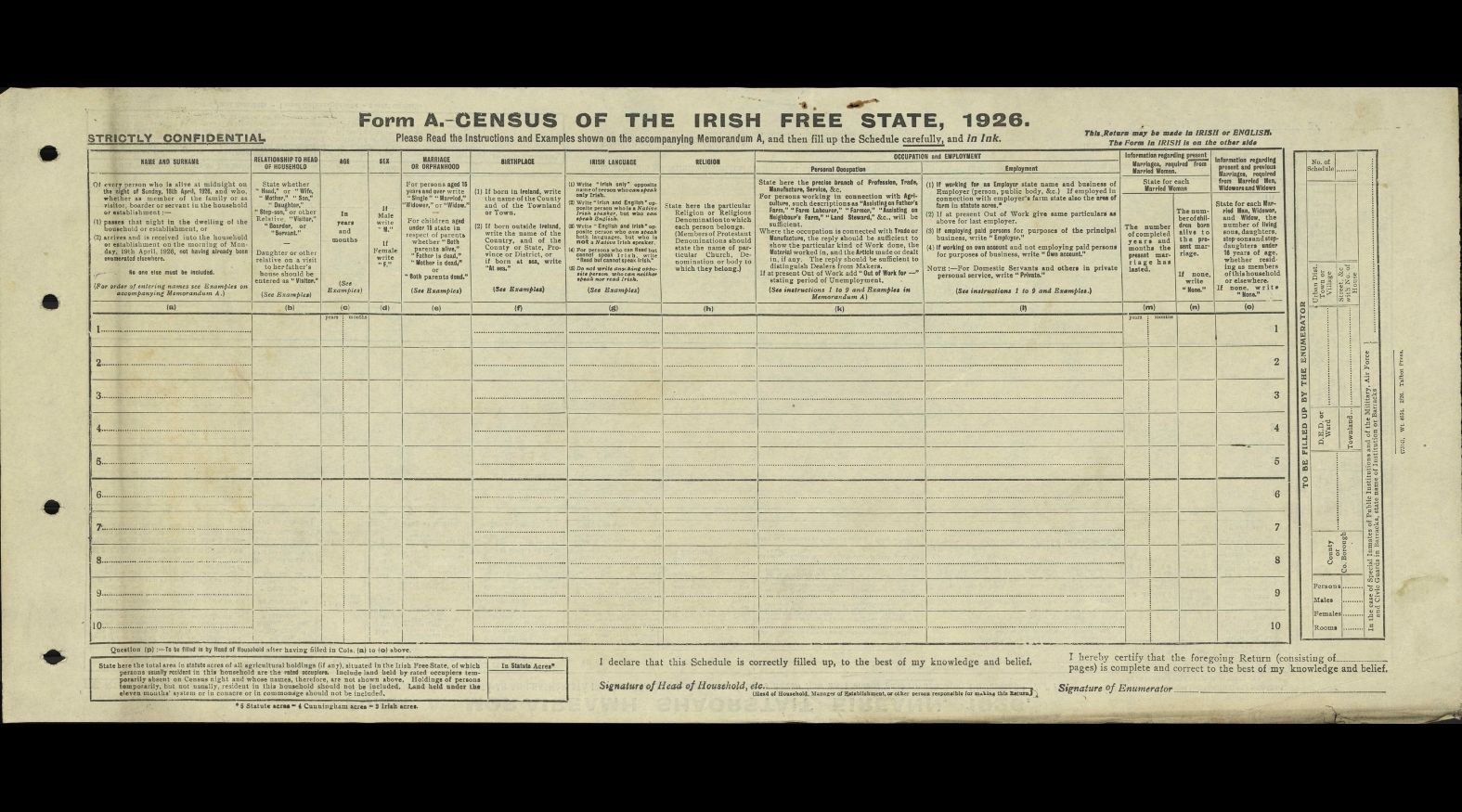
The census forms themselves reflect the new era of Irish independence. For the first time, households could complete the forms in either English or Irish, providing a unique dataset on language use in homes across the state. The census also shifted its focus from the "household" to the "family" as the primary unit of inquiry, reflecting evolving social and political priorities. Each individual entry contains 21 points of information, covering age, sex, occupation, religion, marital status, housing conditions, and proficiency in the Irish language.
Key Developments
The records were made publicly available on 18 April 2026, providing a detailed snapshot of Irish society in the years immediately following the foundation of the state. The census documents record the names, ages, occupations, and addresses of the 2.9 million people residing in the 26 counties of the Irish Free State at the time, offering an unparalleled resource for family history research and historical scholarship. The digitised census is available for free on the National Archives of Ireland website, with a user interface designed for accessibility similar to that of the previously released 1901 and 1911 censuses.
The records have already begun to challenge the historical stereotype of early independent Ireland as a "dreary monochrome of parochialism and conservatism." The data reveals a surprisingly diverse and internationally connected society, with individuals of numerous nationalities — including British, American, French, Italian, German, and Egyptian — living and working throughout the Irish Free State. This included German engineers employed by Siemens in Limerick and foreign holidaymakers recorded in hotels. The census also provides crucial insights into the significant demographic changes of the period, most notably the 32% decline in the Protestant population in the 26 counties between 1911 and 1926, and reveals that 53% of the gainfully employed population over the age of 12 were engaged in agriculture.
Why It Matters
The 1926 census records are not just a genealogical resource — they are a window into the social, economic, and cultural fabric of early independent Ireland. They reveal patterns of migration, occupation, religion, and family structure that shaped the country that Ireland became. For the global Irish diaspora — estimated at around 80 million people spread across the United Kingdom, the United States, Australia, and beyond — the records offer a precious opportunity to trace family roots and understand the lives of ancestors who lived through one of the most turbulent periods in Irish history. For historians and researchers, the dataset will underpin new studies in social and economic history, public health, housing, education, and linguistics.
Local Impact
For communities in Northern Ireland, the 1926 census carries a particular resonance. The census was conducted in the Irish Free State, not in Northern Ireland, which had been established as a separate entity in 1921. However, for the many families in Northern Ireland with roots in the 26 counties — and for the large Irish diaspora community in Belfast and across the North — the records offer a direct connection to the lives of relatives who remained in or moved to the Free State in the years following partition. The release of the records is expected to generate significant interest among genealogical societies and local history groups in Northern Ireland, many of which have members with family connections to the counties covered by the census.
What's Next
The records are available to search online through the National Archives of Ireland, making them accessible to people around the world. The release is being supported by a public programme of exhibitions, documentaries, and publications to help contextualise and explore the rich stories contained within the records. Future updates to the online platform will introduce an analytical dashboard and tools for exploring the approximately 45 million data points across all fields. For more, see National Archives of Ireland: 1926 Census and The Conversation: Why the 1926 Irish Census Release is So Momentous.