£100 Home Heating Oil Voucher Scheme Opens for 340,000 Northern Ireland Households from 9 September
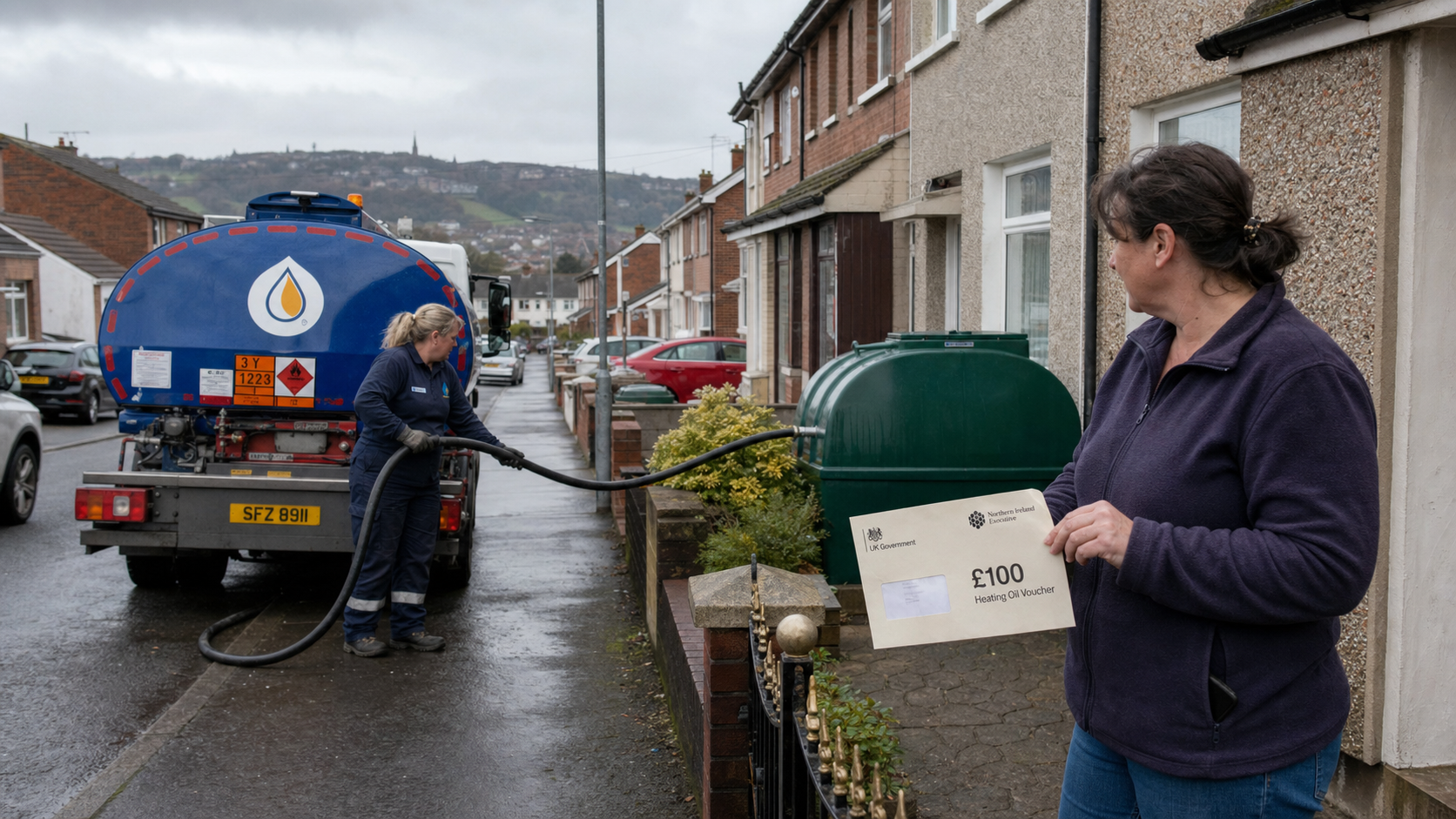
A £100 home heating oil support scheme will open for applications from 9 September 2026, with approximately 340,000 Northern Ireland households eligible for the one-off voucher. The £36.4 million scheme — funded jointly by the UK government (£17.2 million) and the Northern Ireland Executive (£19.2 million) — targets households on income-related benefits, disability payments, or with annual incomes below £30,000 who use oil as their primary heating source.
Background
Northern Ireland is unique within the United Kingdom in its heavy dependence on home heating oil as the primary fuel for domestic heating. Unlike Great Britain, where natural gas is the dominant heating fuel, a significant proportion of Northern Ireland's housing stock — particularly in rural areas — relies on oil-fired central heating systems. This dependence on oil creates a particular vulnerability to fluctuations in global oil prices, and the sharp rise in energy costs that followed the outbreak of conflict involving the US, Israel, and Iran in 2025 has placed significant financial pressure on households across the province.
The £100 home heating oil support scheme was developed in response to this pressure, with the Northern Ireland Executive and the UK government working together to provide targeted financial assistance to the households most at risk of fuel poverty. The scheme follows a similar model to the energy support payments provided during the 2022-23 energy crisis, when the UK government provided a series of payments to help households cope with record energy prices.
The scheme's design reflects the specific characteristics of Northern Ireland's energy market. Unlike gas or electricity, which are supplied through networks and can be metered and billed on a regular basis, home heating oil is typically purchased in bulk deliveries, with households buying oil when prices are favourable or when their tanks are running low. The voucher model — which provides a pre-paid virtual voucher that can be redeemed at participating oil suppliers — is designed to work within this purchasing pattern while ensuring that the support reaches the households that need it most.
Key Developments
The scheme will open for applications on 9 September 2026 and will remain open until 31 March 2027. Applications can be made online through the NI Direct website, with support available through local Jobs and Benefits offices for those unable to access the internet or complete the form independently. A dedicated helpline (0800 072 0266) will be operational from 9 September. The Department for Communities is working with independent advice networks, including Advice NI, to assist individuals with the application process.
To qualify for the £100 voucher, households must use oil as their primary source of heating and must meet one of the following financial or social criteria: receipt of income-related benefits (such as Universal Credit, Pension Credit, or Income Related Employment and Support Allowance); receipt of specific disability benefits (including Personal Independence Payment, Disability Living Allowance, or Attendance Allowance); or, for single people or couples, an annual household income of less than £30,000 after allowable deductions.
The voucher will be issued as a pre-paid virtual voucher that can be redeemed at participating oil suppliers across Northern Ireland. The Department for Communities has indicated that it will publish a list of participating suppliers on the NI Direct website ahead of the scheme's opening date. Households that receive the voucher will be able to use it to offset the cost of their next oil delivery, providing immediate and practical financial relief.
Why It Matters
The home heating oil support scheme matters because fuel poverty is a serious and growing problem in Northern Ireland. The combination of high oil prices, older and less energy-efficient housing stock, and lower average incomes in many parts of the province means that a significant proportion of Northern Ireland's population struggles to heat their homes adequately. The consequences of fuel poverty — including cold-related illness, exacerbation of existing health conditions, and the psychological stress of choosing between heating and eating — are well documented and disproportionately affect older people, people with disabilities, and families with young children.
For context, Northern Ireland has higher rates of fuel poverty than any other part of the United Kingdom. The province's dependence on oil heating, combined with the absence of a natural gas network in many rural areas, means that households in Northern Ireland are more exposed to oil price volatility than their counterparts in Great Britain. The £100 voucher will not eliminate fuel poverty, but it will provide meaningful financial relief to the 340,000 households that are eligible, helping them to manage the cost of heating their homes through the coming winter.
The scheme's joint funding by the UK government and the Northern Ireland Executive is also significant. The £36.4 million total cost represents a substantial commitment of public resources to addressing fuel poverty, and the willingness of both governments to work together on the scheme reflects a recognition of the seriousness of the problem and the importance of providing targeted support to the most vulnerable households.
Local Impact
Across Northern Ireland, the announcement of the scheme has been welcomed by community organisations, advice services, and elected representatives who have been dealing with the consequences of high energy costs for their constituents. In rural areas of Fermanagh, Tyrone, Armagh, and Down — where dependence on oil heating is highest and average incomes are often lower than in urban areas — the scheme will provide particularly significant relief. Advice NI and other advice organisations have indicated that they will be actively promoting the scheme to ensure that eligible households are aware of it and are supported in making applications. The Department for Communities has indicated that it will run a public information campaign in the weeks ahead of the scheme's opening date to maximise awareness and uptake.
What's Next
The scheme opens for applications on 9 September 2026. The Department for Communities will publish a list of participating oil suppliers on the NI Direct website ahead of that date. Applications will be processed on a rolling basis, and vouchers will be issued to successful applicants within a specified timeframe that the Department has indicated will be communicated when the scheme opens. The scheme will remain open until 31 March 2027, and the Department has indicated that it will monitor uptake closely and will consider whether additional support measures are needed as the winter progresses.