Vodafone Ireland Broadband Outage Hits 31,000 Customers Across Multiple Counties for Six Hours
Vodafone Ireland suffered a significant nationwide broadband outage on Sunday afternoon that left more than 31,000 customers without internet connectivity for approximately six hours, with reports of disruption flooding in from Dublin, Limerick, Meath, Wexford, Galway, Donegal, Offaly, Waterford, and Killarney as the company worked to identify and resolve the underlying fault — an incident that has renewed questions about the resilience of Ireland's broadband infrastructure and the adequacy of the country's digital connectivity for a modern economy.
Background
Vodafone Ireland is one of the country's largest telecommunications providers, offering mobile, broadband, and television services to hundreds of thousands of customers across the Republic. The company's broadband network is a critical piece of national infrastructure, supporting not just domestic internet use but the remote working arrangements that have become a permanent feature of the Irish economy since the pandemic, the digital services that businesses of all sizes depend on, and the connectivity that underpins everything from online banking to healthcare appointments.
Ireland's broadband infrastructure has been a subject of political and regulatory debate for years. The National Broadband Plan, which aims to bring high-speed broadband to every home and business in the country, has been one of the most expensive and controversial infrastructure projects in the state's history. While significant progress has been made in extending broadband coverage to rural areas, the quality and resilience of the network in urban areas has also come under scrutiny, with outages affecting major providers on a regular basis.
The Sunday afternoon timing of the Vodafone outage was particularly disruptive. Many Irish people use Sunday afternoons for remote work, online shopping, streaming, and social media, and the loss of broadband connectivity for six hours affected a wide range of activities. For the growing number of people who work from home on a full-time or part-time basis, the outage was a reminder of the vulnerability of remote working arrangements to infrastructure failures.
Key Developments
The outage began at approximately 14:46 UTC on Sunday, August 30, and lasted for roughly five hours and fifty-two minutes, with services restored around 20:38 UTC. At its peak, the disruption affected approximately 82% of reported issues as internet connectivity problems, with the remainder relating to mobile data and other services. Over 31,000 reports were logged via Downdetector.ie, making it one of the most significant broadband outages in Ireland in recent years.
Vodafone Ireland acknowledged the service interruption through social media channels during the event, but was initially unable to provide a clear explanation of the cause or a timeline for resolution. Some technically proficient users reported that the issue appeared to be related to DNS resolution — the system that translates website addresses into the numerical codes that computers use to connect to servers — and that changing DNS settings to public alternatives could restore connectivity for some customers.
The company confirmed that all services were restored by Sunday evening and issued an apology to affected customers. Vodafone Ireland has not yet provided a detailed explanation of the root cause of the outage, and the company is expected to publish a post-incident report in the coming days.
Why It Matters
The Vodafone outage matters because it illustrates the vulnerability of Ireland's digital economy to infrastructure failures. As more and more economic activity moves online — from retail to financial services to healthcare to education — the reliability of broadband connectivity becomes increasingly critical. An outage that affects 31,000 customers for six hours is not merely an inconvenience; it represents a significant economic disruption, with businesses unable to process transactions, remote workers unable to access their systems, and individuals unable to access services that they depend on.
The incident also raises questions about the regulatory framework for broadband resilience in Ireland. ComReg, the telecommunications regulator, has powers to require providers to maintain minimum standards of service quality and to report on outages, but critics have argued that the current framework does not do enough to incentivise investment in network resilience. The frequency of significant outages across multiple providers suggests that the industry as a whole may be under-investing in the redundancy and backup systems that would prevent or limit the impact of infrastructure failures.
For context, Ireland's dependence on digital connectivity is higher than the EU average, driven by the concentration of technology companies in the country and the high rate of remote working. Any weakness in the country's broadband infrastructure therefore has a disproportionate impact on the Irish economy compared to countries with a more diversified economic base.
Local Impact
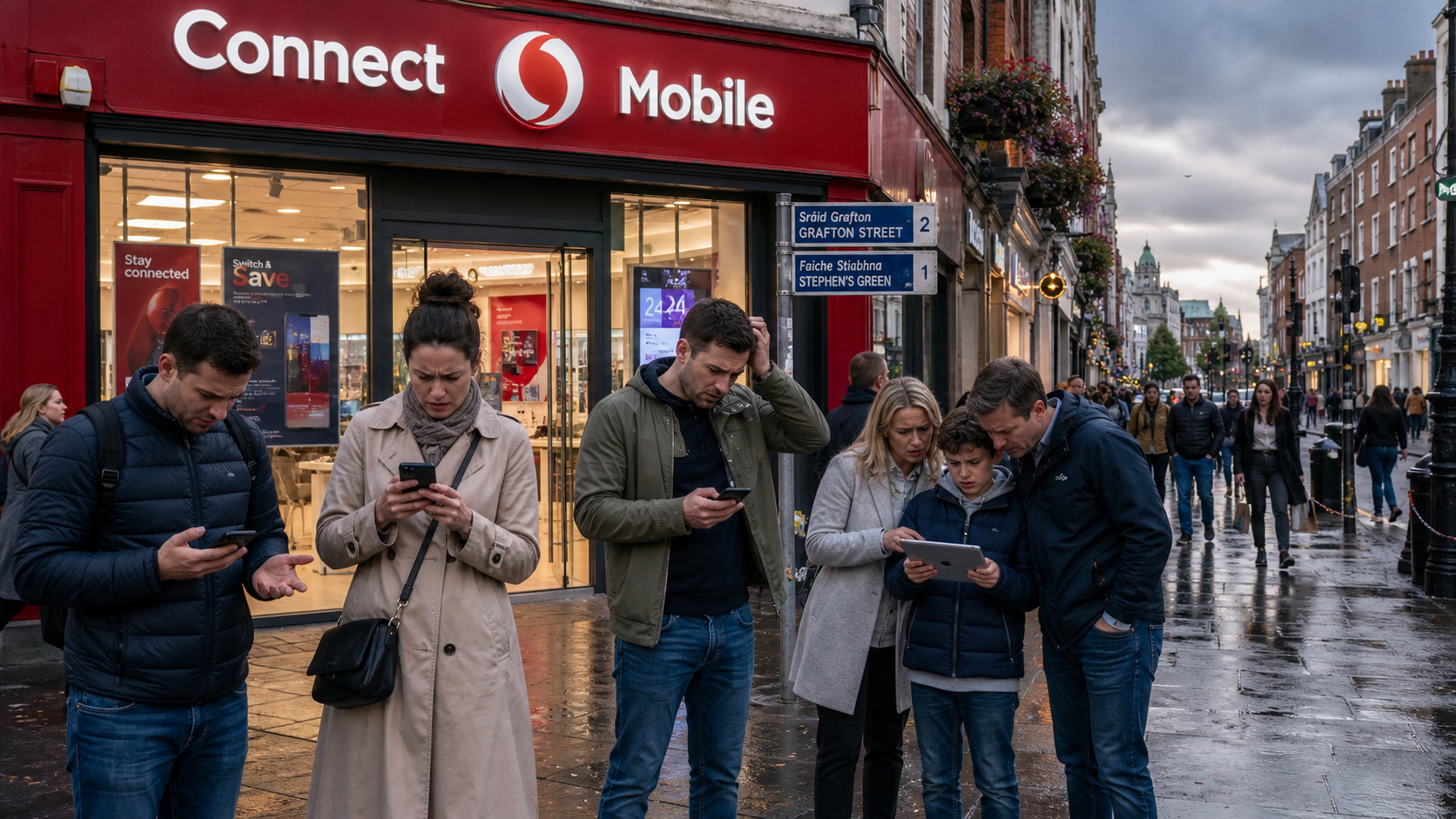
In Dublin, where the outage affected a large number of customers in the city and surrounding counties, the disruption was felt across a wide range of activities. Businesses that rely on cloud-based systems were unable to access their data, remote workers were cut off from their employers' networks, and individuals who use broadband for entertainment and communication were left without connectivity for the afternoon and evening. In Galway and Donegal, where the outage also had a significant impact, the disruption was felt particularly acutely in areas where Vodafone is the primary broadband provider and where alternative connectivity options are limited.
For small businesses across the affected areas, the outage represented a direct financial loss. Retailers who process card payments through internet-connected terminals, restaurants that use online ordering systems, and service providers who communicate with customers through digital channels all reported disruption to their operations during the six-hour outage.
What's Next
Vodafone Ireland is expected to publish a post-incident report explaining the root cause of the outage and the steps being taken to prevent a recurrence. ComReg has indicated that it is monitoring the situation and may seek a formal explanation from the company. The incident is likely to be raised in the Oireachtas communications committee when it returns from recess, with TDs and senators expected to question the regulator about the adequacy of the current framework for broadband resilience. Vodafone customers who suffered financial losses as a result of the outage may be entitled to compensation under the company's terms and conditions, and consumer advocacy groups have advised affected customers to document their losses and to contact the company directly.