Trump's Ireland Visit Stirs Irish-American Community as Diaspora Watches Diplomatic Balancing Act from Afar
Donald Trump's visit to Ireland has generated intense interest and divided opinion among the Irish-American community in the United States, with diaspora organisations and community leaders watching closely as the Irish government navigates the delicate task of maintaining a functional relationship with the US administration while managing the domestic political sensitivities of hosting a president whose policies have generated significant opposition in Ireland.
Background
The Irish-American community is one of the most politically influential diaspora communities in the world, with an estimated 32 million Americans claiming Irish heritage and a significant concentration of Irish-Americans in key political states including New York, Massachusetts, Pennsylvania, and Illinois. The community's political influence has historically been exercised through the Democratic Party, with figures including the Kennedy family, Tip O'Neill, and Joe Biden embodying the Irish-American political tradition.
The election of Donald Trump in 2024 created a complex situation for the Irish-American community, which is itself divided along political lines. While the majority of Irish-Americans have historically voted Democrat, a significant minority — particularly in working-class communities in the Rust Belt and in Catholic communities with conservative social values — have shifted toward the Republican Party in recent years. Trump's Irish heritage — his mother, Mary Anne MacLeod, was born in Scotland, but he has claimed Irish connections through his Doonbeg resort — has been a point of both pride and controversy within the community.
The Irish government's decision to invite Trump to Ireland was driven primarily by the importance of the US-Ireland economic relationship, but it has also been shaped by the recognition that maintaining access to the White House is essential for advancing Irish interests on issues including trade, immigration, and the peace process in Northern Ireland. The visit provides an opportunity for the Taoiseach to raise these issues directly with the president.
Key Developments
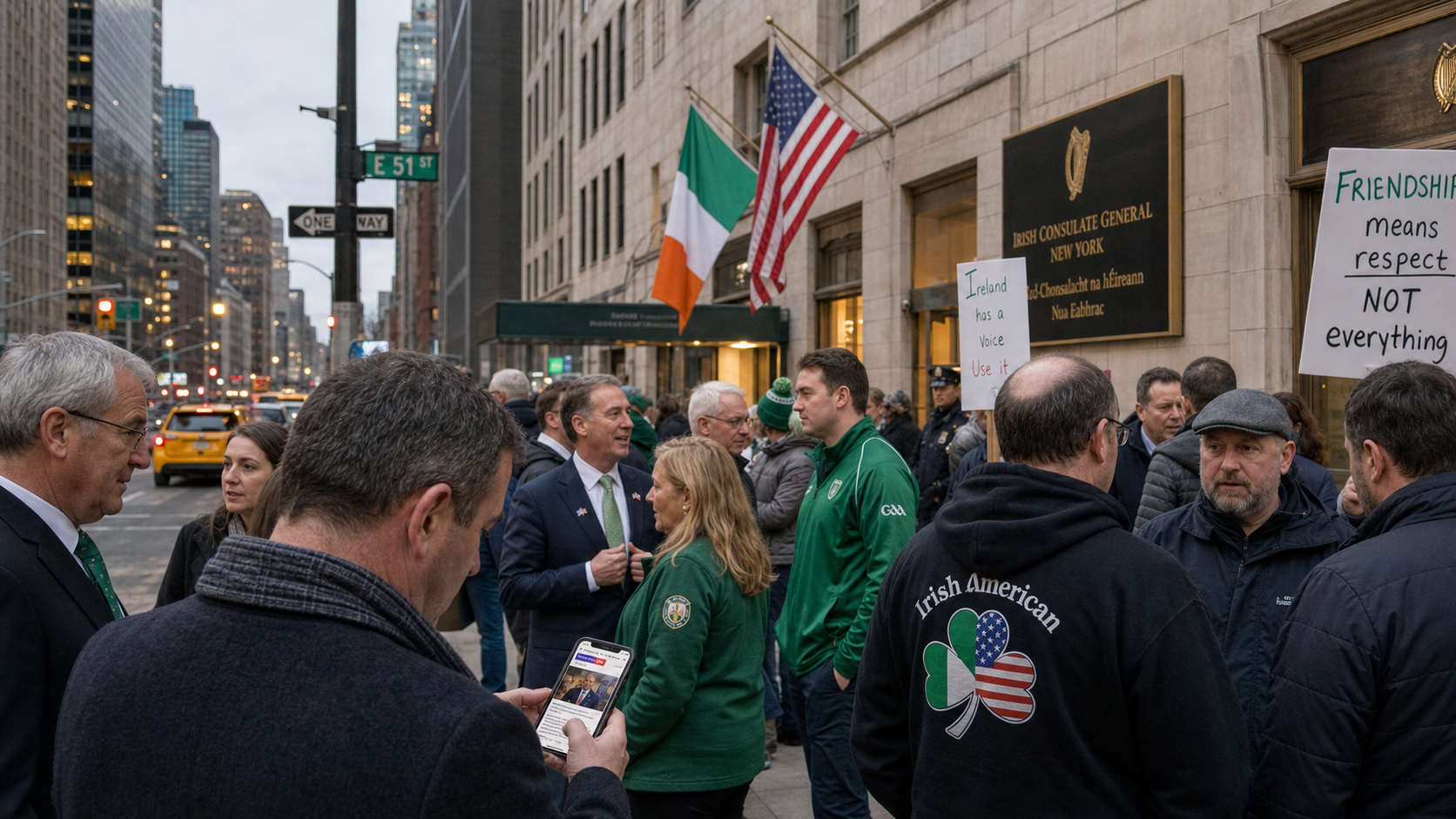
In the United States, the Trump visit to Ireland has been covered extensively by Irish-American media, including the Irish Echo, the Irish Voice, and a range of online platforms that serve the diaspora community. The coverage has reflected the divisions within the community, with some commentators welcoming the visit as an opportunity to strengthen the US-Ireland relationship and others expressing discomfort with the government's decision to host a president whose policies on immigration, trade, and international relations they oppose.
Irish-American organisations including the Ancient Order of Hibernians and the Irish American Unity Conference have issued statements reflecting the complexity of the community's response. The AOH, which has a more conservative political orientation, has welcomed the visit as a sign of the enduring importance of the US-Ireland relationship. The IAUC, which has historically focused on the peace process and Irish unity, has been more cautious, noting that the visit should be used to advance specific Irish interests rather than simply to provide a photo opportunity for the president.
The visit has also prompted renewed debate about the nature of the US-Ireland relationship and the extent to which Ireland can maintain its values-based approach to foreign policy while remaining economically dependent on the United States. The Taoiseach's decision to raise the situation in Gaza in his bilateral meeting with Trump — a move that was widely anticipated given Ireland's prominent role in calling for a ceasefire — has been welcomed by progressive Irish-American organisations.
Why It Matters
The Trump visit to Ireland is significant for the Irish-American community because it crystallises a fundamental question about the nature of Irish identity and Irish values in the contemporary world. For many Irish-Americans, Ireland represents a set of values — solidarity, hospitality, commitment to social justice — that they see as incompatible with the Trump administration's approach to immigration, trade, and international relations. The government's decision to host Trump challenges that narrative and forces a reckoning with the pragmatic realities of Irish foreign policy.
The visit also has implications for the Irish-American community's relationship with the Irish government. The diaspora has historically been a powerful advocate for Irish interests in Washington, and the government's ability to maintain that advocacy depends in part on its credibility with the community. A visit that is seen as too accommodating of Trump's agenda could damage that credibility with the progressive majority of the Irish-American community.
The broader context of US-Ireland relations is also relevant. The US remains Ireland's most important economic partner outside the EU, with American companies employing approximately 300,000 people in Ireland. The government's ability to protect that relationship — and to advance Irish interests on issues including trade tariffs and the corporate tax framework — depends on maintaining access to the White House, regardless of its political complexion.
Local Impact
In Irish communities in New York, Boston, Chicago, and San Francisco, the Trump visit has been a topic of intense discussion in Irish bars, community centres, and social media groups. The visit has provided an opportunity for the diaspora to reflect on its relationship with Ireland and on the values that define Irish identity in the contemporary world.
For Irish emigrants in the United States who are navigating the complexities of the Trump administration's immigration policies — including changes to visa programmes and the tightening of immigration enforcement — the visit has a particular personal resonance. The Taoiseach's ability to raise the concerns of Irish citizens in the United States in his bilateral meeting with Trump is a matter of direct practical importance for many members of the diaspora.
What's Next
Trump is expected to depart Ireland on Saturday, with the diplomatic outcomes of the visit to be assessed in the weeks that follow. The Taoiseach's office will publish a readout of the bilateral meeting, and the Irish government's assessment of the visit's success will be closely watched by diaspora organisations and by the broader Irish-American community. The next major engagement between the Irish and US governments is expected to be at the United Nations General Assembly in New York later this month.