Vincent Browne, Sculptor of Mr Screen and Ireland's Public Spaces, Dies Aged 78
Vincent Browne, one of Ireland's most beloved public sculptors and a member of Aosdána whose work has become woven into the fabric of Irish urban life — from the bronze figure of Mr Screen on Dublin's O'Connell Street to the Anti-War Memorial in Limerick and the Tree of Life in Blanchardstown — has died at his home in County Wicklow aged 78, with the Arts Council of Ireland describing him as an artist whose influence on Irish public art will be "sorely missed."
Background
Vincent Browne was born in Dublin in 1947 and came of age as an artist during one of the most fertile periods in Irish cultural life. He studied at the National College of Art and Design in Dublin before completing his training at the Jan Van Eyck Academy in the Netherlands — an institution that has produced some of the most significant artists in European contemporary art — and returned to Ireland with a vision for sculpture that was rooted in the public sphere rather than the gallery.
His decision to focus on public art was not simply a commercial calculation but a philosophical commitment to the idea that art belongs in the spaces where people live their lives. At a time when Irish public art was often monumental and formal — statues of historical figures on pedestals, commemorative plaques on civic buildings — Browne brought a warmth, wit, and accessibility to his work that made it genuinely beloved rather than merely respected. His sculptures invited engagement rather than reverence, and the affection with which Dubliners and Limerickians have adopted his work over the decades is a testament to the success of that approach.
He was elected to Aosdána in 1992, the same year in which he won the Waterford Glass Prize — a recognition of his standing among his peers in the Irish arts community. His career spanned more than five decades, during which he produced a body of work that ranged from intimate bronze figures to large-scale public installations, always maintaining the commitment to craft and to public engagement that defined his practice from the beginning.
Key Developments
Browne died at his home in County Wicklow on 5 August 2026. The Arts Council of Ireland confirmed his death on 10 August, noting that his influence on Irish art would be "sorely missed." Tributes poured in from across the Irish cultural community, with artists, curators, and public figures paying tribute to a man who had shaped the visual landscape of Irish cities in ways that are so familiar as to be almost invisible — until, that is, they are gone.
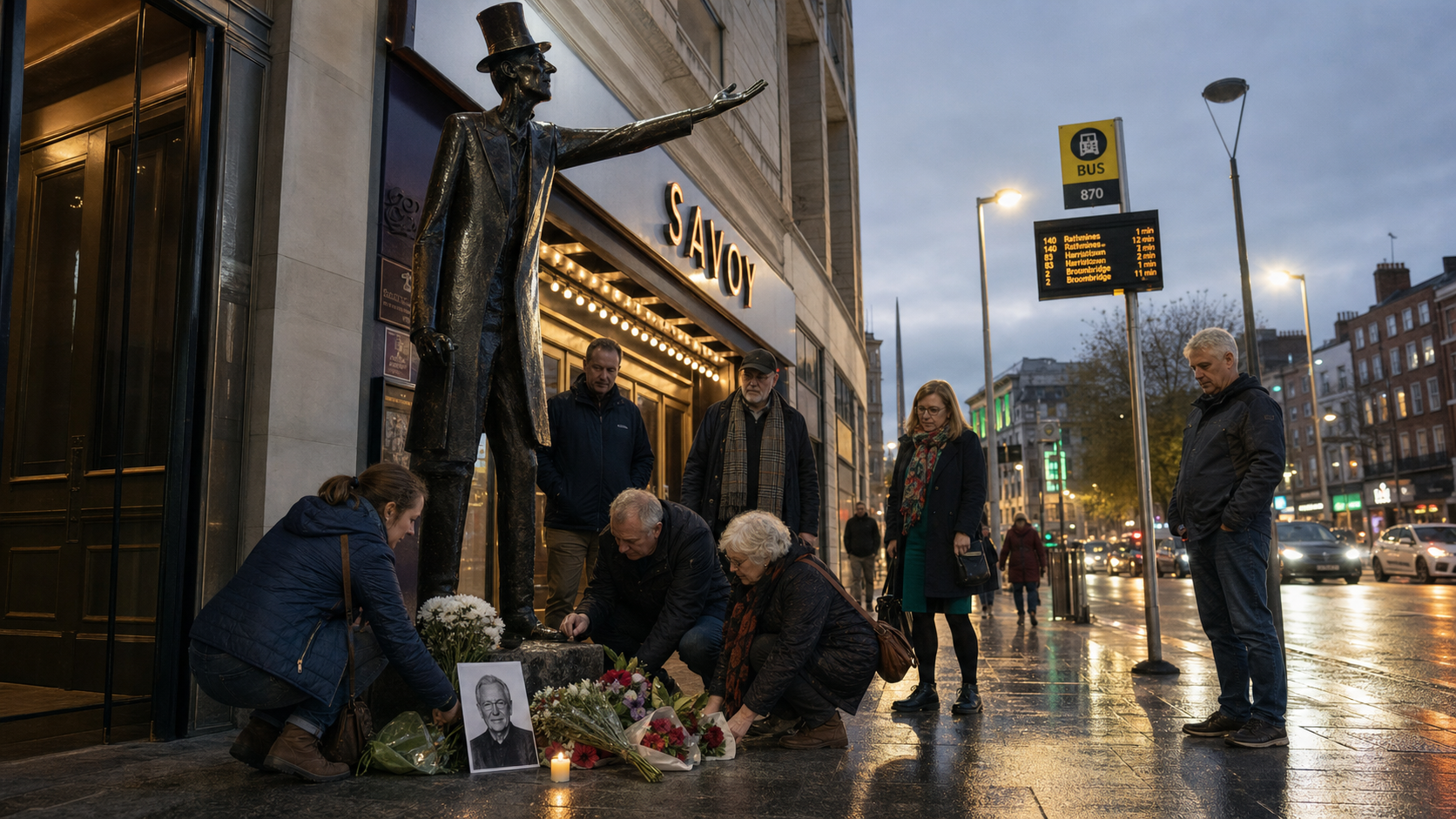
His most celebrated work, Mr Screen, was originally created in 1988 for the Screen Cinema on Hawkins Street in Dublin — a bronze caricature of a cinema usher that captured something of the particular character of Dublin's cultural life in the late 20th century. When the Screen Cinema closed and the building was demolished, the statue was relocated to the Savoy Cinema on O'Connell Street, where it has become one of the most photographed pieces of public art in the city. The Anti-War Memorial in Limerick, unveiled in 1987, is a more sombre work — a powerful statement about the human cost of conflict that has become a focal point for reflection and commemoration in the city. The Tree of Life in Blanchardstown, commissioned in 2005 for the Civic Offices, features a bronze structure with hand-welded leaves designed to resemble a DNA double helix — a work that speaks to the relationship between nature and science, tradition and modernity.
He is survived by his four children, six grandchildren, and his siblings.
Why It Matters
Vincent Browne's death is a significant loss for Irish culture, not just because of the quality of his individual works but because of what his career represented: a sustained commitment to the idea that art can and should be part of everyday life. His sculptures are not in galleries or museums — they are on streets, in civic spaces, in the places where people go about their daily business. They are encountered by people who may not think of themselves as art lovers, and they enrich those encounters in ways that are difficult to quantify but easy to feel.
The tradition of public art in Ireland has been shaped significantly by artists like Browne, who demonstrated that sculpture could be accessible without being simplistic, engaging without being populist. His influence on subsequent generations of Irish sculptors and public artists is considerable, and the works he left behind will continue to shape the experience of Irish cities for generations to come. The loss of an artist of his calibre is a reminder of the importance of supporting and celebrating the creative community that produces such work.
Local Impact
In Dublin, where Mr Screen has become one of the most recognisable pieces of public art in the city, the news of Browne's death has prompted an outpouring of affection from Dubliners who have grown up with his work as part of the fabric of their city. The Savoy Cinema, where the statue now stands, has become an informal gathering point for those wishing to pay their respects. In Limerick, the Anti-War Memorial has been the site of quiet reflection since the news of his death was announced, with flowers and tributes left at the base of the sculpture. In Blanchardstown, the Tree of Life has taken on a new significance as a memorial to the artist who created it. The Arts Council has indicated that it will work with local authorities and cultural institutions to ensure that Browne's legacy is appropriately commemorated in the months and years ahead.
What's Next
A funeral service for Vincent Browne is expected to take place in the coming days, with details to be announced by his family. The Arts Council of Ireland has indicated that it will organise a public tribute to his work in the autumn, bringing together artists, curators, and members of the public who have been touched by his sculptures over the decades. There are also discussions under way about the possibility of a retrospective exhibition of his work, which would provide an opportunity to see the full range of his output — from early works to the major public commissions of his later career — in a single context. His family has indicated that they will work with cultural institutions to ensure that his legacy is preserved and celebrated in a manner that reflects the warmth and generosity that characterised both his art and his life.