Tim Cook's Apple Era Ends as John Ternus Takes the Helm — Cork's 1,300-Strong Operation Watches Leadership Transition Closely
Tim Cook has stepped down as Apple's chief executive after 15 years at the helm of the world's most valuable company, with hardware engineering chief John Ternus assuming the CEO role from 1 September 2026 — a leadership transition that is being watched closely in Cork, where Apple's Irish operation employs more than 1,300 people and where the company's relationship with Ireland stretches back to the establishment of its first European manufacturing plant in Hollyhill in 1980.
Background
Apple's presence in Cork is one of the most significant and enduring relationships between a multinational corporation and an Irish city. The company established its European headquarters in Hollyhill in 1980, making Cork one of the first locations outside the United States where Apple had a significant operational presence. Over the following four and a half decades, that presence has evolved from a manufacturing operation into a complex, multi-functional hub encompassing engineering, operations, procurement, finance, and customer support.
Tim Cook's tenure as CEO, which began in August 2011 when he succeeded Steve Jobs, coincided with a period of extraordinary growth for Apple and for its Irish operation. Under Cook's leadership, Apple's market capitalisation grew from approximately $350 billion to $4.7 trillion, making it the most valuable company in the history of capitalism. The Cork operation grew in parallel, with the company investing in new facilities, expanding its workforce, and deepening its integration with the Irish economy.
The relationship between Apple and Ireland has not been without controversy. The European Court of Justice's 2024 ruling that Apple owed €13 billion in back taxes to the Irish government — a ruling that the Irish government had paradoxically opposed — was a significant moment in the ongoing debate about Ireland's corporate tax regime and its relationship with multinational corporations. The payment of those taxes, which was completed in late 2024, resolved the immediate legal dispute but did not end the broader conversation about the sustainability of Ireland's tax-based approach to attracting foreign direct investment.
Key Developments
John Ternus, who joined Apple in 2001 and served as senior vice president of Hardware Engineering since 2021, was chosen as Cook's successor following a unanimous vote by the board of directors. Ternus is recognised for his role in key hardware transitions, including the shift of Mac computers to Apple's proprietary silicon — a development that significantly improved the performance and efficiency of Apple's laptop and desktop computers. As CEO, he is expected to address ongoing challenges including the company's performance in artificial intelligence and the navigation of global supply chain volatility.
Cook transitions to the role of Executive Chairman of the Board, a position that will allow him to remain involved in Apple's strategic direction while stepping back from day-to-day operational responsibilities. His departure from the CEO role marks the end of an era for a company that has been defined, in many ways, by his particular combination of operational discipline, supply chain expertise, and diplomatic skill in managing Apple's relationships with governments, regulators, and business partners around the world.
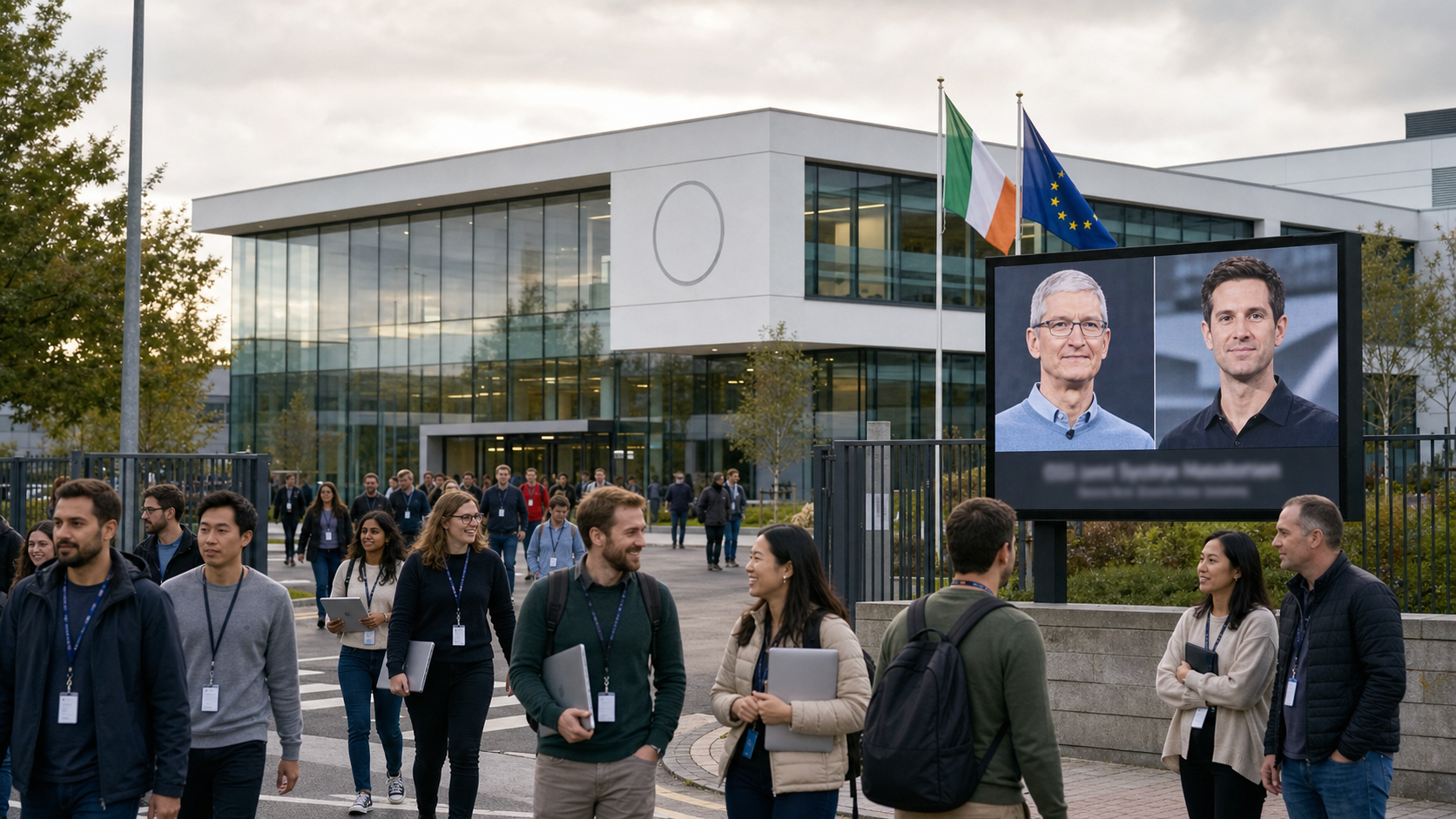
For Cork, the leadership transition comes at a moment of significant investment. Apple recently opened a new facility in Hollyhill capable of accommodating 1,300 workers, and has announced plans for a new office in Dublin — developments that suggest the company's commitment to its Irish operations remains strong under the new leadership. The Irish Examiner has reported that the Cork operation is expected to take on additional responsibilities in the areas of engineering and product development under the new CEO's tenure.
Why It Matters
Apple's leadership transition matters for Ireland because the company is one of the most significant contributors to the Irish economy, both directly through employment and investment and indirectly through the corporation tax revenues that have transformed Ireland's fiscal position in recent years. The company's continued commitment to its Irish operations is not guaranteed — multinational corporations make location decisions based on a complex set of factors, including tax policy, talent availability, infrastructure, and regulatory environment — and any signal about the direction of that commitment is closely watched by the Irish government and the IDA.
The transition from Cook to Ternus also matters because it represents a shift in Apple's leadership philosophy. Cook was, above all, an operations man — a supply chain expert who brought discipline and efficiency to a company that had been defined by its founder's creative vision. Ternus is a hardware engineer, and his appointment signals that Apple's board believes the company's next phase of growth will be driven by product innovation rather than operational optimisation. That shift could have implications for the nature of Apple's Irish operations, which have historically been more focused on operations and support than on engineering and product development.
Local Impact
In Cork, the leadership transition has been followed with interest but without alarm. The company's recent investment in the new Hollyhill facility and its announced plans for a Dublin office are seen as positive signals about its long-term commitment to Ireland. The Cork Chamber of Commerce has noted that Apple's presence in the city is a significant anchor for the broader technology ecosystem, attracting other companies and talent to the region. The IDA has indicated that it has been in contact with Apple's new leadership team and that the company's investment plans for Ireland remain on track. The University College Cork and Cork Institute of Technology, which supply significant numbers of graduates to Apple's Cork operation, have also expressed confidence in the company's continued presence in the city.
What's Next
John Ternus is expected to make his first major public statement as CEO at Apple's annual product launch event, which is scheduled for later in September. The event is expected to feature the launch of the iPhone 18 series and updates to other Apple product lines. Apple's next earnings report, which will be the first under Ternus's leadership, is scheduled for late October and will provide the first detailed picture of the company's financial performance under the new CEO. The IDA has indicated that it will meet with Apple's new leadership team in the coming weeks to discuss the company's investment plans for Ireland.