Dunsink, Armagh and Birr Castle Observatories Unite in Historic UNESCO World Heritage Bid
Three of Ireland's most historically significant astronomical observatories — Dunsink in Dublin, Armagh in Northern Ireland, and Birr Castle Demesne in County Offaly — have launched a joint bid for UNESCO World Heritage recognition, drawing on their combined history of scientific discovery and their collective significance in the development of modern astronomy and astrophysics.
Background
Ireland has a richer astronomical heritage than is commonly appreciated. The island's three great observatories — Dunsink, Armagh, and Birr — were each established in the 18th or 19th century and each made contributions to the development of astronomy that were recognised internationally in their time. Together, they represent a remarkable concentration of scientific heritage on a small island, and their joint bid for UNESCO recognition reflects a growing awareness of the importance of preserving and celebrating that heritage.
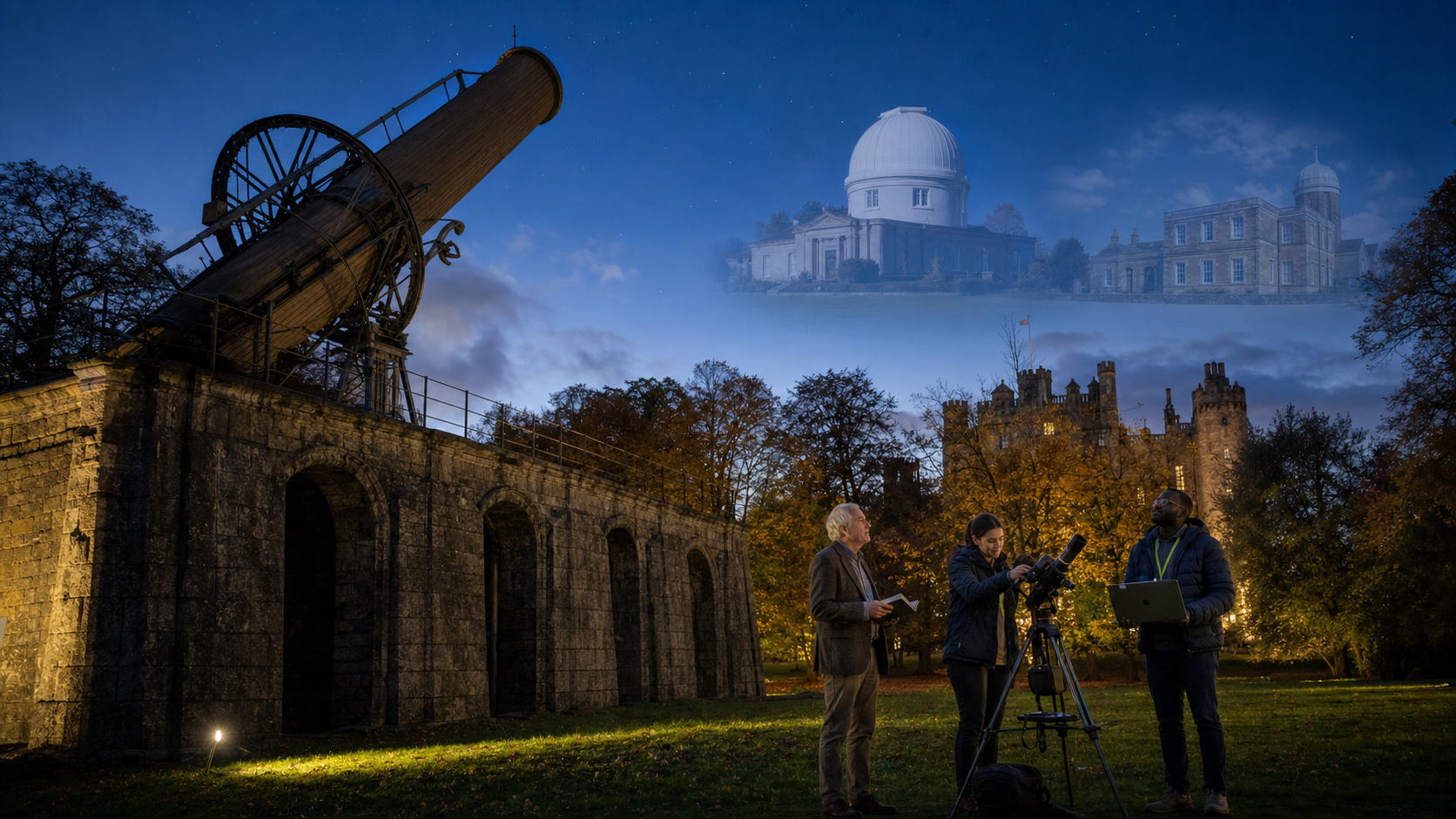
Dunsink Observatory, established in 1785 on the outskirts of Dublin, is one of the oldest scientific institutions in Ireland. It was the home of William Rowan Hamilton, one of the greatest mathematicians of the 19th century, who made fundamental contributions to algebra, optics, and classical mechanics. The observatory is now operated by the Dublin Institute for Advanced Studies and continues to be used for research and public engagement.
Armagh Observatory, founded in 1790, is one of the oldest meteorological stations in the world and has maintained a continuous record of weather observations since its establishment. The observatory has also made significant contributions to stellar astronomy and is now part of the Armagh Observatory and Planetarium, which serves as a major centre for public science education in Northern Ireland.
Birr Castle Demesne in County Offaly is home to the Great Telescope, built by the third Earl of Rosse in the 1840s. At the time of its construction, it was the largest telescope in the world, and it was used to make the first observations of the spiral structure of galaxies — a discovery that fundamentally changed our understanding of the universe. The telescope has been restored to working order and is now a major heritage attraction.
Key Developments
The joint UNESCO bid, which has been in preparation for several years, was formally launched this week as part of Heritage Week 2026. The bid argues that the three observatories, taken together, represent an outstanding example of the scientific culture of the 18th and 19th centuries and that their combined heritage meets the criteria for UNESCO World Heritage designation.
The bid is notable for its cross-border dimension, bringing together institutions in the Republic of Ireland and Northern Ireland in a collaborative project that reflects the all-island nature of Ireland's scientific heritage. The involvement of Armagh Observatory, which is funded by the Northern Ireland Executive, alongside Dunsink and Birr, which are in the Republic, demonstrates the potential for cross-border cultural cooperation in the heritage sector.
The Heritage Council, which is coordinating the bid on behalf of the three institutions, has engaged with UNESCO's advisory bodies and is confident that the bid meets the necessary criteria. A formal submission is expected to be made to UNESCO in the autumn, with a decision anticipated within the next two to three years.
Why It Matters
UNESCO World Heritage designation is one of the most prestigious forms of international recognition available to cultural and natural heritage sites. It brings with it significant benefits in terms of tourism, conservation funding, and international profile, and it provides a powerful framework for the long-term protection of the designated sites.
For Ireland, the designation of the three observatories would be a significant achievement, adding to the country's existing UNESCO World Heritage Sites — which include Brú na Bóinne, Skellig Michael, and the Giant's Causeway — and reinforcing Ireland's profile as a country with a rich and diverse heritage. It would also draw attention to a dimension of Irish heritage — its scientific legacy — that is less well-known internationally than its archaeological and natural heritage.
The bid also has an important educational dimension. The three observatories are all engaged in public science education, and UNESCO designation would significantly enhance their ability to attract visitors and to communicate the importance of science and scientific heritage to new audiences. In a country that is seeking to develop its STEM education and its technology sector, the celebration of Ireland's scientific heritage is both culturally valuable and economically significant.
Local Impact
In County Offaly, the Birr Castle Demesne is already a significant heritage attraction, drawing visitors from across Ireland and internationally. UNESCO designation would substantially increase the site's profile and visitor numbers, with significant economic benefits for the town of Birr and the surrounding area. In Armagh, the observatory and planetarium are central to the city's cultural and educational offer, and designation would reinforce Armagh's position as a heritage destination of international significance.
In Dublin, Dunsink Observatory has been the subject of significant investment in recent years, with the Dublin Institute for Advanced Studies working to restore and develop the site as a centre for research and public engagement. UNESCO designation would provide a powerful boost to these efforts and would help to secure the long-term future of one of Dublin's most historically significant scientific institutions.
What's Next
The formal UNESCO submission is expected to be made in the autumn of 2026, following a period of final preparation and consultation with UNESCO's advisory bodies. The submission will be assessed by the World Heritage Committee, which meets annually to consider new nominations. A decision is expected within two to three years. In the meantime, the three observatories will continue their public engagement programmes and will use the UNESCO bid as an opportunity to raise awareness of Ireland's astronomical heritage.