Therapy Dogs Bringing Calm and Comfort to Children Across Northern Ireland as Demand for Animal-Assisted Support Grows
Across Northern Ireland's hospitals, schools, and care settings, a quiet revolution in child wellbeing is under way — one led not by clinicians or policymakers, but by a growing cohort of trained therapy dogs whose calming presence is transforming how children engage with some of the most stressful environments they will ever encounter.
Background
Assistance Dogs Northern Ireland (ADNI) has been at the forefront of animal-assisted therapy in the region for over a decade, training dogs — predominantly Labradoodles, chosen for their hypoallergenic coats and gentle temperament — to work alongside children with autism, severe anxiety, and complex medical needs. The organisation's approach is grounded in Animal Assisted Therapy (AAT), a structured therapeutic model with measurable goals, rather than the more informal "pet therapy" visits that have become common in care homes and hospices.
The science underpinning the work is well established. Interaction with trained animals has been shown to lower cortisol levels, reduce heart rate, and improve emotional regulation in children who might otherwise struggle to engage with medical or educational settings. For children with autism spectrum disorder in particular, the non-judgemental, consistent presence of a therapy dog can provide a bridge to social interaction that human relationships sometimes cannot.
ADNI's training programme is rigorous. Puppies begin their preparation at eight to twelve weeks old, with weekly sessions continuing for approximately a year before a dog is deemed ready for deployment. The investment of time and resources is considerable — and it is precisely this cost that the organisation says is preventing it from meeting the full scale of demand it now faces.
Key Developments
As of this week, ADNI has 34 fully trained therapy dogs operating across Northern Ireland, with a further six currently in training. The dogs are active in a wide range of settings: the Royal Victoria Hospital and the Belfast City Hospital, primary schools in County Armagh and County Down, youth courts, and specialist autism units. One of the programme's most striking success stories involves a Labradoodle named Mia, whose work at a Belfast paediatric ward has helped children overcome phobias of blood tests and medical procedures that had previously required sedation or significant clinical intervention.
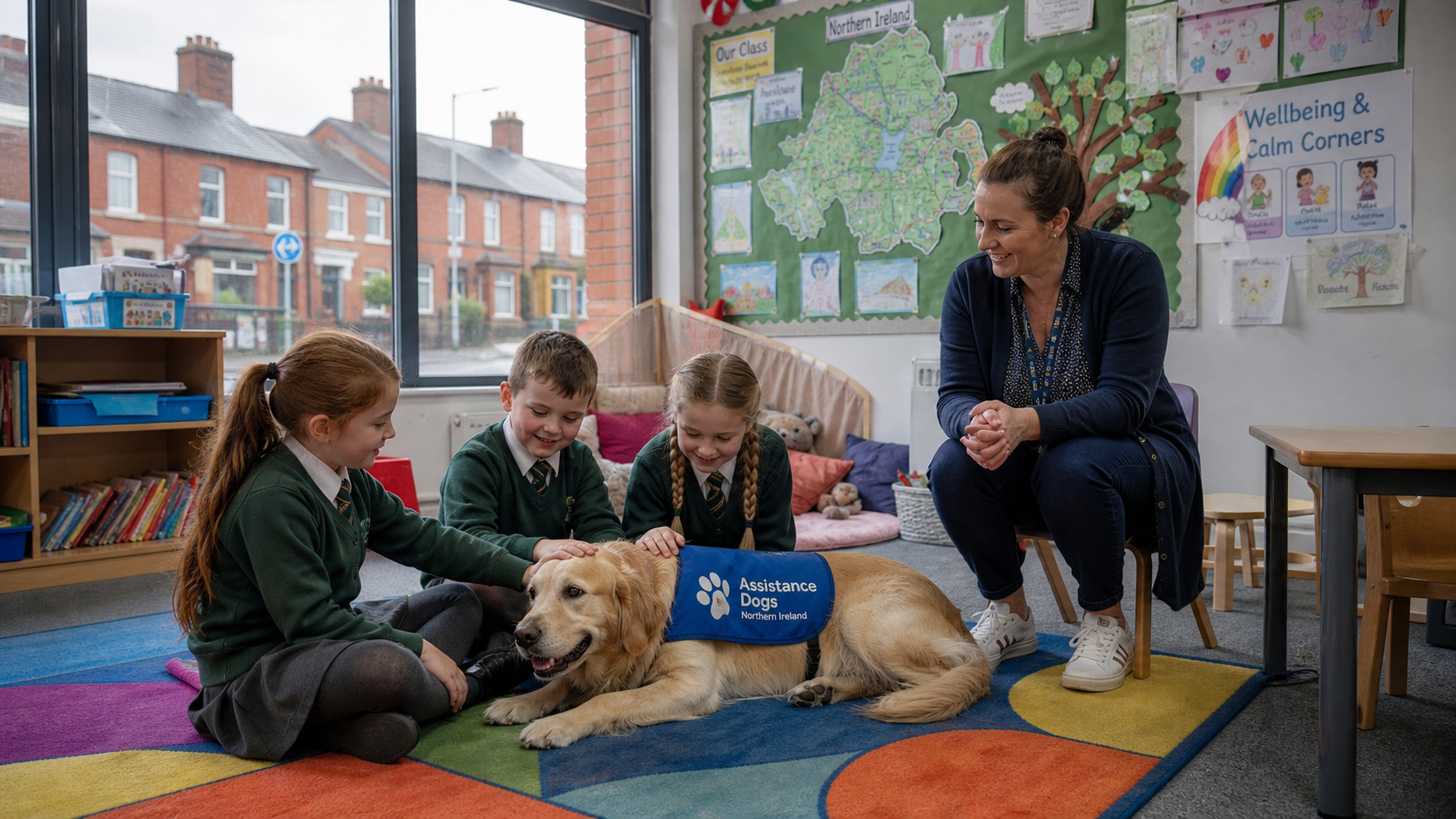
At Edenderry Primary School in County Armagh, the school's resident therapy dog has been credited with improving attendance rates among pupils with anxiety-related difficulties, with teachers reporting that children who previously refused to enter the building are now arriving willingly, motivated by the prospect of time with the dog. The school's principal described the impact as "transformative in a way that no curriculum intervention has been."
ADNI's chief executive noted this week that demand for the programme has increased sharply over the past two years, driven in part by the post-pandemic surge in childhood anxiety and the growing recognition of autism as a lifelong condition requiring sustained support. "We are turning away families who need us," she said. "That is not a position any organisation wants to be in."
Why It Matters
The growth of animal-assisted therapy in Northern Ireland sits within a broader context of acute pressure on children's mental health services. The Belfast Health and Social Care Trust's CAMHS waiting lists remain among the longest in the United Kingdom, and the Western and Southern trusts have faced repeated criticism for the time children wait before receiving any form of specialist support. Against this backdrop, the work of organisations like ADNI represents not a luxury but a practical, cost-effective intervention that reduces the burden on overstretched clinical services.
The economic argument is compelling. ADNI estimates that each successful intervention — a child who can attend a blood test without sedation, a pupil who re-engages with school — generates measurable savings for the NHS and the education system. Unlike pharmaceutical interventions or extended clinical programmes, a therapy dog visit requires no prescription, no referral pathway, and no waiting list. The barrier is funding, not efficacy. This is the third consecutive year that ADNI has raised the alarm about the gap between demand and capacity, and the organisation is now formally requesting that the Department of Health and the Department of Education consider ring-fenced funding for animal-assisted therapy as part of the next Programme for Government.
Local Impact
The practical reach of ADNI's work spans the length and breadth of Northern Ireland. In Derry, dogs have been deployed to support children giving evidence in the city's youth court, reducing the trauma associated with the legal process. In Newry, a therapy dog programme at a special educational needs unit has been credited with reducing the number of behavioural incidents requiring physical intervention. In rural Fermanagh and Tyrone, where access to specialist services is particularly limited, ADNI's outreach visits to schools represent one of the few structured mental health supports available to children outside of a hospital setting. The organisation is also responding to growing demand from families of autistic adults, recognising that the need for animal-assisted support does not end at eighteen.
What's Next
ADNI will present its case for sustainable government funding to the Stormont Health Committee in October, ahead of the Executive's budget deliberations. The organisation is also in discussions with the Education Authority about a pilot programme that would place trained therapy dogs in ten primary schools across the most deprived areas of Belfast and Derry. A decision on that pilot is expected before the end of the year. In the meantime, ADNI is continuing to train its next cohort of six dogs, with deployment expected in early 2027.