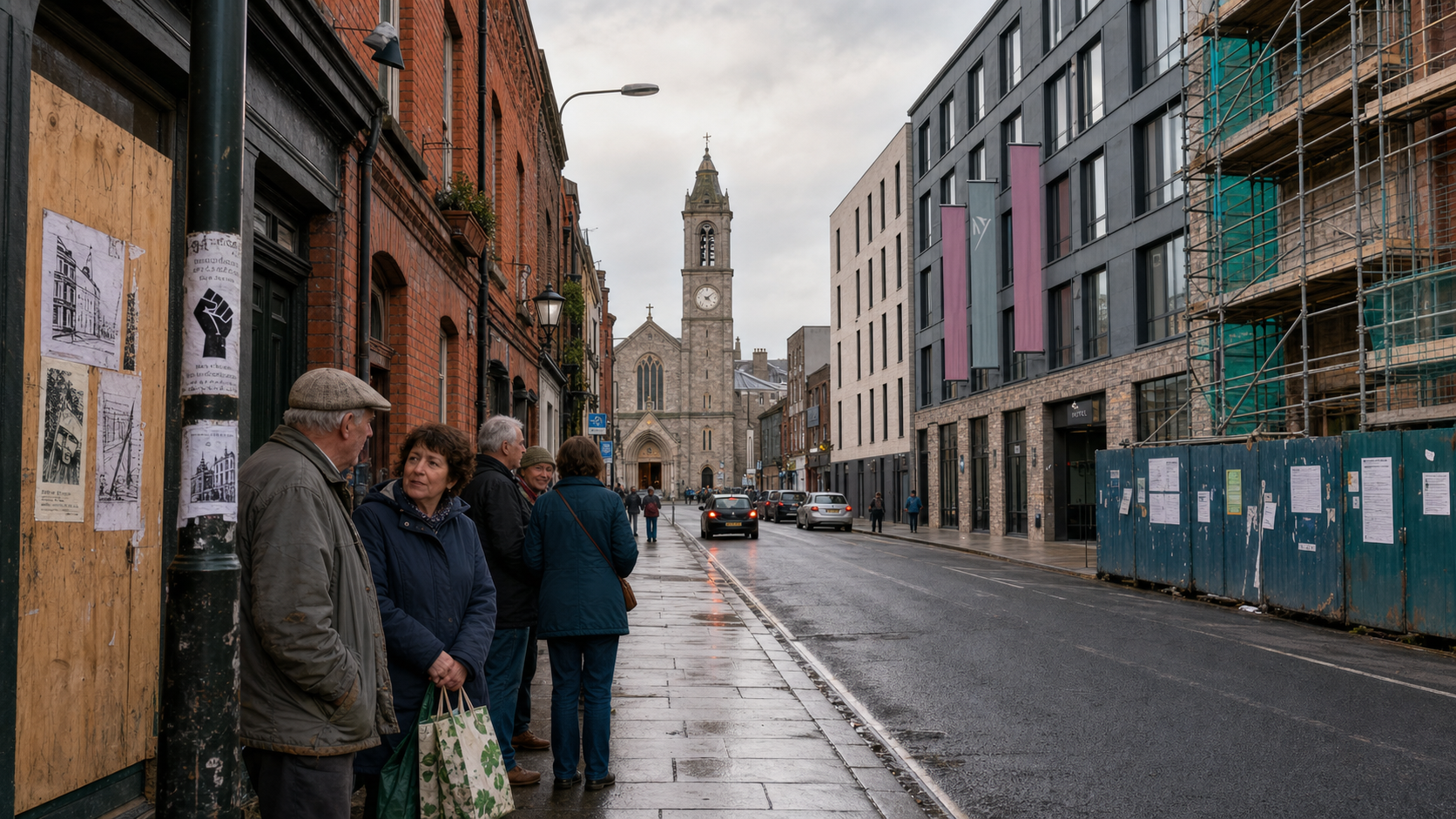
Dublin's Liberties: A Historic Quarter Fighting for Its Soul as Development Pressure Mounts
Dublin's historic Liberties quarter, one of the oldest and most culturally significant areas of the capital, is facing an identity crisis as long-term residents, community groups, and cultural organisations warn that the area is "sadly dying, fading away" under the combined pressure of development, tourism, and the displacement of the working-class communities that have defined its character for generations.
Background
The Liberties is one of Dublin's oldest neighbourhoods, its history stretching back to the medieval period when it lay outside the jurisdiction of the city's civic authorities — hence the name. The area has been home to successive waves of immigrants and working-class communities, from the Huguenot weavers who established the silk industry in the 17th century to the families who lived in the flat complexes built in the 1950s and 1960s to replace the tenements of an earlier era.
The Liberties has always been a place of contradictions: poverty and creativity, hardship and community solidarity, decline and renewal. The area gave Dublin the Guinness Brewery, which has dominated the skyline of the south-west inner city for over 250 years, and it has produced writers, musicians, and artists who have drawn on its distinctive character and history. It is also an area that has experienced significant deprivation, with high rates of unemployment, poor housing, and limited access to services.
In recent years, the Liberties has been the focus of significant development activity, driven by its proximity to the city centre, its relatively low land values compared to other inner-city areas, and its designation as a Strategic Development and Regeneration Area under the Dublin City Development Plan. New apartment developments, hotels, and commercial premises have transformed parts of the area, bringing investment but also raising concerns about the displacement of existing communities and the erosion of the area's distinctive character.
Key Developments
The Irish Times has published a major investigation into the state of the Liberties, drawing on interviews with long-term residents, community leaders, and cultural organisations. The picture that emerges is one of an area under profound stress, with the traditional street life, local businesses, and community networks that have sustained the Liberties for generations under threat from forces that are difficult to resist.
Dublin City Council's regeneration strategy for the area, which is outlined in the Liberties Local Area Plan, attempts to balance the need for new housing and economic development with the preservation of the area's heritage and community character. The strategy identifies nine key sites for redevelopment, including the Guinness Quarter and the Digital Hub lands, and includes commitments to social housing regeneration, public realm improvements, and the support of cultural infrastructure.
The Iveagh Markets, a magnificent Victorian market building on Francis Street that has been closed for decades, remains a symbol of the area's unrealised potential. Plans for its reopening have been discussed for years, but progress has been slow, and the building continues to deteriorate while the community waits for a resolution.
Why It Matters
The Liberties is not just a neighbourhood — it is a repository of Dublin's working-class history and culture. The loss of that history, through the displacement of communities and the erasure of the physical fabric that embodies it, would be an irreversible impoverishment of the city's cultural life. Dublin has already lost much of its historic inner-city character to development and gentrification, and the Liberties represents one of the last areas where that character survives in recognisable form.
The challenge facing the Liberties is not unique to Dublin. Cities across Ireland and Europe are grappling with the tension between the need for new housing and economic development and the desire to preserve the character and community life of historic urban areas. The solutions are rarely simple, and they require a level of political will and community engagement that is not always forthcoming.
The regeneration strategy's emphasis on social housing, public realm improvements, and cultural infrastructure is the right approach in principle, but its success will depend on the pace and quality of implementation. The history of urban regeneration in Dublin suggests that good intentions do not always translate into good outcomes for existing communities.
Local Impact
In the Liberties itself, the debate about the area's future is intensely felt. Long-term residents who have watched their neighbourhood change dramatically over the past decade are concerned about the pace of development and the lack of meaningful consultation with existing communities. Community organisations, including the Liberties Association and a range of local groups, have been vocal in their advocacy for a regeneration approach that puts people first.
The area's cultural institutions — including the Irish Museum of Modern Art at the Royal Hospital Kilmainham, the Digital Hub, and a range of smaller arts organisations — have a stake in the outcome of the regeneration process and have been active participants in the debate about the area's future. Their presence is both a resource and a reminder of the cultural richness that the Liberties has to offer.
What's Next
Dublin City Council is expected to publish an updated Liberties Local Area Plan in the coming months, incorporating feedback from the public consultation process that has been underway. The council has committed to a series of community engagement events in the autumn, at which residents and community groups will have the opportunity to input into the planning process. The future of the Iveagh Markets is expected to be a central issue in these discussions, with the council under pressure to bring forward a viable plan for the building's restoration and reuse.