Talkback at 40: Four Decades of Northern Ireland's Most Distinctive Public Voice
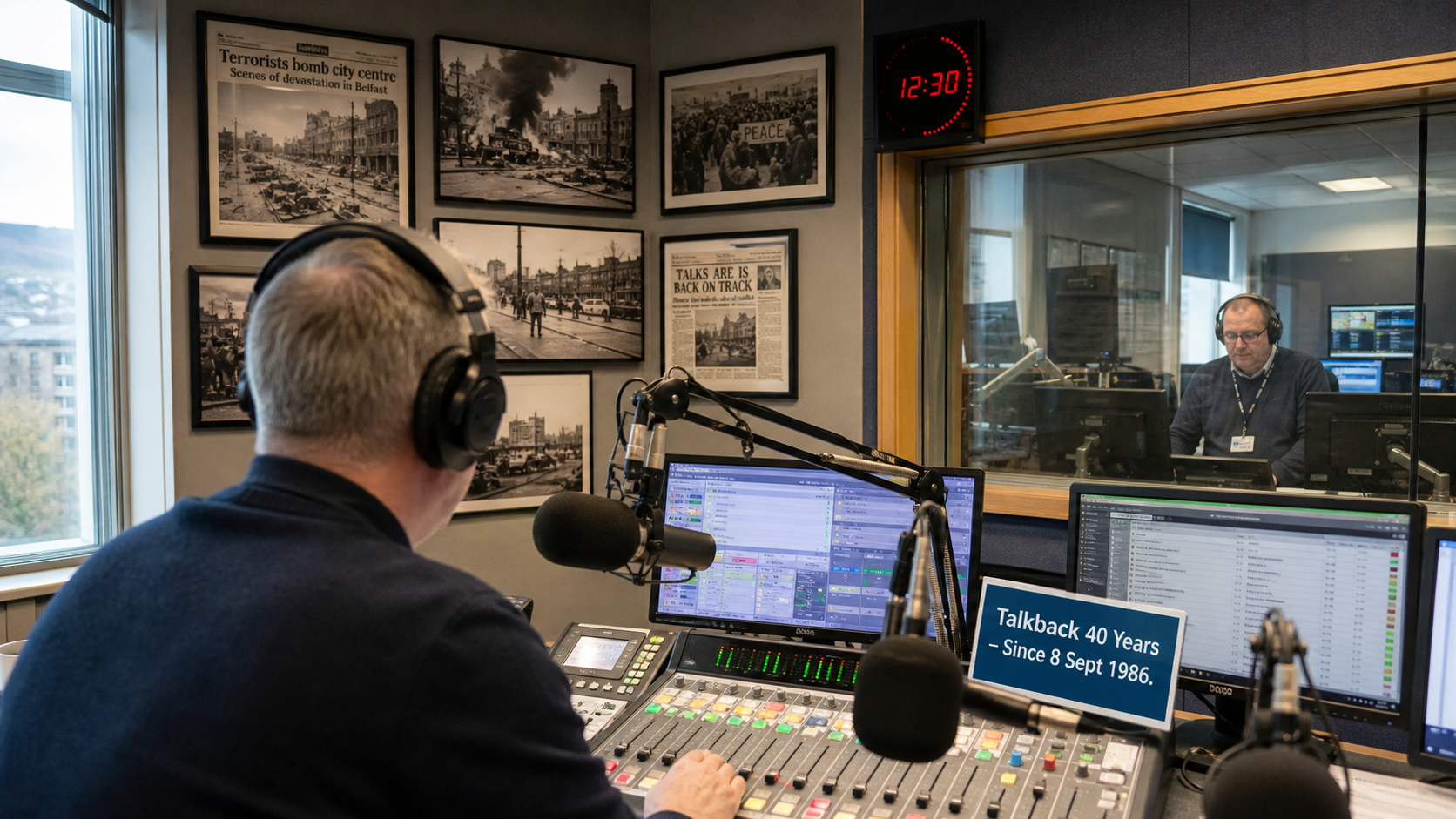
BBC Radio Ulster's Talkback programme celebrates its 40th anniversary today, having first broadcast on September 8, 1986, with a discussion of the Anglo-Irish Agreement and a leaked government document. What began as a straightforward phone-in has evolved into one of the most distinctive public forums in these islands — a programme that has hosted Ian Paisley, John Hume, Desmond Tutu, and a pre-presidential Donald Trump, and that has given ordinary people in Northern Ireland a platform to speak about their lives through some of the most turbulent decades in the region's history.
Background
When Talkback first went to air in September 1986, Northern Ireland was in the grip of the Troubles. The Anglo-Irish Agreement, signed the previous November, had provoked a furious unionist backlash, and the political temperature was as high as it had been in years. Into this environment, BBC Radio Ulster launched a daily phone-in programme that invited listeners to call in and speak their minds — a format that was, in the context of Northern Ireland at the time, genuinely radical. The idea that ordinary people from both communities could share a platform and debate the issues of the day was not something that could be taken for granted in a society where the divisions ran so deep.
The programme's first presenter, Barry Cowan, set a tone of intellectual rigour and political engagement that would define Talkback for years. Cowan was known for his forensic interviewing style and his ability to hold politicians to account in a way that was unusual for regional radio at the time. His most famous moment came in 1986 when the Reverend Ian Paisley walked out of the studio following a heated exchange — an incident that became part of Northern Ireland broadcasting folklore and that illustrated both the programme's willingness to challenge power and the volatility of the political environment it was navigating.
Over four decades, Talkback has been led by four permanent presenters: Cowan, David Dunseith (who served for 20 years and was known for a robust but courteous style), Wendy Austin (who took over in 2009 and broke barriers for female broadcasters in the region), and the current presenter William Crawley, who assumed the role in November 2014. Each has brought a distinct personality to the programme while maintaining its core identity as a space for genuine public debate.
Key Developments
The programme's 40-year archive is a remarkable document of Northern Ireland's social and political history. In 1993, SDLP leader John Hume used Talkback to discuss his controversial decision to initiate talks with Sinn Féin's Gerry Adams — a conversation that was, at the time, deeply contentious and that prefigured the peace process that would eventually produce the Good Friday Agreement. The programme has also provided a platform for some of the most personal and painful testimonies in Northern Ireland's recent history, including the account of Helen McKendry regarding the abduction and murder of her mother, Jean McConville, by the IRA.
Among the more unexpected moments in the programme's history is an interview from the 1980s with a then-relatively unknown American businessman named Donald Trump, who discussed his views on wealth and success. The clip has taken on a different resonance in the years since Trump's political rise, and it has been replayed on the programme's anniversary coverage as a reminder of how much the world has changed since Talkback first went to air.
Under William Crawley's stewardship, the programme has adapted to the changing media landscape, incorporating podcasting and digital distribution while maintaining its radio identity. The format has shifted somewhat toward more structured panel discussions, though the phone-in element remains central to the programme's identity. Crawley has described Talkback as a "people's parliament" — a phrase that captures both its ambition and its limitations, since a phone-in programme is inevitably shaped by who chooses to call.
Why It Matters
Talkback's longevity is not simply a matter of institutional inertia. The programme has survived because it fills a genuine need in Northern Ireland's public life — a need for a space where the issues that matter to ordinary people can be debated openly, without the filtering that characterises much political communication. In a society where the legacy of the Troubles continues to shape public discourse, and where the divisions between communities remain real even as the violence has receded, a programme that brings different voices together has a value that goes beyond entertainment or information.
The comparison with equivalent programmes elsewhere in the UK and Ireland is instructive. RTÉ Radio 1's Liveline, which has been running since 1993, occupies a similar space in the Republic — a daily phone-in that serves as a barometer of public mood and a platform for stories that might not otherwise receive attention. But Talkback predates Liveline by seven years and has operated in a more politically charged environment. The fact that it has maintained its credibility across four decades, through the Troubles, the peace process, the Brexit referendum, and the ongoing tensions over the Protocol and its successor arrangements, is a genuine achievement.
For the BBC, Talkback represents one of its most successful regional public service broadcasting outputs — a programme that justifies the licence fee in the most direct way possible, by giving citizens a voice and holding power to account at a local level.
Local Impact
Across Northern Ireland, Talkback has become part of the daily rhythm of life in a way that few media programmes achieve. In Belfast, in Derry, in the rural communities of Fermanagh and Tyrone, the programme is a fixture of the morning — something that people listen to in the car, in the kitchen, or at work, and that gives them a sense of connection to the broader public conversation. The programme's ability to reflect the concerns of communities across the region — from housing and health to culture and sport — has made it genuinely representative in a way that more metropolitan media often fails to be. Its 40th anniversary is a moment to acknowledge that achievement and to recognise the contribution of the four presenters, the production teams, and the thousands of listeners who have called in over the decades.
What's Next
Talkback will mark its anniversary with special programming throughout September, including archive material and interviews with former presenters and notable guests. William Crawley has indicated that the programme will continue to evolve its format in response to changing listener habits, with an expanded digital presence planned for the coming year. The BBC's broader review of its regional radio output, which is expected to conclude before the end of 2026, will be watched closely by Talkback's audience — any reduction in the programme's airtime or budget would be strongly resisted by its loyal listenership. For now, the programme enters its fifth decade in good health, still asking the questions that matter to the people of Northern Ireland.