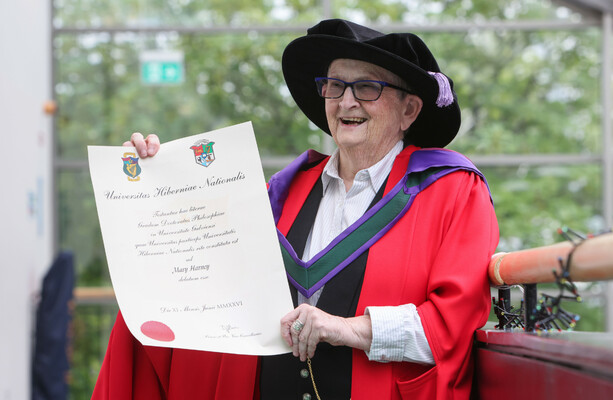
Survivor of Ireland's Mother and Baby Homes Awarded PhD at 77 in Galway — 'It Is Never Too Late'
A 77-year-old woman who spent part of her childhood in one of Ireland's mother and baby homes has been awarded a doctorate by the University of Galway, completing a journey of academic achievement that began decades after the institutional trauma she endured as a child. The conferral ceremony this week was met with a standing ovation from staff and fellow graduates, and her story has since resonated far beyond the walls of the university.
Background
Ireland's mother and baby homes were institutions that operated for much of the twentieth century, housing unmarried mothers and their children in conditions that a landmark government commission of investigation, which reported in 2021, found to be characterised by neglect, poor care, and in many cases, profound cruelty. Thousands of children died in these institutions; many more were separated from their mothers and adopted, often without proper consent. The survivors of these homes have spent decades seeking acknowledgement, justice, and truth.
For the woman who received her doctorate this week — who has chosen to be identified only by her first name, Máire, in keeping with her wish for a degree of privacy — the journey to Galway's conferral hall was anything but straightforward. She spent her early years in one of the homes before being placed with a family, and the disruption to her education was severe. She left school without qualifications and spent much of her adult life working in domestic service and later in community care.
It was not until her sixties that Máire began to engage formally with education again, initially through adult literacy programmes and later through access courses at the University of Galway. Her doctoral research, completed over seven years, examines the lived experiences of women in Irish institutional care during the mid-twentieth century — a subject she knows with an intimacy that no archive can replicate.
Key Developments
The conferral ceremony took place at the University of Galway's Aula Maxima on Thursday, with Máire receiving her doctorate in social history. Her supervisor described her as "one of the most rigorous and courageous researchers I have encountered in thirty years of academic life." The thesis, which runs to over 90,000 words, draws on oral history interviews with more than forty survivors and has already attracted interest from publishers.
"It is never too late," Máire told reporters after the ceremony, visibly moved but composed. "I was told many times that education was not for people like me. I want every person who was told that to know that it was a lie." Her words were met with applause from the gathered crowd, which included fellow survivors of the mother and baby homes who had travelled from across Ireland to witness the occasion.
The University of Galway's president offered a formal acknowledgement of the institution's role in supporting survivors of historical abuse through education, noting that the university had in recent years developed specific access pathways for mature students from disadvantaged backgrounds.
Why It Matters
Máire's achievement matters on multiple levels. At the most personal level, it is a story of extraordinary individual determination — of a woman who refused to allow the circumstances of her early life to define the limits of her later one. But it is also a story about Ireland's ongoing reckoning with its institutional past.
The mother and baby homes commission report was a watershed moment in Irish public life, but the process of acknowledgement and redress has been slow and contested. Many survivors have expressed frustration with the pace of the government's response and the limitations of the redress scheme. In that context, Máire's doctorate carries a particular weight: it is a form of self-authored justice, a reclamation of the intellectual life that was denied to her and to thousands like her.
It is also a reminder that the consequences of institutional abuse do not end with the closure of the institutions. They ripple through lifetimes, shaping educational trajectories, economic opportunities, and self-belief. The fact that Máire has overcome those consequences so spectacularly does not diminish the scale of what was taken from her — but it does offer something genuinely hopeful to those still carrying similar burdens.
Local Impact
In Galway, the response to Máire's conferral has been warm and immediate. The university's access and lifelong learning office has reported a significant increase in enquiries from mature students in the days since her story became public. Several local community organisations that work with survivors of historical abuse have reached out to the university to explore partnership opportunities. The Galway Survivors Network, which supports former residents of institutional care in the west of Ireland, described the news as "a moment of pure joy in what has been a long and painful journey for so many of our members."
What's Next
Máire's thesis is expected to be submitted for publication consideration in the coming months, with her supervisor expressing confidence that it will find a publisher. She has also been invited to speak at a conference on historical institutional abuse in Dublin in September. The University of Galway is exploring the possibility of establishing a small bursary in her name to support other mature students from disadvantaged backgrounds pursuing postgraduate research. For Máire herself, the immediate plan is simpler: "I am going to have a very large cup of tea and a very long sleep," she said, laughing, as she left the Aula Maxima with her doctorate in hand.