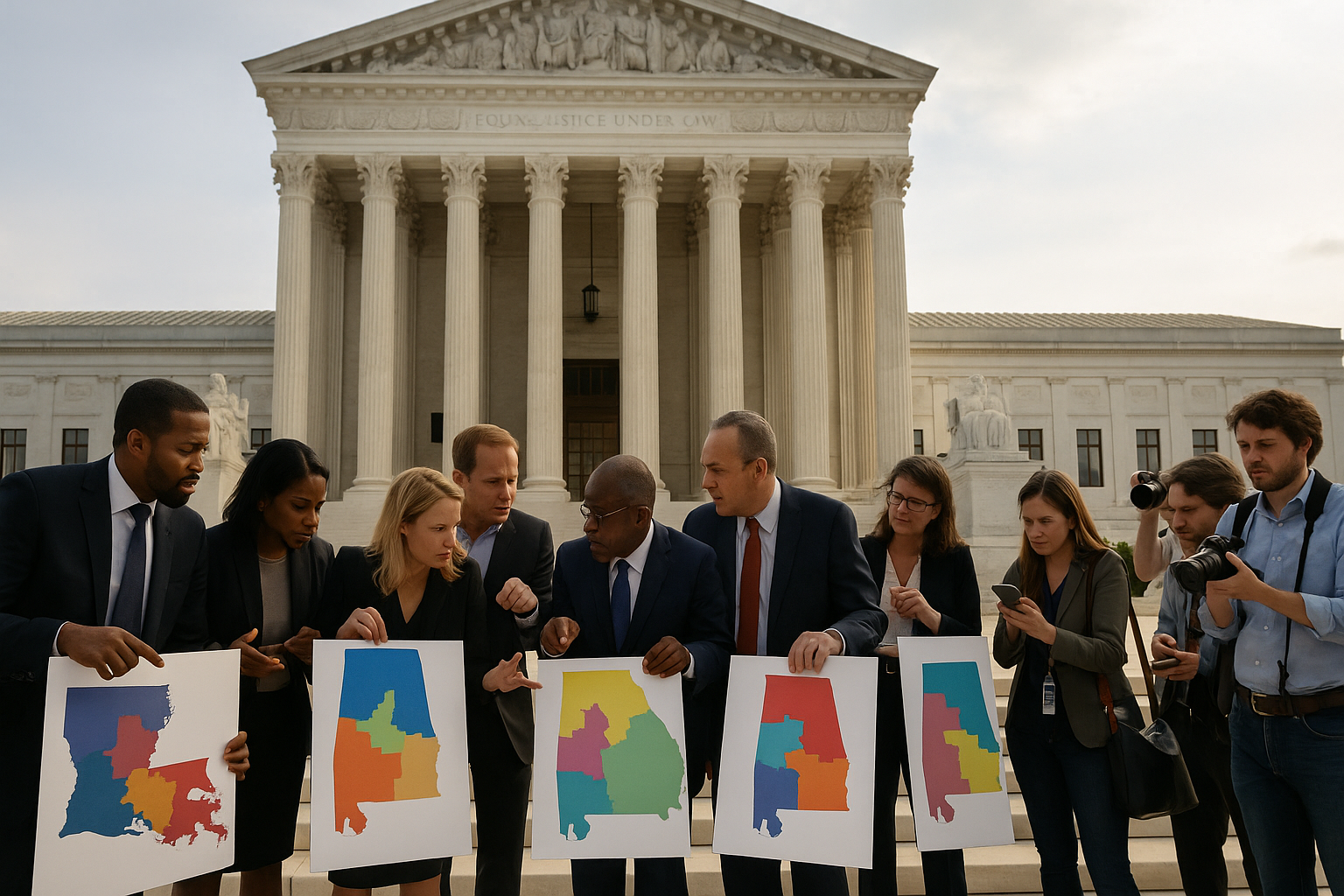
Supreme Court Fast-Tracks VRA Ruling, Sending Southern States Into Redistricting Chaos
The Supreme Court took the extraordinary step of waiving its customary 32-day waiting period on May 4, allowing its landmark Voting Rights Act ruling to take effect immediately — a procedural move that triggered emergency legislative sessions across five Southern states and ignited one of the sharpest intra-Court exchanges in years. Justice Ketanji Brown Jackson accused the majority of "spawning chaos," while Justice Samuel Alito called her dissent "utterly irresponsible." The political and electoral consequences are already unfolding in real time.
Background
The underlying ruling, handed down on April 29 in Callais v. Louisiana, effectively gutted Section 2 of the Voting Rights Act of 1965. The 6-3 conservative majority struck down a Louisiana congressional map that had created a second Black-majority district, ruling that the map relied too heavily on race in violation of the Equal Protection Clause. The decision reversed decades of precedent that had required states to draw majority-minority districts to ensure minority representation in Congress.
The ruling's immediate scope was already sweeping — analysts at the Brennan Center for Justice projected it could cost Democrats up to 19 House seats across the South. But the Court's May 4 decision to expedite implementation transformed a legal earthquake into an operational emergency for state governments still managing active primary election cycles.
Key Developments
Louisiana Governor Jeff Landry moved first, postponing congressional primary elections where absentee voting was already underway and calling an emergency legislative session to redraw the state's map. The move drew immediate legal challenges from voting rights organizations, who argued that halting an active election mid-stream violated state and federal procedural law.
Alabama Governor Kay Ivey called a special session to move the state's May 19 primary in affected districts, citing the need to draw new maps before voters go to the polls. Republican leaders in Arizona, Florida, Georgia, and Mississippi announced similar emergency sessions, with Florida's Republican-controlled legislature signaling it would move aggressively to consolidate minority-held districts.
The New York Times analysis projects Democrats could lose a dozen House seats across the South under the new legal framework. A separate analysis by the National Democratic Redistricting Committee estimates Republicans could gain more than 190 seats in 10 Southern state legislatures if the ruling is applied broadly to state-level maps as well.
Why Americans Should Care
The immediate electoral consequences fall hardest on Black and Latino voters in Alabama, Georgia, Louisiana, Mississippi, and Florida — states where majority-minority congressional districts have been the primary mechanism for electing minority representatives to Congress since the 1990s. Congressional districts in Georgia's Atlanta suburbs, Louisiana's New Orleans corridor, and Alabama's Black Belt region face the most direct threat of being redrawn in ways that dilute minority voting power.
For voters in North Carolina and Virginia — states that have their own pending redistricting litigation — the ruling creates legal uncertainty about whether their current maps will survive court scrutiny. The downstream effect on the 2026 midterm map is significant: if Democrats lose even eight to ten House seats in the South due to redistricting, Republicans could expand their House majority regardless of the national political environment. Federal policy on healthcare, housing, and immigration would shift accordingly.
Why It Matters
The Supreme Court's decision to expedite implementation is itself historically unusual. Courts typically allow a 25-to-32-day window before a ruling takes effect, giving affected parties time to seek emergency stays. By waiving that window at the request of the Louisiana map challengers, the majority signaled that it views the redistricting timeline — not the disruption to ongoing elections — as the paramount concern.
The historical parallel is instructive. After the Court's 2013 ruling in Shelby County v. Holder, which gutted the VRA's preclearance requirement, Republican-controlled states moved within hours to enact voting restrictions that had previously been blocked. The pattern repeated itself in 2021 after Brnovich v. Democratic National Committee narrowed Section 2 enforcement. Each ruling has been followed by a rapid legislative response that outpaced legal challenges. The current ruling goes further than either predecessor, and the Court's decision to accelerate implementation suggests the majority anticipated — and accepted — the disruption that would follow. International observers note that no comparable democracy allows a court ruling to immediately invalidate active election procedures without a transition period, making the US approach an outlier in democratic governance.
What's Next
Emergency legal challenges are already moving through federal district courts in Louisiana and Alabama. Voting rights organizations have filed for emergency injunctions to halt the redistricting sessions pending further review. The Supreme Court will likely face requests for emergency stays within days. Meanwhile, the Justice Department has not yet indicated whether it will intervene. Congressional Democrats are calling for emergency hearings, and Senate Majority Leader Chuck Schumer has pledged to bring a legislative fix to the floor — though it faces near-certain Republican opposition.
Sources: The Guardian; SCOTUSblog; Stateline; Reuters



Insight/2026/05.2026/05.01.2026_Earnings%20Insight/01-sp500-earnings-above-inline-below-estimates-q1-2026.png)