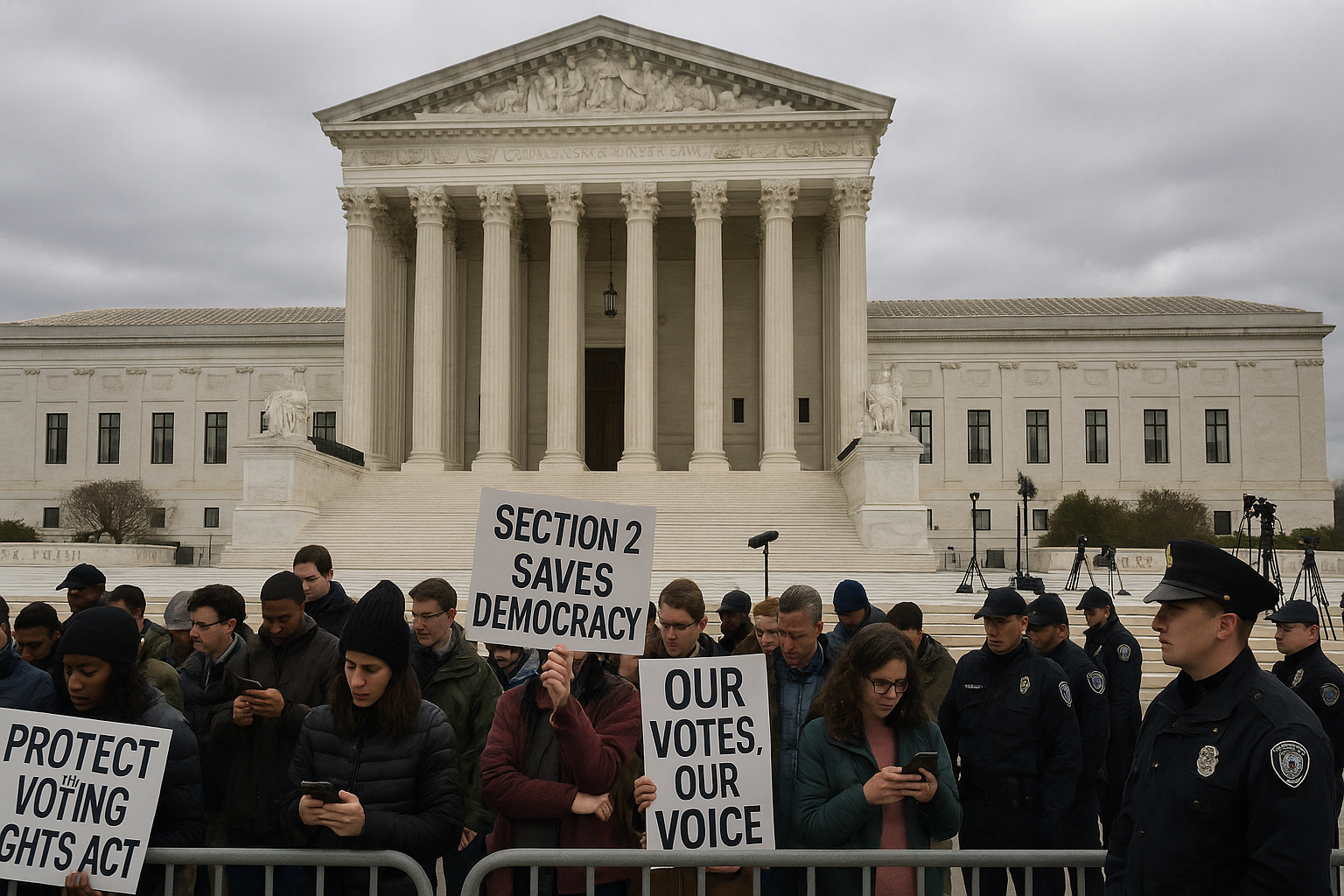
Supreme Court Dismantles Voting Rights Act in 6-3 Ruling, Opening Door to Sweeping Redistricting
The Supreme Court handed down one of the most consequential election-law decisions in a generation on April 29, 2026, gutting the core enforcement mechanism of the Voting Rights Act of 1965 in a 6-3 party-line ruling. The decision in Callais v. Louisiana reverses decades of precedent protecting minority voting power and immediately triggered Republican-led states to begin redrawing congressional maps in ways that could lock in structural advantages for years.
Background
The Voting Rights Act of 1965 stands as one of the most transformative pieces of legislation in American history, dismantling the legal architecture of Jim Crow-era voter suppression across the South. Section 2 of the law prohibited any voting practice that resulted in the denial or abridgment of the right to vote on account of race. For six decades, federal courts used Section 2 to strike down racially gerrymandered maps and compel states to create majority-minority congressional districts that gave Black, Latino, and other minority voters a meaningful chance to elect representatives of their choice.
The court's conservative wing had been chipping away at the VRA since the 2013 Shelby County v. Holder ruling, which gutted the preclearance requirement that forced states with histories of discrimination to obtain federal approval before changing voting laws. Callais v. Louisiana completes that project, with Justice Samuel Alito writing for the majority that compelling states to draw majority-minority districts violates the 14th Amendment's Equal Protection Clause when existing maps are otherwise race-neutral.
Key Developments
The majority opinion, authored by Justice Alito and joined by Chief Justice John Roberts and Justices Clarence Thomas, Neil Gorsuch, Brett Kavanaugh, and Amy Coney Barrett, holds that Section 2 cannot require states to create new majority-minority districts if their current maps do not explicitly discriminate by race. The ruling effectively means that states can draw maps that dilute minority voting power through facially neutral criteria — compactness, contiguity, partisan advantage — without triggering VRA liability.
Justice Elena Kagan wrote a sharp dissent joined by Justices Sonia Sotomayor and Ketanji Brown Jackson, warning that the decision completes a decades-long effort to render the VRA a dead letter. Kagan wrote that the majority had chosen raw political power over legal precedent, stripping Black Americans of the representational gains they fought for across generations.
The political fallout was immediate. Louisiana lawmakers moved within days to postpone their May 16 primaries to facilitate the creation of a 6-0 Republican congressional map, eliminating two districts currently held by Black Democrats. Similar efforts are underway in Florida, Mississippi, Tennessee, and South Carolina. Analysts at the Brookings Institution estimate the ruling could shift up to 19 U.S. House seats from Democratic to Republican control and eliminate nearly 200 state legislative seats currently held by minority-backed candidates.
Why Americans Should Care
The practical consequences of this ruling will be felt most acutely in the Deep South, where majority-minority congressional districts have been the primary vehicle for Black political representation since the 1990s. Georgia's 5th Congressional District — the seat once held by the late John Lewis — and Alabama's 7th District, won by Democrats following a prior VRA lawsuit, face immediate vulnerability under the new legal standard. In Mississippi, where Black residents make up 38 percent of the population, the ruling could eliminate the state's only Black-held congressional seat. Florida's congressional map, already redrawn aggressively by Governor Ron DeSantis in 2022, could face further consolidation of Republican-held districts. Beyond the South, the ruling reshapes the legal landscape for redistricting litigation in states from Texas to North Carolina, where minority communities have relied on Section 2 claims to challenge maps drawn after the 2020 census.
Why It Matters
The Callais ruling represents the culmination of a 40-year conservative legal project to reinterpret the Voting Rights Act as a race-neutral statute — a goal that would have been unthinkable to the legislators who passed it in 1965 and the presidents who signed its reauthorizations in 1970, 1975, 1982, and 2006. The 2006 reauthorization passed the Senate 98-0 and the House 390-33, reflecting a bipartisan consensus that the VRA remained necessary. That consensus has now been overridden by six justices appointed by Republican presidents. Internationally, the decision draws comparisons to democratic backsliding in Hungary and Poland, where ruling parties have used legal mechanisms to entrench electoral advantages. The difference is that the United States Supreme Court — rather than a parliament — has sanctioned the change. Historically, the ruling echoes the post-Reconstruction era, when the Supreme Court's 1876 United States v. Cruikshank decision effectively nullified the 15th Amendment's voting protections for Black Americans for nearly a century. Several states have begun advancing state-level voting rights acts to fill the federal void, but those laws face their own legal challenges and offer uneven protection.
What's Next
Republican-controlled legislatures in at least five states are expected to pass new congressional maps before the 2026 midterm primaries. Democrats and civil rights organizations have signaled they will challenge the new maps under state constitutional provisions and the remaining provisions of federal law, but legal experts say the path to relief has narrowed dramatically. Congress could theoretically pass new voting rights legislation, but the current Republican majority in both chambers makes that prospect remote. The 2026 midterms, scheduled for November 3, will be the first federal election conducted entirely under the post-Callais legal framework.
Sources: NBC News; The Atlantic; Brookings Institution; The Guardian