Solar Eclipse Draws Thousands to Viewing Events Across Ireland as Moon Covers 98% of Sun in Kerry
A deep partial solar eclipse drew thousands of people to viewing events across Ireland on Wednesday evening, with up to 98% of the sun obscured in Kerry and Cork and around 94% in the north and east, as communities from Dingle to Derry gathered to witness a celestial event that scientists say will not be matched from Irish skies until 2090.
Background
Solar eclipses of the magnitude experienced across Ireland on Wednesday evening are extraordinarily rare events in the Irish astronomical calendar. The island's position in the North Atlantic means that total solar eclipses — in which the moon completely blocks the sun — are extremely infrequent, with the last total eclipse visible from Ireland occurring in 1999 and the next not expected until the 22nd century. Partial eclipses of the depth experienced on Wednesday, with coverage exceeding 90% across most of the island, are similarly uncommon, and the astronomical community had been anticipating the event for years.
The eclipse reached its maximum coverage at 7:10pm on Wednesday evening, a timing that allowed many people to observe the event after work or school and that contributed to the large crowds at viewing events across the island. The depth of coverage varied significantly by location — Kerry and Cork, in the southwest, experienced the most dramatic obscuration at up to 98%, while areas in the north and east saw coverage of around 94%. Even at 94%, the reduction in light and temperature during the eclipse was noticeable, with observers reporting a distinctive twilight quality to the evening light and a drop in temperature of several degrees at the moment of maximum coverage.
The event had been anticipated with particular excitement because of its rarity and because of the clear skies that prevailed across much of Ireland on Wednesday evening, following a period of warm and settled weather associated with the ongoing heatwave. While some cloud cover affected parts of Cork and the west, the majority of viewing events were able to observe the eclipse clearly, and the combination of warm temperatures and a spectacular celestial event created an atmosphere of communal celebration that was widely remarked upon.
Key Developments
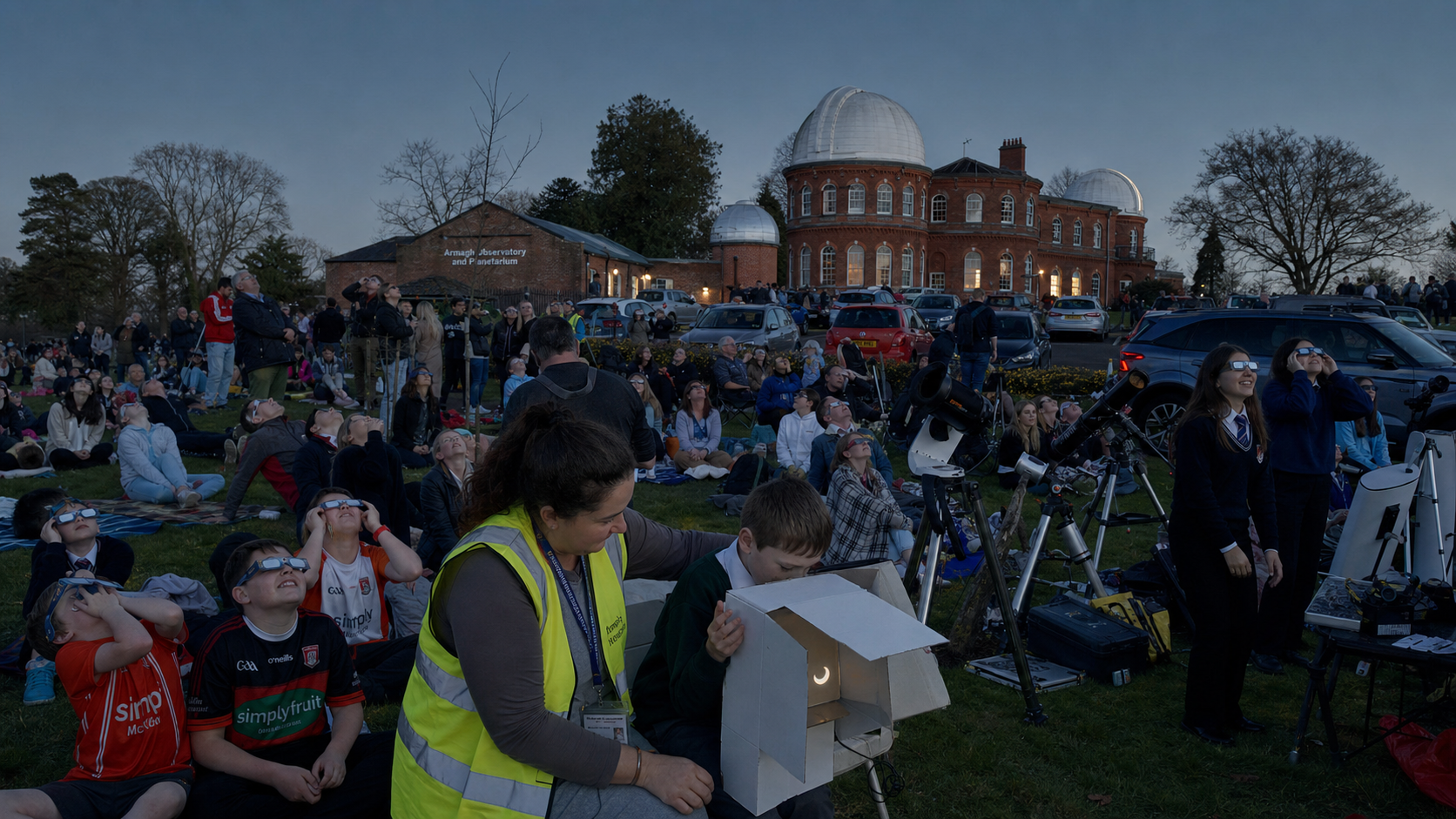
Public viewing events were organised at venues across the island, from the Phoenix Park in Dublin — where thousands gathered on the open grassland with eclipse glasses and telescopes — to the Armagh Observatory and Planetarium in County Armagh, which hosted a dedicated viewing event with expert commentary from the observatory's astronomers. Queen's University Belfast organised a viewing event at its main campus, drawing hundreds of students and members of the public despite some cloud cover that intermittently obscured the view. In Kerry, the Skellig Experience visitor centre on Valentia Island hosted one of the most dramatic viewing events, with the 98% coverage creating conditions that approached totality and left observers genuinely awestruck.
Scientists from Astronomy Ireland, the national astronomical society, were present at events across the country, providing commentary and context for the public. The society's director noted that the eclipse provided a unique opportunity to study the sun's corona — the outer atmosphere that is normally invisible against the brightness of the solar disc — and that the data collected during the event would contribute to ongoing research into solar physics. The event also provided an opportunity to study the behaviour of wildlife during the eclipse, with observers reporting that birds fell silent and that Dublin's seagulls appeared confused by the sudden reduction in light.
The eclipse generated significant social media activity, with images and videos from viewing events across Ireland shared widely online. The combination of the warm evening, the dramatic celestial event, and the communal atmosphere at viewing events created a moment of shared national experience that commentators compared to other rare collective events such as major sporting victories or significant cultural milestones.
Why It Matters
Solar eclipses of this magnitude are significant not just as astronomical events but as cultural moments that bring communities together around a shared experience of wonder. In an era when public discourse is often fragmented and divisive, the eclipse provided a rare opportunity for people across Ireland — north and south, urban and rural, young and old — to share a moment of collective awe at the natural world. The event also served as a powerful reminder of the importance of science education and public engagement with astronomy, with the large crowds at viewing events suggesting that there is a genuine public appetite for accessible scientific experiences. The Armagh Observatory, which has been at the centre of Irish astronomical research for more than two centuries, used the occasion to highlight its work and to make the case for continued investment in public science education.
Local Impact
The eclipse had a tangible impact on communities across Ireland, from the large urban viewing events in Dublin and Belfast to the more intimate gatherings in rural Kerry and Donegal. In Killorglin, where Puck Fair had concluded just the previous day, the eclipse provided an unexpected additional spectacle for visitors who had remained in the area. In Derry, the eclipse coincided with the final days of the Fleadh Cheoil, adding a celestial dimension to what had already been an extraordinary week of cultural celebration. For schools across Ireland, the eclipse provided a real-world context for science education, with teachers reporting that the event had generated genuine enthusiasm for astronomy among pupils who might otherwise have found the subject abstract and remote.
What's Next
Astronomy Ireland has announced that it will publish a report on the eclipse observations collected at events across the country, contributing to the international scientific record of the event. The society is also planning a series of public lectures and school visits in the autumn to build on the interest generated by the eclipse. The next solar eclipse visible from Ireland will be a partial eclipse in 2028, though it will be significantly less dramatic than Wednesday's event. The next eclipse of comparable magnitude to Wednesday's will not be visible from Ireland until 2090, making Wednesday's event a genuinely once-in-a-lifetime experience for the vast majority of those who witnessed it.