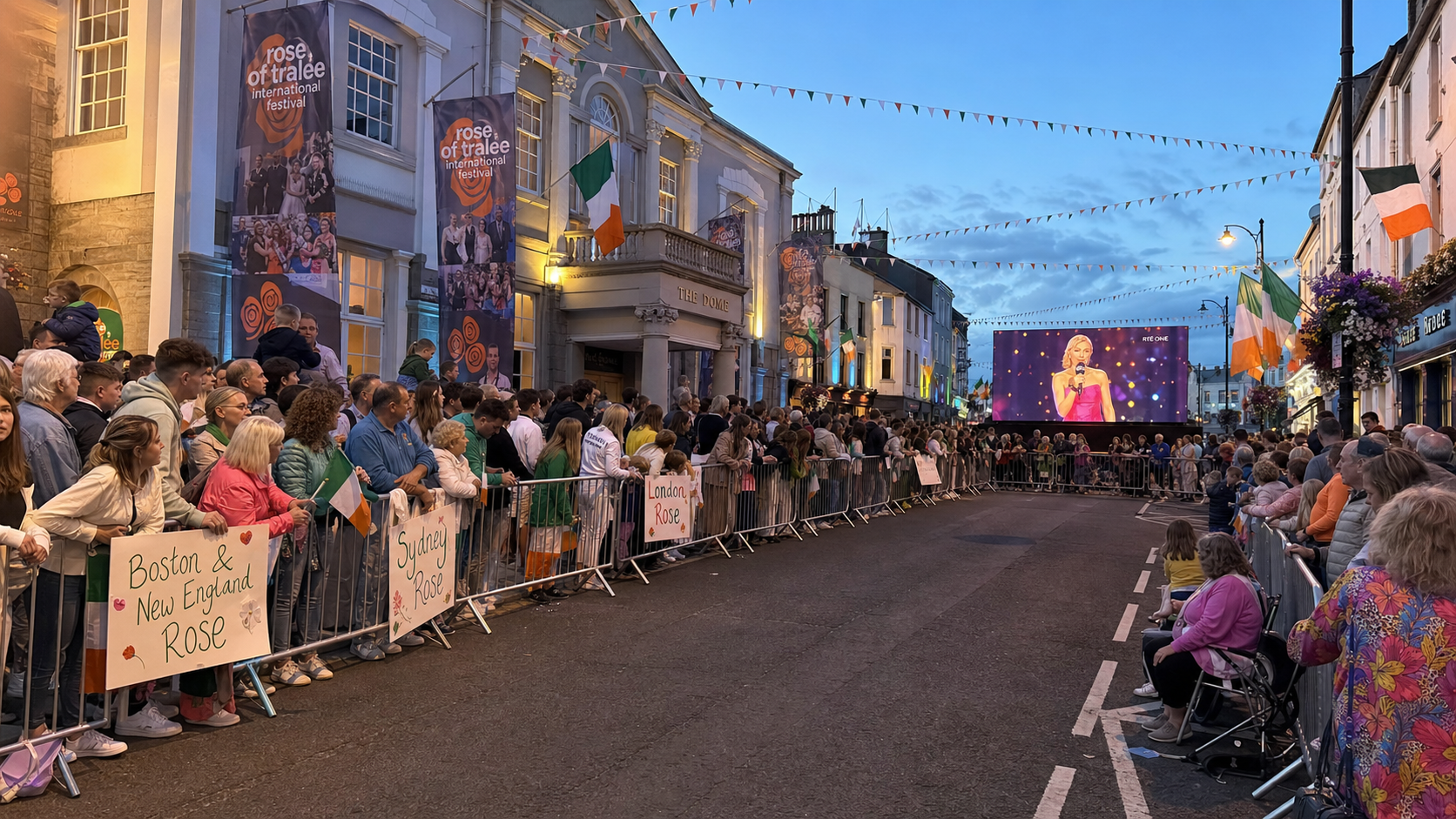
Rose of Tralee 2026: All Roads Lead to Tralee as TV Finale Airs Tonight on RTÉ One
The 66th Rose of Tralee International Festival reaches its televised climax tonight as RTÉ One broadcasts the Rose Selection from the Dome in Tralee, with 32 contestants representing Irish communities from around the world competing for the title in a festival that its co-host Kathryn Thomas has robustly defended against critics who dismiss it as a relic of a less enlightened era.
Background
The Rose of Tralee has been a fixture of the Irish cultural calendar since 1959, when the festival was established to celebrate the song of the same name and to honour the Irish diaspora. Over the intervening 67 years, it has evolved from a relatively modest local event into one of the most watched programmes on Irish television, attracting audiences of hundreds of thousands for its televised selection nights and drawing contestants from Irish communities across five continents.
The festival has always attracted a degree of controversy. Critics have argued that it perpetuates outdated notions of Irish femininity, that its emphasis on personality and presentation is at odds with contemporary values of gender equality, and that its association with a particular vision of Irish womanhood is exclusionary. Supporters counter that the festival has evolved significantly over the decades, that it provides a genuine platform for young Irish women to celebrate their heritage and their communities, and that the criticism often says more about the critics than about the festival itself.
The 2026 edition has been notable for the diversity of its contestants, with Roses representing Irish communities in Australia, the United States, Canada, the United Kingdom, and across Europe. The festival has also attracted attention for the quality of the contestants' achievements — this year's field includes doctors, engineers, teachers, athletes, and community activists, reflecting the breadth of what Irish women are doing in the world.
Key Developments
Co-host Kathryn Thomas has been characteristically direct in her response to critics of the festival. Asked about those who dismiss the Rose of Tralee as outdated, Thomas described such comments as "boring" and "lazy," arguing that the festival has consistently evolved to reflect the changing reality of Irish life and that the criticism often fails to engage with what the festival actually is. "Come and see it before you judge it," she said, a challenge that reflects the confidence of a festival that has survived and thrived through decades of cultural change.
Dáithí Ó Sé, the festival's other co-host and a Kerry man who has become synonymous with the event, has emphasised that the judges are looking for personality, authenticity, and a genuine connection to Irish heritage rather than physical perfection or performance polish. "We're not looking for faults," he said. "We're looking for the person who best represents what it means to be Irish in the world today."
The 32 contestants have spent the week in Tralee participating in a programme of events that includes a grand parade through the town, visits to local attractions, and the informal interactions with the public that have always been one of the festival's most distinctive features. The televised selection nights, which air on 17 and 18 August, will see each Rose interviewed by the hosts before the judges make their decision.
Why It Matters
The Rose of Tralee matters because it is one of the few remaining events in the Irish cultural calendar that explicitly celebrates the Irish diaspora and the connections between Irish communities around the world. In an era when emigration remains a significant feature of Irish life — with tens of thousands of young Irish people leaving the country each year to work and live abroad — the festival provides a moment of connection between those who have left and those who have stayed, and a reminder that Irish identity is not confined to the island of Ireland.
The festival also matters as a piece of living cultural heritage. It has survived for 67 years not because it has remained unchanged but because it has been willing to evolve while retaining its essential character. The 2026 edition, with its diverse and accomplished field of contestants, is evidence that the festival continues to find ways to be relevant to contemporary Irish life while honouring the traditions that have sustained it.
Local Impact
In Tralee, the festival is the most significant event of the year. The town's economy benefits enormously from the influx of visitors — contestants, their families, and supporters from across the Irish diaspora — and the festival's profile on RTÉ provides a level of national and international exposure that no other event could match. Local businesses, hotels, and restaurants have been operating at full capacity throughout the festival week, and the economic impact is estimated to run into millions of euros. The festival also provides a significant boost to Kerry's tourism profile, with many visitors using the Rose of Tralee as an opportunity to explore the county's wider attractions.
What's Next
The Rose of Tralee 2026 will be selected tonight, with the announcement expected in the final segment of the RTÉ One broadcast. The new Rose will take on a year of engagements representing the festival and the Irish diaspora, including visits to Irish communities around the world and appearances at major Irish cultural events. The 2027 festival is already in planning, with the festival committee expected to announce the dates and the host venue in the coming months. The Rose of Tralee's continued ability to attract high-quality contestants and large television audiences suggests that reports of its demise have been greatly exaggerated.