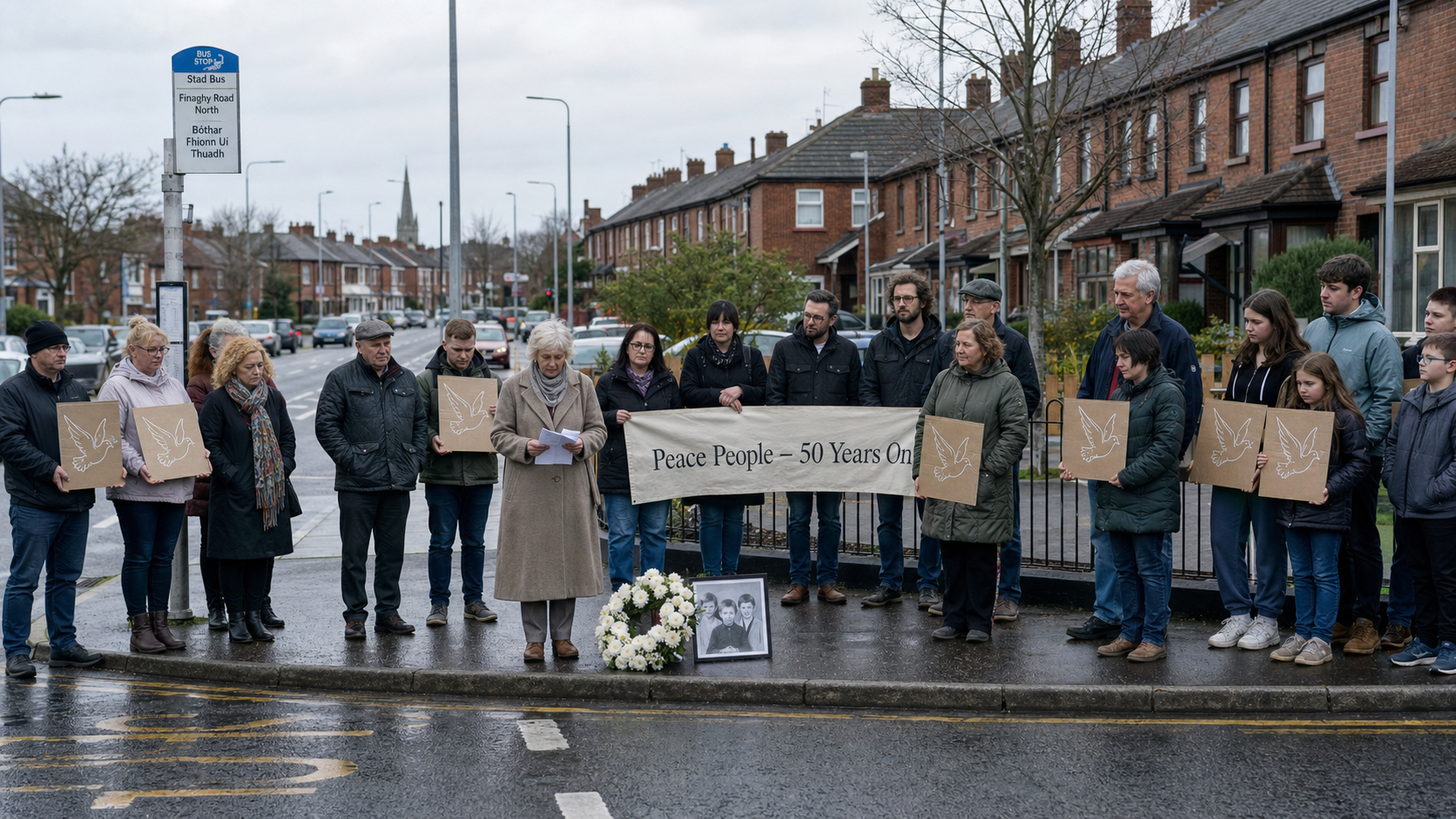
Peace People Mark 50 Years Since West Belfast Tragedy That Sparked Global Movement
The Peace People movement has marked the 50th anniversary of its founding with commemorative events across Belfast, honouring the memory of the three Maguire children whose deaths on Finaghy Road North on 10 August 1976 sparked a mass movement for peace that drew hundreds of thousands of people onto the streets of Northern Ireland and earned co-founders Mairead Corrigan-Maguire and Betty Williams the Nobel Peace Prize — a moment of extraordinary moral courage that continues to resonate half a century later.
Background
The events of 10 August 1976 unfolded with the terrible swiftness that characterised so much of the violence of the Troubles. Danny Lennon, a member of the Provisional IRA, was shot by British soldiers while driving a car in the Andersonstown area of west Belfast. Mortally wounded, Lennon lost control of the vehicle, which mounted the pavement on Finaghy Road North and struck Anne Maguire and her four children. Eight-year-old Joanne and six-week-old Andrew died at the scene; two-year-old John died from his injuries the following day. Anne Maguire survived, though she suffered severe physical and psychological trauma. She took her own life four years later.
The deaths of the three children provoked an outpouring of grief and anger that transcended the sectarian divisions of Northern Ireland. Mairead Corrigan, the children's aunt, appeared on television in a state of raw anguish and called for an end to the violence. Betty Williams, a Protestant woman who had witnessed the accident, began collecting signatures for a peace petition. Together, they founded the Peace People, a cross-community movement that organised a series of mass rallies — in Andersonstown, in Ormeau Park, and across Northern Ireland — that drew tens of thousands of participants from both communities.
The movement attracted international attention and support, and in 1977, Corrigan-Maguire and Williams were jointly awarded the Nobel Peace Prize — one of the most significant international recognitions ever accorded to individuals from Northern Ireland.
Key Developments
The 50th anniversary was marked on 10 August 2026 with a series of events organised by the Peace People and supported by community organisations, churches, and political representatives from across the spectrum. SDLP leader Claire Hanna and Kenny Donaldson of the South East Fermanagh Foundation were among those who paid tribute to the "immense courage" of the founders and reflected on the progress made in Northern Ireland since 1976.
A cultural event titled Celebrating Pop For Peace at 50 was held at Minnowburn, the National Trust property on the banks of the River Lagan on the outskirts of Belfast, bringing together musicians, artists, and community representatives to celebrate the legacy of the movement. The event drew a large and diverse crowd, reflecting the enduring resonance of the Peace People's message across generations and communities.
Mairead Corrigan-Maguire, now in her eighties, participated in the commemorations and spoke of her continued commitment to non-violence and to the work of reconciliation. "The Peace People was never just about ending the Troubles," she said. "It was about building a different kind of society — one based on respect, dialogue, and the recognition of our common humanity."
Why It Matters
The 50th anniversary of the Peace People is an opportunity to reflect on both the achievements and the limitations of the movement. At its peak, the Peace People mobilised hundreds of thousands of people in a society that was deeply divided and traumatised by violence, demonstrating that the desire for peace was not confined to any one community or political tradition. The Nobel Peace Prize was a recognition of that achievement and of the personal courage of Corrigan-Maguire and Williams in speaking out at a time when doing so carried real risks.
The movement's legacy is complex. It did not end the Troubles — that would take another two decades and the Good Friday Agreement of 1998. But it demonstrated that civil society could play a role in challenging violence and in articulating an alternative vision for Northern Ireland, and it inspired subsequent generations of peace activists and community leaders. The work of reconciliation that the Peace People began continues today, in the community relations programmes, cross-community initiatives, and dialogue processes that are part of the fabric of post-conflict Northern Ireland.
Local Impact
In west Belfast, where the tragedy that sparked the movement occurred, the anniversary was marked with particular solemnity. The Finaghy Road North, where the Maguire children died, has changed enormously in the fifty years since 1976, but the memory of what happened there remains vivid for those who lived through it. Community organisations in the area organised a series of events to mark the anniversary, including a memorial service at the site of the accident and a community gathering that brought together people from across the religious and political divide. The Peace People's office in Belfast confirmed that it would continue its work of promoting non-violence and reconciliation in the year ahead.
What's Next
The Peace People will continue their programme of community events and educational work throughout the remainder of 2026, with a particular focus on engaging young people who have grown up in a post-conflict Northern Ireland and who may not be fully aware of the history of the movement and the Troubles from which it emerged. A documentary about the 50th anniversary, produced with the support of the Arts Council of Northern Ireland, is expected to be broadcast on BBC Northern Ireland in the autumn. The organisation has also announced plans for a major conference on non-violence and conflict resolution, to be held in Belfast in November 2026.