Northern Ireland Economy Hits New Series High with 1% Growth in Q2 2026 as Dual Market Access Cited as Key Advantage
Northern Ireland's economy has reached a new series high after growing by 1.0 per cent in real terms in the second quarter of 2026, placing the region's output 12.7 per cent above its pre-pandemic level and outpacing both the UK's 0.4 per cent quarterly growth and the Republic of Ireland's growth rate for the same period, with Economy Minister Caoimhe Archibald citing the region's unique dual market access arrangement as a key competitive advantage while simultaneously calling for fuel duty and VAT cuts to ease pressure on families and businesses.
Background
The Northern Ireland Composite Economic Index, published by the Northern Ireland Statistics and Research Agency, is the primary measure of economic output in the region. The index tracks activity across the production, services, and construction sectors, providing a quarterly snapshot of the health of the Northern Ireland economy. The index has shown consistent growth since the post-pandemic recovery began in 2021, with the region's economy demonstrating a resilience that has surprised some economists given the political uncertainty associated with the Brexit negotiations and the subsequent Windsor Framework.
The dual market access arrangement — which allows Northern Ireland to trade freely with both the UK internal market and the European Union single market — has emerged as a significant competitive advantage for the region in the post-Brexit environment. Businesses in Northern Ireland can access both markets without the tariffs and regulatory barriers that apply to goods moving between Great Britain and the EU, a position that has attracted investment from companies seeking a base that offers access to both trading blocs. The arrangement has been particularly beneficial for the agri-food sector, which exports significant volumes of product to both the UK and EU markets.
The second quarter of 2026 figures, published by NISRA in September, show that the Northern Ireland economy grew by 1.0 per cent over the quarter and by 2.3 per cent compared to the same period in 2025. Both the production and services sectors contributed to the growth, with the production sector showing particularly strong performance driven by manufacturing, electricity and gas supply, and water and waste management.
Key Developments
Economy Minister Caoimhe Archibald welcomed the figures as evidence of the Northern Ireland economy's strength and resilience. "These figures demonstrate that our economy is performing well, and that our unique dual market access position is delivering real benefits for businesses and workers," she said. "We are outperforming both the UK and the Republic of Ireland in terms of quarterly growth, and our output is now 12.7 per cent above its pre-pandemic level — a remarkable achievement given the challenges of the past few years."
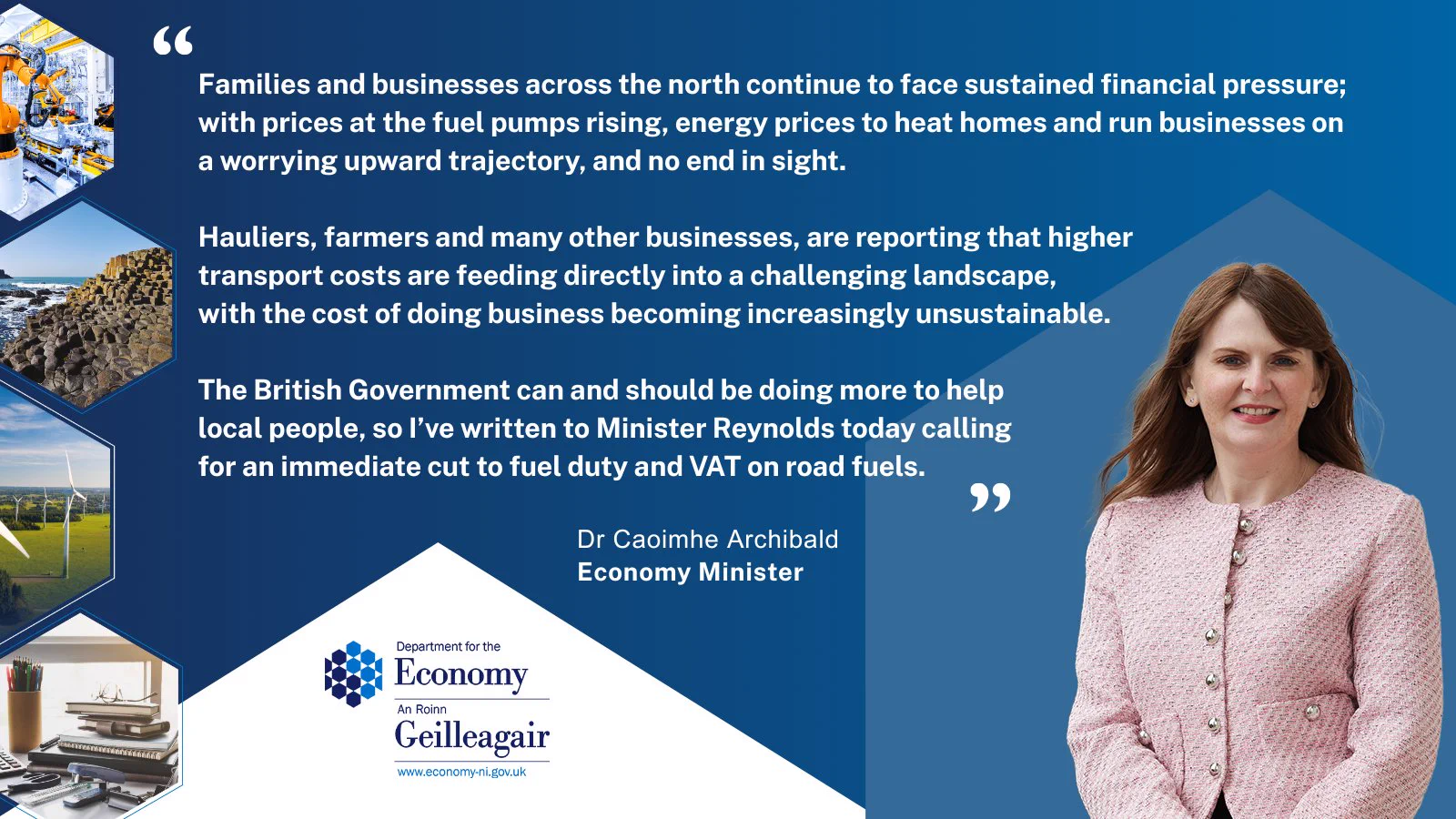
The minister also highlighted the growth in payrolled employee numbers, which rose to 819,200 in August 2026, with median monthly pay reaching £2,509. Total Northern Ireland goods exports grew by 3.6 per cent in the year ending Q2 2026, according to HMRC Regional Trade Statistics, reflecting the benefits of the dual market access arrangement for exporters. However, the minister also expressed concern about the growing pressure on families and businesses from energy costs, calling for fuel duty and VAT cuts in the UK Autumn Budget to provide relief.
Why It Matters
The Northern Ireland economic figures are significant for several reasons. First, they demonstrate that the region's economy is performing well in absolute terms, with output at a record high and employment at historically elevated levels. Second, the outperformance relative to the UK as a whole suggests that the dual market access arrangement is delivering tangible economic benefits — a finding that has implications for the ongoing political debate about Northern Ireland's constitutional position and its relationship with both the UK and the EU. Third, the figures provide a positive backdrop for the Stormont Executive's budget negotiations with the UK government, which are ongoing following the tabling of a £1.5 billion offer earlier this week. A strong economic performance strengthens the Executive's hand in arguing for additional investment in public services and infrastructure.
Local Impact
The economic growth is felt across Northern Ireland's diverse regional economy. In Belfast, the services sector — which includes financial services, professional services, and the growing technology sector — has been a significant driver of growth, with companies such as Allstate, Citi, and a range of fintech startups continuing to expand their operations in the city. In the rural areas of Antrim, Down, and Armagh, the agri-food sector has benefited from the dual market access arrangement, with food processors and exporters able to access both UK and EU markets without the friction that applies to their counterparts in Great Britain. In Derry/Londonderry, the manufacturing and logistics sectors have shown strong performance, reflecting the city's strategic position on the cross-border corridor between Belfast and Dublin.
What's Next
The next NICEI figures, covering the third quarter of 2026, are expected to be published in December. The Stormont Executive is expected to use the positive economic data to support its case for additional funding from the UK government in the ongoing budget negotiations. Economy Minister Archibald is also expected to publish a new economic strategy for Northern Ireland in early 2027, building on the dual market access advantage and setting out a vision for the region's economic development over the next decade. The strategy is expected to focus on attracting investment in the technology, life sciences, and green energy sectors, as well as on developing the skills pipeline required to support the growth of these industries.