NIFL Clubs Face 'Biggest Decision in Recent History' as Irish League Considers Radical Calendar Shift to May-February Season
The Northern Ireland Football League is evaluating a transformative proposal to shift its season from the traditional August-to-May calendar to a May-to-February format, a move that NIFL chair Chris Brindley has described as "probably the biggest decision in recent history" for Irish League clubs. The proposed change would align Northern Ireland football more closely with European competition cycles, allow clubs to play in better weather conditions during the summer months, and potentially improve the quality of pitches and the experience for supporters. But it would also require a fundamental restructuring of how clubs operate, plan, and recruit.
Background
The Northern Ireland Football League — the Irish Premiership and its associated divisions — has operated on a traditional autumn-to-spring calendar for most of its history, broadly aligned with the football seasons in England, Scotland, and the Republic of Ireland. The season typically begins in August and concludes in May, with a winter break of varying length depending on weather conditions. This calendar has served the league well in many respects, but it has also created challenges — particularly in relation to European competition, where NI clubs must qualify in July and August, before their domestic season has begun, meaning they are often at a significant disadvantage in terms of match fitness and preparation.
The proposal to shift to a May-to-February calendar is not new — it has been discussed in various forms for several years — but it has gained renewed momentum in 2026 as the NIFL's leadership has engaged more seriously with the question of how to improve the league's competitiveness and its attractiveness to players, supporters, and broadcasters. The May-to-February model would see the season begin in late spring, when weather conditions are generally better, and conclude in mid-winter, avoiding the worst of the January and February weather that can cause significant fixture disruption under the current calendar.
The model has been adopted by several other European leagues, most notably in Scotland, where the Premiership operates on a broadly similar calendar. Proponents argue that it improves the quality of football by allowing clubs to play in better conditions, reduces fixture congestion caused by weather postponements, and aligns the league's European qualification rounds with the start of the domestic season rather than the pre-season period.
Key Developments
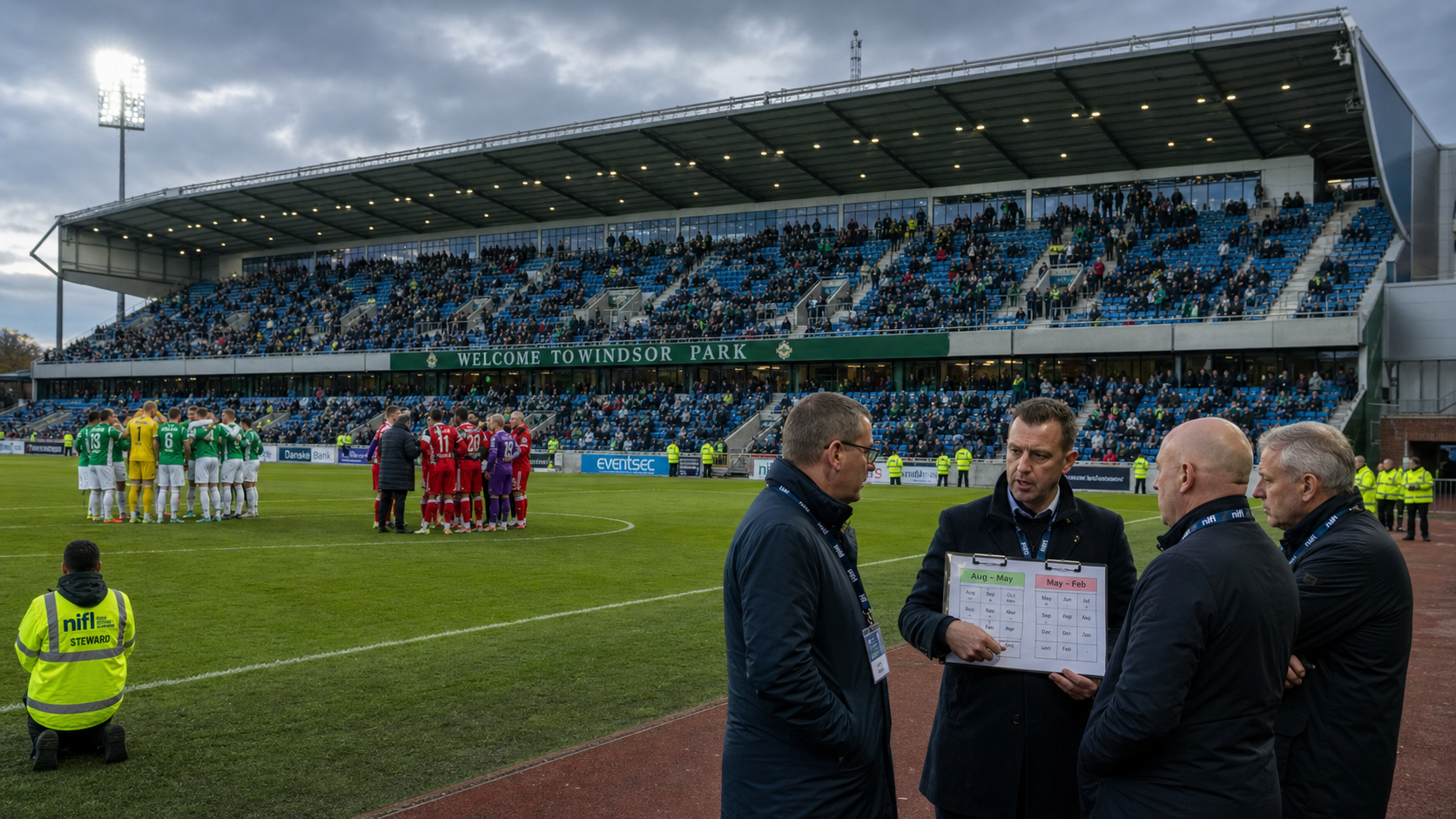
NIFL chair Chris Brindley has confirmed that the proposal is being formally evaluated by the league's board and that clubs will be consulted before any decision is made. Speaking to the Belfast News Letter, Brindley described the potential calendar change as "probably the biggest decision in recent history that our clubs will have to consider," acknowledging both the potential benefits and the significant operational challenges that a shift would entail.
The consultation process is expected to involve all clubs in the Irish Premiership and the Championship, as well as the Irish Football Association, which governs the game in Northern Ireland and has a significant interest in how any calendar change would affect the international programme and the cup competitions. The NIFL has indicated that it will publish a detailed analysis of the proposal — including the financial, operational, and competitive implications — before asking clubs to vote on whether to proceed.
The reaction from clubs has been mixed. Some of the larger clubs, particularly those with European ambitions, have expressed enthusiasm for a calendar that would allow them to begin their domestic season in better shape for European qualifying rounds. Smaller clubs, for whom the operational and financial implications of a calendar change are more significant, have been more cautious, raising concerns about the impact on supporter attendance, sponsorship arrangements, and the availability of players who may have other commitments during the summer months.
Why It Matters
The calendar question is, at its heart, a question about what kind of league the Irish Premiership wants to be. If the ambition is to compete more effectively in European competition — to progress beyond the first qualifying round, to generate the prize money and profile that comes with European group stage football — then a calendar that aligns the domestic season with the European qualifying rounds makes strategic sense. If the priority is to maintain the traditional rhythms of the game in Northern Ireland, with all the community and cultural associations that come with them, then the case for change is less compelling.
The decision will also have implications for the relationship between the Irish Premiership and the League of Ireland in the Republic, which operates on a broadly similar calendar to the current NI model. A shift to a May-to-February season in the north would create a significant divergence between the two leagues, potentially complicating cross-border competitions and the movement of players between the two jurisdictions.
Local Impact
The potential calendar change is being discussed in clubs and supporters' groups across Northern Ireland. For supporters of clubs like Linfield, Glentoran, Cliftonville, and Crusaders, the prospect of summer football — played in better weather, on better pitches, with longer evenings — is an attractive one. For clubs in smaller towns and cities, the implications are more complex, with concerns about the impact on supporter numbers during the summer holiday period and on the availability of volunteer staff and committee members who may have other commitments. The NIFL has committed to a thorough consultation process before any decision is made, and clubs have been encouraged to engage their supporters in the discussion.
What's Next
The NIFL board is expected to publish its formal analysis of the calendar change proposal within the next month, with a consultation period for clubs to follow. A vote on whether to proceed with the change is expected before the end of the 2026 calendar year, with any new calendar taking effect from the 2027-28 season at the earliest. The Irish Football Association has indicated that it will engage constructively with the consultation process and will provide its assessment of the implications for the international programme and cup competitions. Clubs have been encouraged to hold their own internal discussions and to submit their views to the NIFL before the consultation period closes.